#InterSystems API Manager (IAM)

1 Follower · 68 Posts

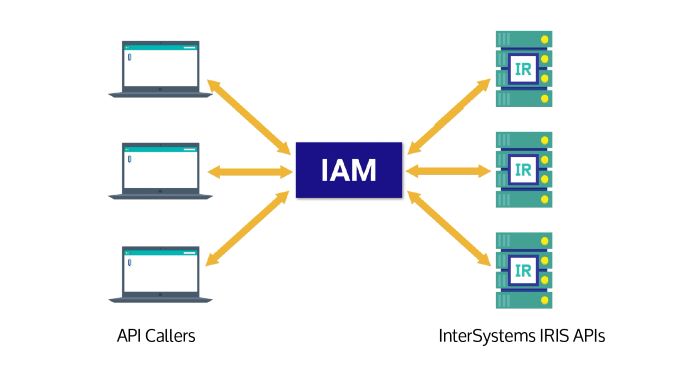
The InterSystems API Manager (IAM) enables you to monitor and control traffic to and from your web-based APIs. If you are building service-oriented application layers, you are very likely to find the number of APIs you are using quickly rise. The more distributed your environment the more critical it becomes to properly govern and monitor your API traffic. The API Manager enables you easily route all your traffic through a centralized gateway and forward API request to appropriate target nodes.

Additional Resources: 
Documentation
Introducing InterSystems API Manager [Article] 
What is InterSystems API Manager [Video] 
InterSystems API Manager Introduction [Video] 
InterSystems API Manager: Gummy Bear Factories Demo [Video] 

InterSystems staff + admins Hide everywhere
Hidden post for admin
InterSystems Official Bob Kuszewski · Apr 3, 2023

IAM 3.2 Release

InterSystems API Manager (IAM) version 3.2.1 is now Generally Available.  In additional to bug fixes and minor improvements IAM 3.2 adds new plug-ins that might be of interest to IRIS customers.

  • OAS Validation (oas-validation)
    • Validate HTTP requests and responses based on an OpenAPI 3.0 or Swagger API Specification.
  • SAML (saml)
    • Provides SAML v2.0 authentication and authorization between a service provider (Kong Gateway) and an identity provider (IdP).
  • XML Threat Protection (xml-threat-protection)
    • This new plugin allows you to reduce the risk of XML attacks by checking the structure of XML payloads. This validates maximum complexity (depth of the tree), maximum size of elements and attributes.
  • AppDynamics (app-dynamics)
    • Integrate Kong Gateway with the AppDynamics APM Platform.
  • JWE Decrypt (jwe-decrypt)
    • Allows you to decrypt an inbound token (JWE) in a request.
0
0 386
Article Kate Lau · Mar 15, 2023 2m read

In this article, I am trying to walk through my deploying step of IAM on my EC2(ubuntu).

What is IAM?

IAM is InterSystems API Manager
you may reference to the link below to get more idea about IAM

https://docs.intersystems.com/components/csp/docbook/Doc.View.cls?KEY=PAGE_apimgr

Before deploying IAM

Check the license of your API host


Enable the User IAM

Deploy IAM

Reference 

https://community.intersystems.com/post/introducing-intersystems-api-manager

Download the image from the following link

https://wrc.intersystems.com/wrc/coDistGen.csp

I downloaded the following version to my pc

2
0 519
Question Joel Espinoza · Oct 3, 2022

Hello!

Greetings from Chile, I have a question about IAM, I have a client who implements IAM in a QA environment, I configure a workspace and a series of routes (quite a few) and now he wants to export what has been created and take it to production (another server), which is the procedure to do it? Is it possible to export the workspace, routes, plugins, etc.?

Thank you!!

2
0 310
Job Spencer Frey · Aug 31, 2022

Hi everyone!

I am recruiting on a fully remote Intersystems Developer.  This role will be a long term contract to begin with high likelihood of extensions or conversion permanent.  Please check out the job description down below and feel free to send me an email with your resume: Spencer.Frey@insightglobal.com 

1
0 425
Article Eduard Lebedyuk · Nov 20, 2019 9m read

In this article, I would like to talk about the spec-first approach to REST API development.

While traditional code-first REST API development goes like this:

  • Writing code
  • REST-enabling it
  • Documenting it (as a REST API)

Spec-first follows the same steps but reverse. We start with a spec, also doubling as documentation, generate a boilerplate REST app from that and finally write some business logic.

This is advantageous because:

  • You always have relevant and useful documentation for external or frontend developers who want to use your REST API
  • Specification created in OAS (Swagger) can be imported into a variety of tools allowing editing, client generation, API Management, Unit Testing and automation or simplification of many other tasks
  • Improved API architecture.  In code-first approach, API is developed method by method so a developer can easily lose track of the overall API  architecture, however with the spec-first developer is forced to interact with an API from the position if API consumer which usually helps with designing cleaner API architecture
  • Faster development - as all boilerplate code is automatically generated you won't have to write it, all that's left is developing business logic.
  • Faster feedback loops - consumers can get a view of the API immediately and they can easier offer suggestions simply by modifying the spec

Let's develop our API in a spec-first approach!

6
10 3520
Article Sylvain Guilbaud · Apr 19, 2022 2m read

Kong provides an open source configuration management tool (written in Go), called decK (which stands for declarative Kong)

  • Check that decK recognizes your Kong Gateway installation via deck ping
deck ping   
Successfully connected to Kong!
Kong version:  2.3.3.2-enterprise-edition
  • Export Kong Gateway configuration to a file named "kong.yaml" via deck dump
deck dump
  • After modifying the kong.yaml, show the differences via deck diff
0
0 815
InterSystems Official Stefan Wittmann · Feb 16, 2021

The GA release is now published for the 1.5 version of the InterSystems API Manager (IAM).


The container for IAM, including all relevant artifacts to upgrade from earlier versions of IAM can be downloaded from the WRC Software Distribution site in the Components area.


The build number for this release is IAM 1.5.0.9-4.


InterSystems API Manager 1.5 makes it easier to manage your API traffic, integrate with your environment and onboard users of your APIs. It has many new capabilities, including:


  • Improved User Experience
  • Introducing new Developer Portal tools
  • Support for Kafka connectivity
6
0 702
Announcement Anastasia Dyubaylo · Jan 19, 2022

Hey Developers,

Watch as the presenter uses IKO to deploy the WebGateway, SAM, and InterSystems API Manager with the latest version of the InterSystems Kubernetes Operator: 

⏯ IKO: The InterSystems Kubernetes Operator (Version 3.0)

0
0 472
Question Cindy Fawcett · Jun 28, 2021

Has anyone else seen this error?  From the API Manager Catalog, I can select an API and use the "Try it Out" feature.  An error is returned - TypeError: Failed to fetch.

The same Curl can be imported into Postman and executed successfully.  For us, API Manager is in a container and the container can ping the server. Also, this error is in the Developer Tools/Console -

1
0 274
InterSystems Official Stefan Wittmann · May 21, 2021

The GA release is now published for the 2.3 version of the InterSystems API Manager (IAM).

The container for IAM, including all relevant artifacts to upgrade from earlier versions of IAM can be downloaded from the WRC Software Distribution site in the Components area.

The build number for this release is IAM 2.3.3.2-1. 

This release is based on Kong Enterprise version 2.3.3.2.

InterSystems API Manager 2.3 makes it easier to deploy in a secure manner and for high-availability scenarios  It has many new capabilities including:

  • Introduction of hybrid mode
  • Broader support for Docker Secrets
0
0 371
Question Cindy Fawcett · Apr 12, 2021

I am working with InterSystems API Manager product and I'm trying to solve an authentication problem.  In our implementation, API Manager accepts basic authentication.  One of the endpoints accepts OAuth2.  The request coming into API Manager is FHIR and needs to have basic auth in the header.  The OAuth token is passed to API Manager as a parameter.  I want to send FHIR to the endpoint with a Bearer Token in the header instead of the basic auth that came into API Manager.  Has anyone used a transformation plug-in to solve a similar issue?  I'm trying to solve this problem in API Manager

4
0 1509
Article Eduard Lebedyuk · Oct 21, 2019 4m read

InterSystems API Management (IAM) - a new feature of the InterSystems IRIS Data Platform, enables you to monitor, control and govern traffic to and from web-based APIs within your IT infrastructure. In case you missed it, here is the link to the announcement. And here's an article explaining how to start working with IAM.

In this article, we would use InterSystems API Management to Load Balance an API.

In our case, we have 2 InterSystems IRIS instances with /api/atelier REST API that we want to publish for our clients.

There are many different reasons why we might want to do that, such as:

  • Load balancing to spread the workload across servers
  • Blue-green deployment: we have two servers, one "prod", other "dev" and we might want to switch between them
  • Canary deployment: we might publish the new version only on one server and move 1% of clients there
  • High availability configuration
  • etc.
3
4 1006
Article Alberto Fuentes · Feb 24, 2021 1m read

Hi Community!  Today I'd like to share with you a link to some exercises from a workshop about developing REST APIs and how to manage them using InterSystems API Manager.

It includes step by step exercises to:

  • Developing REST APIs from OpenAPI specifications.
  • Adding the created API in an interoperability production (optional).
  • Basic API management in InterSystems API Manager (service, route, auth, consumers, rate limiting, etc.).
  • Some other more complex scenarios in InterSystems API Manager like load balancing, or routing by header.
0
0 350
Article Yuri Marx · Jun 27, 2020 1m read

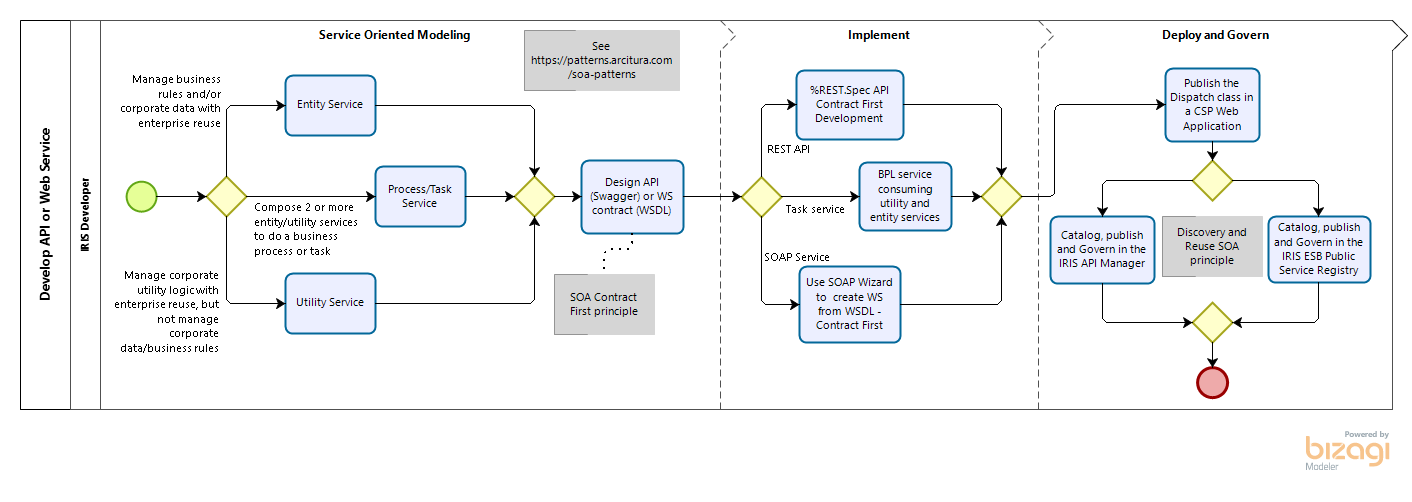
Using SOAP Web Services or REST API Resources, if you want to deliver strategic digital assets for your organization, SOA aproach is an excellent option. The InterSystems IRIS supports like a charm the SOA principles with Contract First technique to model services aligned with the business, and create the services from the service contracts (Open API or WSDL).

0
2 678
Article Yuri Marx · Jun 17, 2020 1m read

In 2017, Forbes published an article talking about API Economy (see: https://www.forbes.com/sites/louiscolumbus/2017/01/29/2017-is-quickly-b…). This article was the trigger to popularize the use of API and API Management by large companies. The article published a maturity model. My understanding is that Intersystems IRIS allows you to reach the top of the pyramid with your current technologies. See the figure above.For this it is important to combine % CSP.REST package, IRIS API Manager (IAM), ML Pack and IntegratedML, Native API for Python, BPL and

0
2 589