- Log in to post comments
All
Accepted answers
I can recommend also this very simple but robust source control tool.
It simply exports class to the certain directory after every compilation in Studio and loads it to Studio if there is updated version on disk.
It imports/exports all the classes, routines and dfi's in namespace and can do it even in UDL form.
- Log in to post comments
Alex, thanks for the bright article!
Does it mean that we should substitute all $I() for $S() immediately and get the performance boost?
Are there any cases, where we should keep $Increment instead of $Sequence?
- Log in to post comments
Lexi, you are right. I thought about Year->Month->Day hierarchy with Year->MonthYear-> DayMonthYear time functions for the levels of course.
And the "wrong" hierarchy, in this case, would be Year->MonthNumber-DayNumber because if you have more than one year in the facts you'll get several years for one January.
- Log in to post comments
Hi, Scott.
There was a bug in subscriptions.
In your subscriptions overview you should see 0 for Content type subscriptions.
I just cleared that for you, hope you will not get any silly notifications.
Colleagues!
If you get annoying email notifications and cannot turn them off, please contact me, or comment in this post.
- Log in to post comments
Hi, Laura!
Not sure if it is an answer, but have you seen Class Explorer app?
It can show all the classes in namespace or package.
- Log in to post comments
Hi, Greg!
It is filed.
But, for the compact view mode there is a button on the home page which solves this:
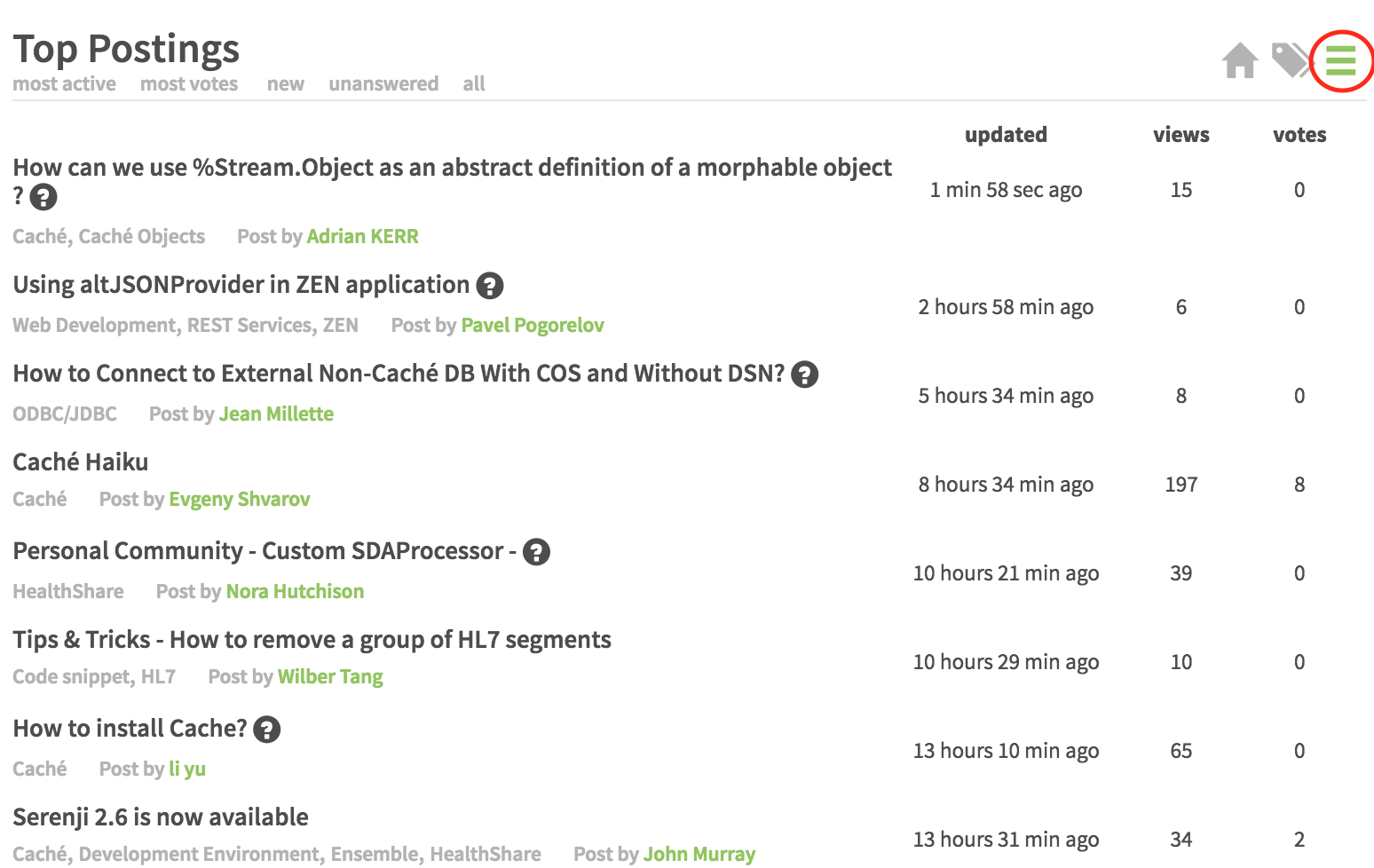
- Log in to post comments
Yes, it's a pain, but search within tag maybe worth it?
BTW you shouldn't scroll through the list - just start typing in tag field, it will find the valid tag for you.
- Log in to post comments
Hi, Greg!
You can search within not Community but within a Tag.
For example let's search your post with the word "way".
There are a lot of results and it's a trick to find your post.
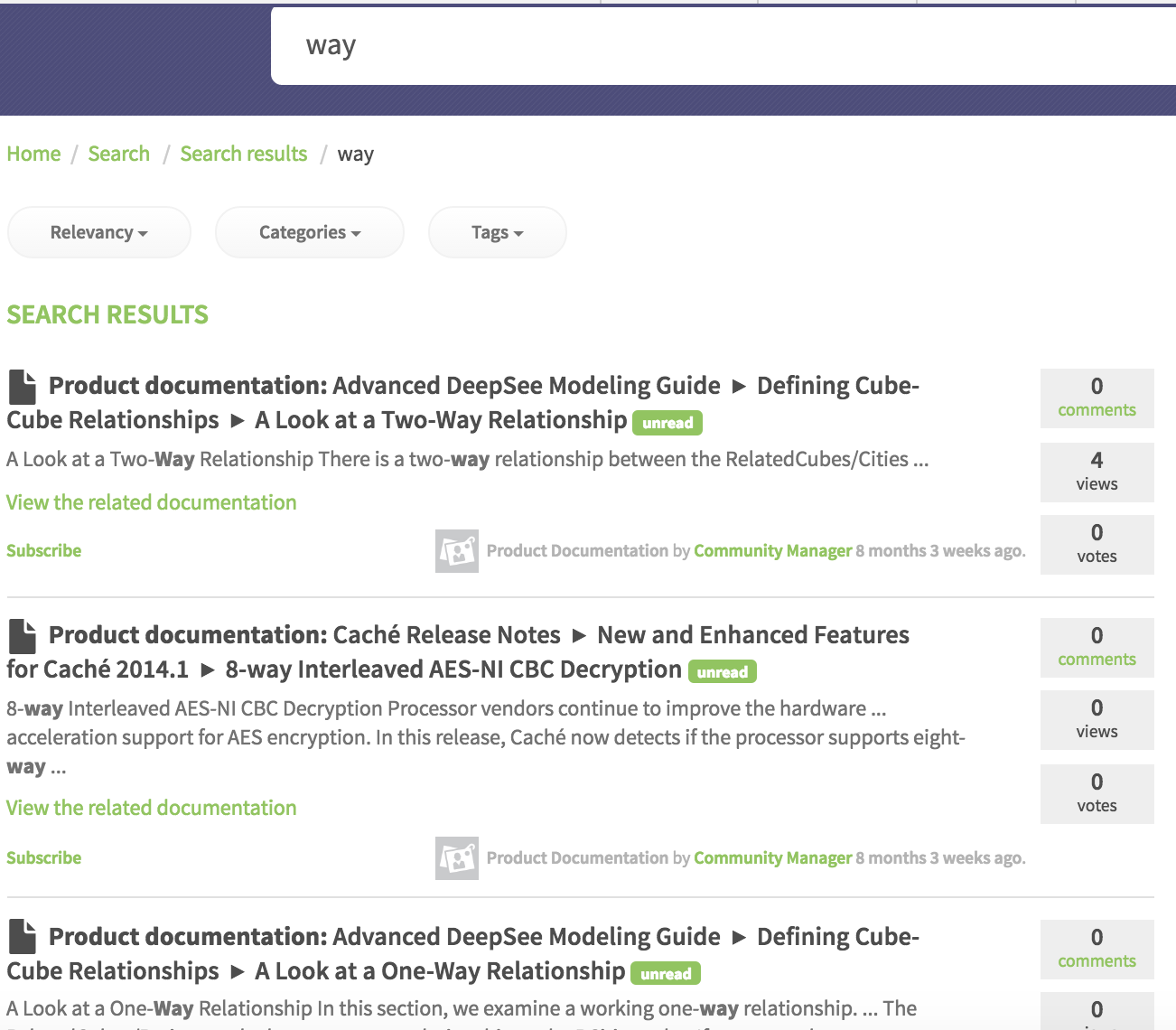
But you can dropdown Tag menu in the search result and filter results to Tag. F.e. your post has 'online-learning' tag.
Let's do it and see search results then:

You can search within several tags simultaneously.
Hope that helps.
P.S. 'Online learning' is the not very fit tag for this post. Please consider to change it to 'Developer Community' tag.
- Log in to post comments
Hi, Kyle!
Thank you, great stuff!
The guys in Russian forum says there is a bug in the line:
Property Data as %String (MAXLEN=100, MINLEN=200);
How can MINLEN be higher MAXLEN?
- Log in to post comments
Hi, Thomas!
That's true. Would be fixed.
Thank you!
- Log in to post comments
Hi Greg!
We do not support this type of posts anymore.
Code packages should be placed as code snippets, gist or github repos.
But thank you! We'll delete this artefact.
- Log in to post comments
We have votes) Can't votes help?
- Log in to post comments
Hi Greg!
Subscriptions are not ideal at this moment and we are working to make them better.
Your suggestions are quite reasonable we'll try to introduce them to the subscription module soon.
Thanks!
- Log in to post comments
Hi, Greg!
Thanks for the request!
Yes, you are right. It's very helpful option and we have this task in our backlog.
- Log in to post comments
Hi, Sergey!
Thanks for the answer!
Yes, it's the possible reason. But the problem also appears on Unicode installations too. See my answer below.
- Log in to post comments
Hi, Randy!
It's a known issue. The problem is that DSW(DeepSeeWeb) contains some unicode symbols in UI and they come from CSP Gateway in ISO 1859-1 codepage, which is not Unicode obviously.
It happens because in your NLS scheme (I believe it is enuw) there is the default setting for non-CSP files that they should go in ISO 1859-1.
While it is not fixed in the release, it is fixable two ways:
1. Copy index.html to index.csp and try to connect to it same way you do with index.html page. Symbols should go in Unicode now.
2. Write your current codepage setting in CSP Gateway for the files:
zw ^%SYS("CSP","DefaultFileCharset")This setting should be "utf-8". If there is another setting, save it somewhere and change to "utf-8"
So this should fix it:
set ^%SYS("CSP","DefaultFileCharset")="utf-8"- Log in to post comments
Good idea Scott, it's filed. Thank you!
- Log in to post comments
Hi, Mike!
There is no option to delete your own posts now.
But you can unpublish them.
- Log in to post comments
Hi, Rustam!
A lot of Caché code parts (classes, mac and int routings, DFI's etc) are stored in the database itself, not in files. They should be exported some way to be presented in files.
I see you have already the way to export classes, so I believe you can repeat similar code logic to export mac and int code part into the files in the same or another OS folder.
- Log in to post comments
Sorry, Cheng Cheng!
Got the idea now: you wanted Sum function for each Product Category, and Avg function for All Products in the same pivot)
And this use case of IIF and LEVEL_NUMBER solves the task.
Great! Thanks!
- Log in to post comments
Hi, Cheng!
Thank you for the explanation! Great use case, btw. Now it's more clear with your initial post.
It would be great if you include Level_number in the query too to see what rows has different Level_number.
Like this:
WITH MEMBER measures.[with avg summary info] AS

                              'IIF(Product.CurrentMember.Properties("LEVEL_NUMBER") = 1,

                                 AVG(Product.[Product Category].Members, measures.[amount sold]),

                                 SUM(Product.[Product Category].Members, measures.[amount sold]))'

               MEMBER measures.[total count] AS 'SUM(Product.[Product Category].Members)'

SELECT {Product.[Product Category].Members, [Product].[All Product]} ON 1,

               {Product.CurrentMember.Properties("LEVEL_NUMBER"),measures.[with avg summary info],measures.[total count]} ON 0

FROM Holefoods
I suppose 'All Product' level should have the Sum of all Product levels. But in your example 'All product' lesser than 'Snack' for example.
- Log in to post comments
One more hint from Russian forum:
%GCMP - Compares two globals in the same or different namespace.
- Log in to post comments
HI, Cheng!
Thanks, great example!
What is the "LEVEL_NUMBER"? Is it a kind of internal property?
- Log in to post comments
That depends on property collation. For EXACT/ TRUNCATE/SQLSTRING collation, yes "val" should exactly match the value of the property (compared part of the value), case sensitive. For SQLUPPER - no.
Should I see this collation setting in Index or in property definition?
And what is the default setting - SQLUPPER?
- Log in to post comments
Thank you, Scott!
- Log in to post comments
Thank you, Benjamin!
It is still so much to work to make email notifications really helpful.
We'll try to fix the issues in some next releases.
- Log in to post comments
Thank you, Eduard. We plan to add Member Collaboration page with posts and comments and I think this page will be changed to the link of Member's collaboration of yourself and will go with pagination.
So it will be fixed in some next releases.
- Log in to post comments
ClassMethod PropertyGetStored(id)For datatype properties this method returns their logical value, for object properties, it returns the id. It’s a wrapped global reference to the class data global and the fastest way to retrieve the singular property value. This method is only available for stored properties.
Eduard, you say it's the fastest way to take the value. Did you measure it?
- Log in to post comments