If you're trying to check that the first character is " then you need to double the quotes. In other words, test as follows:
if $e(chunk,1,1)=""""
- Log in to post comments
If you're trying to check that the first character is " then you need to double the quotes. In other words, test as follows:
if $e(chunk,1,1)=""""
I expect it gets hit whenever an HTTP client accesses that URL.
I expect it will consume a license in the normal way.
Can you use web server logs to find out where the HTTP requests are coming from?
Also, is this a duplicate of a previous question from you?
Is the GetPatientInfo method of your com.siemens.med.hs.Country.WebServices.pats.ClassPatientServices class responding with that message?
That doc section refers to inbound interfaces, but the OP seemed to be talking about outbound ones.
Mike, the facility already exists for the original poster to accept an answer by clicking the checkmark alongside the answer. My suggestion here is that doing this should also make the question's icon appear different.
As you're asking about an outbound connection, I'm not clear what you mean by making HealthShare "use the virtual IP address" of your 2-server Windows cluster. Please explain.
Anything stopping you creating one app for each namespace?
Maybe adding the /recursive=1 qualifier will give you what you want. If so, please click the checkmark to accept this answer.
SAMPLES>d $system.OBJ.Export("Cinema.Film.cls","c:\s\exp1.xml")
Exporting to XML started on 04/13/2017 09:49:36
Exporting class: Cinema.Film
Export finished successfully.
SAMPLES>d $system.OBJ.Export("Cinema.Film.cls","c:\s\exp2.xml","/recursive=1")
Exporting to XML started on 04/13/2017 09:49:39
Exporting class: Cinema.Duration
Exporting class: Cinema.Film
Exporting class: Cinema.FilmCategory
Export finished successfully.
SAMPLES>
Excellent discussion starter Sean. But does your third sentence need a little debugging? You wrote (my highlighting):
It's not because I don't dislike them...
Eduard, that only restricts access to the CSP Web Gateway Management pages. It has no effect on who can use the web applications that can be reached through this instance of the CSP Web Gateway.
Maybe define an extra Web Application in Portal for your REST/SOAP services to be available on. Choose whatever path suits you, making it one that doesn't overlap with one that Management Portal uses.
Maybe add the "f" flag to your compilation options?
Please help me understand why it is important to you that the debugging goes through the code in A's INT routine rather than the equivalent code in B's INT routine.
What is your $ZVERSION value?
Please try this:
C:\InterSystems\Ensemble\bin>ccontrol console ENSEMBLE
Launch an admin-level command window, then run csession.exe in the bin directory of your Caché install, giving your instance name as the argument, e.g.

If this works for you please click the checkmark alongside the answer.
Thanks. If you make this an Answer rather than a Comment then I can mark it accepted.
Be aware that by fetching $H twice there's a small possibility of an unwanted outcome. For example, consider what happens if the first time it returns "64382,86399" and the second time "64383,0". Harmless in Danny's prompt code, but in other contexts it could cause problems.
By "license limits" are you referring to the way that some types of license only permit a maximum of 250 databases? Or is there some other constraint?
Linking to this post which draws attention to how BPLs and DTLs can already be edited in diagram format in Atelier. I was interested to read that these diagram editors modify the associated class definition on the server, in contrast to the general Atelier principle that changes are made in files in the local workspace.
Good to see this indicator behaving reliably now.
Is there a fault with the Unsubscribe link in the emails? Here's one I received:

The highlighted link's URL is https://community.intersystems.com/user//subscriptions/node#edit-0-chec… and when I click on it I get a new browser tab at the following URL:
https://community.intersystems.com/user/john-murray#edit-0-checkboxes-4…
The page looks like this:
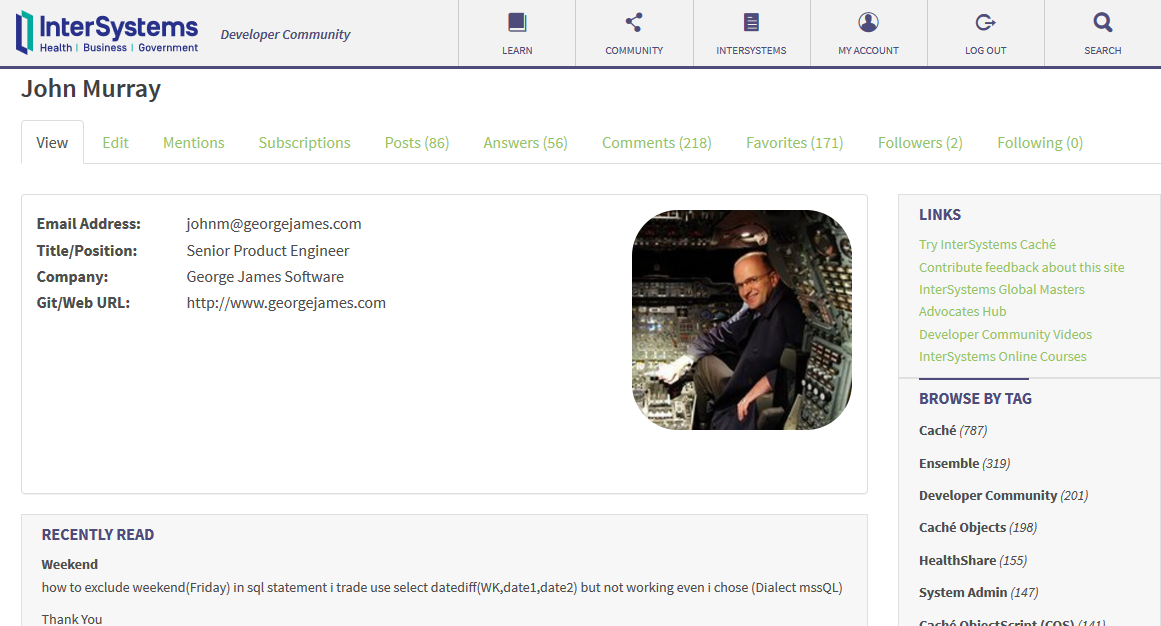
Was it supposed to take me somewhere on the Subscriptions tab?
I think you meant to write that you changed the group and tag from Caché to Developer Community. I assume you did this because my original posting on the Caché group and tag was not sufficient to make it crosspost to the Google Group. I guess there is some human involvement in the crossposting, and this filtered my posting out.
Fabian, thank you for posting my original onto the group [Update: 3-Apr-2017 I can no longer find Fabian's post there  ]
]
Very neat!
What Ensemble version are you connecting to?
This appears to have been fixed.