What do you mean by "productdescription" ?
- Log in to post comments
What do you mean by "productdescription" ?
Something is going on with that Google Group. When I visited it this morning I was given this message:
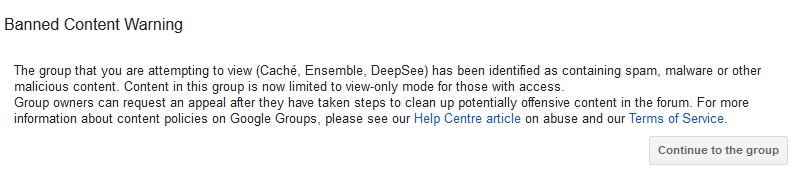
Continuing to the group, it then says "No topics are available in this group"
When Ensemble runs on Windows its background processes typically run with whatever Windows credentials the Ensemble service (see Windows Service Control Manager) is set to "Log on as". If that is LocalSystem then your background processes won't be able to access UNC paths.
For more information, see my post here.
If my answer here resolves your question please click the checkmark alongside it above.
I suggest you export the package to XML, then edit the XML, then import it.
There's a flaw in your original idea of eliminating the comma from two $H-format timestamps and then comparing them with the "greater than" operation. For most of a 24 hour period the resulting $TR(dollarH,",") is 10 digits long, but from midnight until 00:00:09 it is only 6 digits long, from 00:00:10 to 00:01:39 it is 7, from 00:01:40 to 00:16:39 it is 8 and from 00:16:40 to 02:46:39 it is 9 long.
A working alternative would be to compute $P(dollarH,",")*86400+$P(dollarH,",",2) for each and compare the results, which are the number of seconds since midnight at the start of 31st December 1840.
if you need to compare a $H-format timestamp against the current time don't use $P($H,",")*86400+$P($H,",",2) as one of the expressions because there's a small possibility that your two fetches of $H will fall either side of midnight. Instead, fetch $H once, store it in a variable, then process that variable.
What is your question?
Laura, this probably deserves to be posted as a new question so more people will see it. But your situation isn't clear to me. If a user can't log in (why?), how are they going to be able to run something that will log out all their sessions?
I also recommend the use of the "comment" link that appears under questions, answers, or other comments. I think this helps put a response into the relevant context.
I didn't see any mention of a "USA and Europe" restriction on the website information.
Any reason for not including, say, Canada?
Glad to have helped you Laura. Please click the checkmark against the answer I gave so that your question no longer lists as "unanswered", and so that I get a few points on Global Masters.
Stephen, are you still using the original https URL Evgeny posted, i.e. https://globalmasters.intersystems.com/ ? My browser still reports an issue with the certificate for that.
Evgeny, I'm not clear what got fixed. The change Alexander requested isn't yet present:
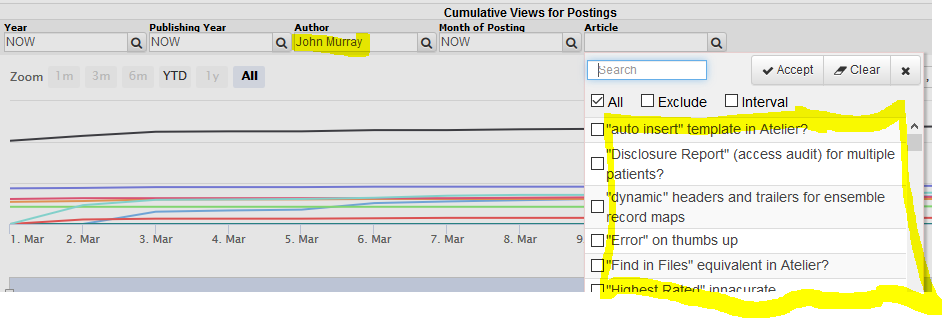
After setting myself in the Author field the Articles list still contains ones I didn't write.
Are you aware of the ChangePassword method of %SYSTEM.Security? You can call it from the $system SVN, i.e. something like:
set blnOK=$system.Security.ChangePassword($username,newPW,oldPW,.status)
If blnOK is false there should be more information in status.
Award yourself the checkmark for an accepted answer!
Has CCR become a released product?
I assume Evgeny's initial fix was to change the hyperlink in the article so it's an http one rather than an https one.
Like most DC posts nowadays, this one got auto-crossposted to the intersystems-public-cache Google Group. When I checked this morning there were 5 responses from people trying to help the original poster. But since those answers don't automatically feed across to DC I'm drawing attention to them here. Because unless the OP knows to look there they may never see them.
https://groups.google.com/forum/#!topic/intersystems-public-cache/fngd5…
This recent post about Ontodia and Caché describes an interesting variation on the UML class diagram presentations we previously discussed here.
Just trying to make the "no answer" view more useful...
On the newer Cache versions you no longer need to pick a database when defining %ALL. Provided you tab off the "Name of the namespace" field after entering "%ALL", the form simplifies:
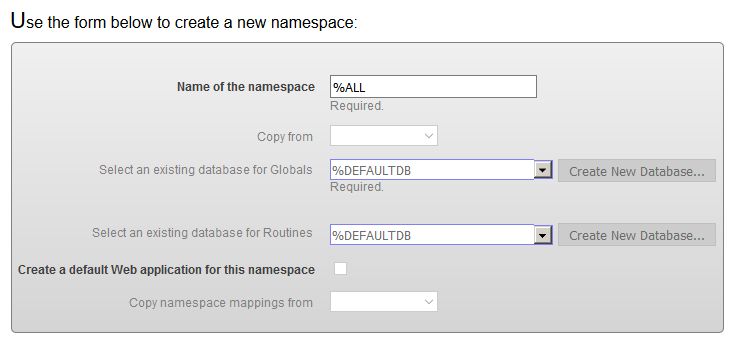
The above screenshot is from 2016.2.
In COS the function $Char(10) returns the ASCII newline character. Or if you need a CRLF sequence you can use $Char(13,10)
Did you ever solve this? If so, maybe add an Answer to the post. You can even accept your own answer (click the checkmark) and thus prevent the pot from listing as "unanswered".
Answered in comments.
Answered by the OP in comments.
As Eduard indicated in his comment, there are many possible factors. I'm posting this as an answer so the question no longer appears in DC's "no answer" view. And if the OP wants to accept this answer, click the checkmark alongside it. Then it will no longer appear in DC's "unanswered" view.
With the DO command?
The "My Account" section already looks like it separates Subscriptions from Favorites, but currently the "MY FAVORITES" option goes to the "Saved Content" tab of a page called "My Content".
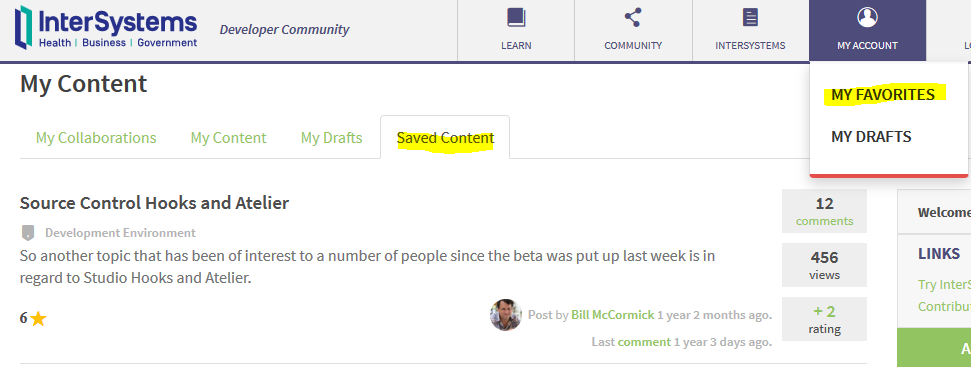
AFAIK the "Saved Content" tab is no longer operational in its original mode. But perhaps it could be useful for this case.
Here are some initial suggestions / comments (no particular priority):
I hope this is a useful start.