Thanks a lot! We could add more features like this later. Another similar helper module is this one by @Guillaume Rongier
- Log in to post comments
Thanks a lot! We could add more features like this later. Another similar helper module is this one by @Guillaume Rongier
Alex, this is great! Could this be an ipm module?
Thanks @Clayton Lewis . I like the Message Map approach. And it could suggest messages that 99% fit choosing from Message Map but also let the option to be completely flexible as it is now.
You also can use intersystemsdc/iris-community:latest or just intersystemsdc/iris-community for the latest InterSystems IRIS Community Edition release.
And intersystemsdc/iris-community:preview for the latest preview build.
intersystemsdc/irishealth-community and intersystemsdc/irishealth-community:preview for InterSystems IRIS For Health Community Edition
Congratulations to all the participants! You are amazing!
Hi @Shanshan Yu !
Try to use DeepSeeWeb project to alter the visualization?
Wow. This is much easier. It’s a pity this is not in documentation. Thank you!
It's is a bit dangerous saying "Package Manager is server-centric".
I never code with "server-centric" paradigm, but I always use Package manager. So I install all the necessary packages I need during the docker build procedure of my dev-environment with IRIS. E.g. like in this line:
zn "USER"
    zpm "install git-source-control"
    do ##class(%Studio.SourceControl.Interface).SourceControlClassSet("SourceControl.Git.Extension")
    zpm "install passwordless"
    zpm "install objectscript-json-trace-viewer"

    zpm "load /home/irisowner/dev/ -dev -v":1:1
    halt
Can I use such an approach with snippets?
Hi @Ikram Shah !
Tomorrow we'll publish the bonus table for all the applications. If something is not accurate you comment here or in Discord
Hi @John Murray ! Great idea!
Will snippets be shown also with client-centric approach for editing? Or this is only a server-side approach feature?
Another option is to use MergeCPF to add users.
See an example repo from @Guillaume Rongier with MergeCPF usage. Guillaume modifies user in this repo, but probably you can create one with the same approach.
Also it is very easy to let IRIS execute MergeCPF file - just update the following Env Variable listed in docker-compose.yml.
@Gautam Rishi , I see it contains module.xml in the root. So it is prepared to act as a ZPM module.
You probably can install it as:
USER>zpm "load https://github.com/GendronAC/InterSystems-UnitTest-Mocking"
Hi @AndreClaude Gendron !
Raising again this topic - could you please share your project on Open Exchange? Thanks in advance!
It's not published on OEX, thus is not available on the public ZPM.
Calling @AndreClaude Gendron to publish it on Open Exchange.
In addition to what @Dmitry Maslennikov says here is the related information in docs.
Hi @Dheeraj Gupta !
Maybe this article and project by @henry could be helpful!
Also this project by @Dmitry Maslennikov could be of help.
Calling @Timothy Leavitt as Tim has a lot experience in Mocking. There is also a lib Forgery on OEX by @Rubens Silva that is related.
Hi Gautam!
It's not an answer for your question, but I encourage you to try manage tests via Package manager - in this case you don't need to create any directories and globals.
this will be:
USER>zpm "test your-package-name"
that will run all the tests. And you'll be able to introduce tests in a CI pipeline.
Thank you both @Dmitry Maslennikov @Gertjan Klein !
This is what I'm looking for!
Thank you, @Alex Woodhead ! This works for me!
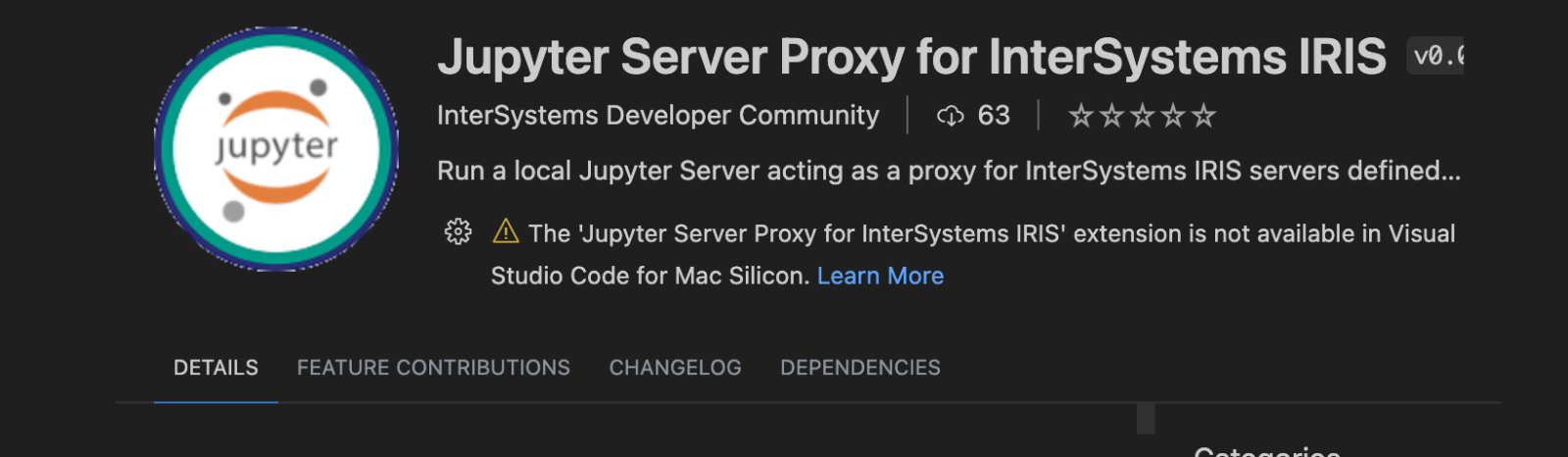
Installed. But failing to form a connection string. Cannot it just use what I have for VSCode connected automatically?
It wants me to create a server in server manager which I never used before (no need).
Thanks both @John Murray @Dmitry Maslennikov
Thanks, @Alex Woodhead !
What about $objproperty and $objmethod?
The first one could be really helpful
Hi @Guillaume Rongier !
Is it possible to add Python based BO into the production with ObjectScript based components (Services, Operations)?
Thank you @Mark OReilly , @John Murray
Love it! Thanks a lot, @Alex Woodhead !
This is exactly what I need!
@Philipp Bonin - is it possible to switch the color scheme back to the one I used before? The one that comes with the extension is too bright for me) Thanks!
Thanks a lot, @Alex Woodhead !
@Philipp Bonin , maybe you could consider that in your wonderful ObjectScript to Embedded Python translator?
Hi @Alex Woodhead!
Having IPM client in place you can check the installed modules and its versions. The newly installed module will replace the old one.
I'm not sure I understand correctly what you are asking here. Anyway, one can setup their own IPM registry to supply its customers/clients with IPM modules. and this private IPM registry has the list of all the versions available and the stats of installations if this is set up. So any client that has access to this registry can install any desired version or just the latest if the version is omitted.
I'm not sure this functionality exists. It's better to have a newly published module version with the upgraded IRIS $zversion bytecode.
But if this functionality is in need please submit an issue.