
#Python

8 Followers · 482 Posts

Python is an interpreted high-level programming language for general-purpose programming. Created by Guido van Rossum and first released in 1991, Python has a design philosophy that emphasizes code readability, notably using significant whitespace

Official site.

InterSystems Python Binding Documentation.

Article Alberto Fuentes · Jan 29, 2024 12m read

We have a yummy dataset with recipes written by multiple Reddit users, however most of the information is free text as the title or description of a post. Let's find out how we can very easily load the dataset, extract some features and analyze it using features from OpenAI large language model within Embedded Python and the Langchain framework.

Loading the dataset

First things first, we need to load the dataset or can we just connect to it?

3
2 446
Article Renato Banzai · Jul 19, 2020 3m read

This is the third post of a series explaining how to create an end-to-end Machine Learning system.

Training a Machine Learning Model

When you work with machine learning is common to hear this work: training. Do you what training mean in a ML Pipeline? Training could mean all the development process of a machine learning model OR the specific point in all development process that uses training data and results in a machine learning model.

picture Source

So Machine Learning Models are not equal Common Applications?

In the very last point it looks like a normal application.

10
2 446
Article Evgeny Shvarov · Jul 30, 2019 2m read

Hi Developers!

This is the second post on the resources for Developers. This part is about Open Exchange

Using Open Exchange to Learn InterSystems

InterSystems Open Exchange is a applications gallery of tools, connectors, and libraries which InterSystems Developers submit to share the experience, approaches and do business. All the applications are either built with InterSystems data platforms or are intended to use for development with InterSystems data platforms.

If you are a beginner developer you can take a look at applications in Technology Example category. All the applications in this category come with open source code repositories, so you are able to run the samples and examples in a docker container with IRIS on your laptop or in the cloud IRIS sandbox. Examples:


4
0 446
Article Ashok Kumar T · Feb 7, 2025 6m read

In this article, exceptions are covered.

Working with Exceptions

Instead of returning a %Status response, you can raise and throw an Exception. You are then responsible for catching the exception and validating it. IRIS provides five main classes to handle exceptions effectively. Additionally, you can create custom exception class definition based on your needs.

These exceptions are different from %Status, so you can't directly/efficiently use the exception object with $SYSTEM.OBJ.DisplayError() or $SYSTEM.Status.DisplayError().

0
2 438
Article Evgeniy Potapov · Mar 18, 2024 10m read

Pandas is not just a popular software library. It is a cornerstone in the Python data analysis landscape. Renowned for its simplicity and power, it offers a variety of data structures and functions that are instrumental in transforming the complexity of data preparation and analysis into a more manageable form. It is particularly relevant in such specialized environments as ObjectScript for Key Performance Indicators (KPIs) and reporting, especially within the framework of the InterSystems IRIS platform, a leading data management and analysis solution.

4
2 432
Article Nicole Raimundo · May 15, 2024 9m read

DNA Similarity and Classification was developed as a REST API utilizing InterSystems Vector Search technology to investigate genetic similarities and efficiently classify DNA sequences. This is an application that utilizes artificial intelligence techniques, such as machine learning, enhanced by vector search capabilities, to classify genetic families and identify known similar DNAs from an unknown input DNA.

K-mer Analysis: Fundamentals in DNA Sequence Analysis

Fragmentation of a DNA sequence into k-mers is a fundamental technique in genetic data processing.

2
1 431
Article Maria Nesterenko · Apr 20, 2023 5m read

Many factors affect a person's quality of life, and one of the most important is sleep. The quality of our sleep determines our ability to function during the day and affects our mental and physical health. Good quality sleep is critical to our overall health and well-being. Therefore, by analyzing indicators preceding sleep, we can determine the quality of our sleep. This is precisely the functionality of the Sheep's Galaxy application.

5
0 402
Article Alexey Nechaev · Sep 23, 2023 5m read

Hi folks

I want to tell you how you can make your own assistant based on IRIS and OpenAI (perhaps you can then move to your own AI models)

iris-recorder-helper

This is the first time I have fully tried developing an application for IRIS and I want to point out steps that may also be useful to you

  1. Deploy to google cloud via github workflows (One container with an IRIS database and a web server in Python (flask)) and placing secrets inside the application not through an environment variable
  2. Record audio from the browser and send to the server
  3. Launching cron jobs via the ZPM module
  4. Integration
5
1 402
Article Ashok Kumar T · Jul 21, 2025 13m read

This article is a continuation of the IRIS JSON project and features additional methods and insights.

Let's continue with the instance methods

%GetTypeOf(Key)

This instance method is used to determine the JSON data type of the %DynamicObject or %DynamicArray.

It returns one of the following strings:


"null" - JSON null
"boolean" - Either "true" or "false"
"number" - Any numeric value
"oref" - An %ObjectHandle (an ObjectScript oref)
"object" - A nested object
"array" - A nested array
"string" - Normal text string
"unassigned" - The value is unassigned

USER>Set array = [1,"test",true,12.
1
6 400
Article Sergey Mikhailenko · Aug 14, 2021 2m read

Continuing the description of work on the use of the openhl python module in productive mode.

Since the version of iris with Embedded Python, does not yet have a final release, it is already necessary to use it in production now. We decided to back up the service for exporting requests to a xlsx file on a separate server, and save the query result in a global in a separate database.

This database was made networked, local for the service server and remote for the product server. The communication between the prod server and the service was implemented using a rest service.

0
1 399
Article Lucas Enard · Sep 11, 2022 16m read

Hello everyone, I’m a French student that just arrived in Prague for an academical exchange for my fifth year of engineering school and here is my participation in the interop contest.

I hadn’t much time to code since I was moving from France to Prague and I’m participating alone, so I decided to make a project that’s more like a template rather than an application.

I wanted to participate since my field (Data Science and AI) is not often linked with sustainability and the contest was a way for me to express myself in this important subject that is sustainability and Environnement.

4
0 397
Article Guillaume Rongier · Jul 8, 2024 8m read

django_logo

Description

This is a template for an Django application that can be deployed in IRIS as an native Web Application.

Installation

  1. Clone the repository
  2. Create a virtual environment
  3. Install the requirements
  4. Run the docker-compose file
git clone
cd iris-django-template
python3 -m venv .venv
source .venv/bin/activate
pip install -r requirements.txt
docker-compose up

Usage

The base URL is http://localhost:53795/django/.

Endpoints

  • /iris - Returns a JSON object with the top 10 classes present in the IRISAPP namespace.
  • /interop - A ping endpoint to test the interoperability framework of IRIS.
1
0 396
Article Rodolfo Pscheidt Jr · Mar 17, 2025 2m read


In this article I will be discussing the use of an alternative LLM for generative IA. OpenIA is commonly used, in this article I will show you how to use it and the advantages of using Ollama

In the generative AI usage model that we are used to, we have the following flow:

  • we take texts from a data source (a file, for example) and embedding that text into vectors
  • we store the vectors in an IRIS database.
  • we call an LLM (Large Language Model) that accesses these vectors as context to generate responses in human language.
2
2 394
Article Vadim Aniskin · Jan 31, 2024 3m read

Django, a high-level web framework written in Python, has become a staple for developers seeking a robust, efficient, and easy-to-learn solution for building web applications. Its popularity stems from its versatility, offering developers an efficient toolkit for building web applications. Integrating Django with InterSystems IRIS introduces a dynamic synergy, providing developers with a comprehensive web development and database management solution. That's why on the Ideas Portal, @Evgeny Shvarov suggested that having Examples to work with IRIS from Django would be beneficial. In this article, we'll explore two projects created to answer the posted idea — Django-iris by @Dmitry Maslennikov and Iris-size-django by @Heloisa.Paiva.


0
2 393
Article Heloisa Paiva · Jul 4, 2023 10m read

Our objective

In the last article, we talked about a few starters for Django. We learned how to begin the project, ensure we have all the requisites, and make a CRUD. However, today we are going a little further. 
Sometimes we need to access more complex methods, so today, we will connect IRIS to a Python environment, build a few functions and display them on a webpage. It will be similar to the last discussion, but further enough for you to make something new, even though not enough to feel lost.

0
1 390
Article sween · Mar 4, 2024 8m read

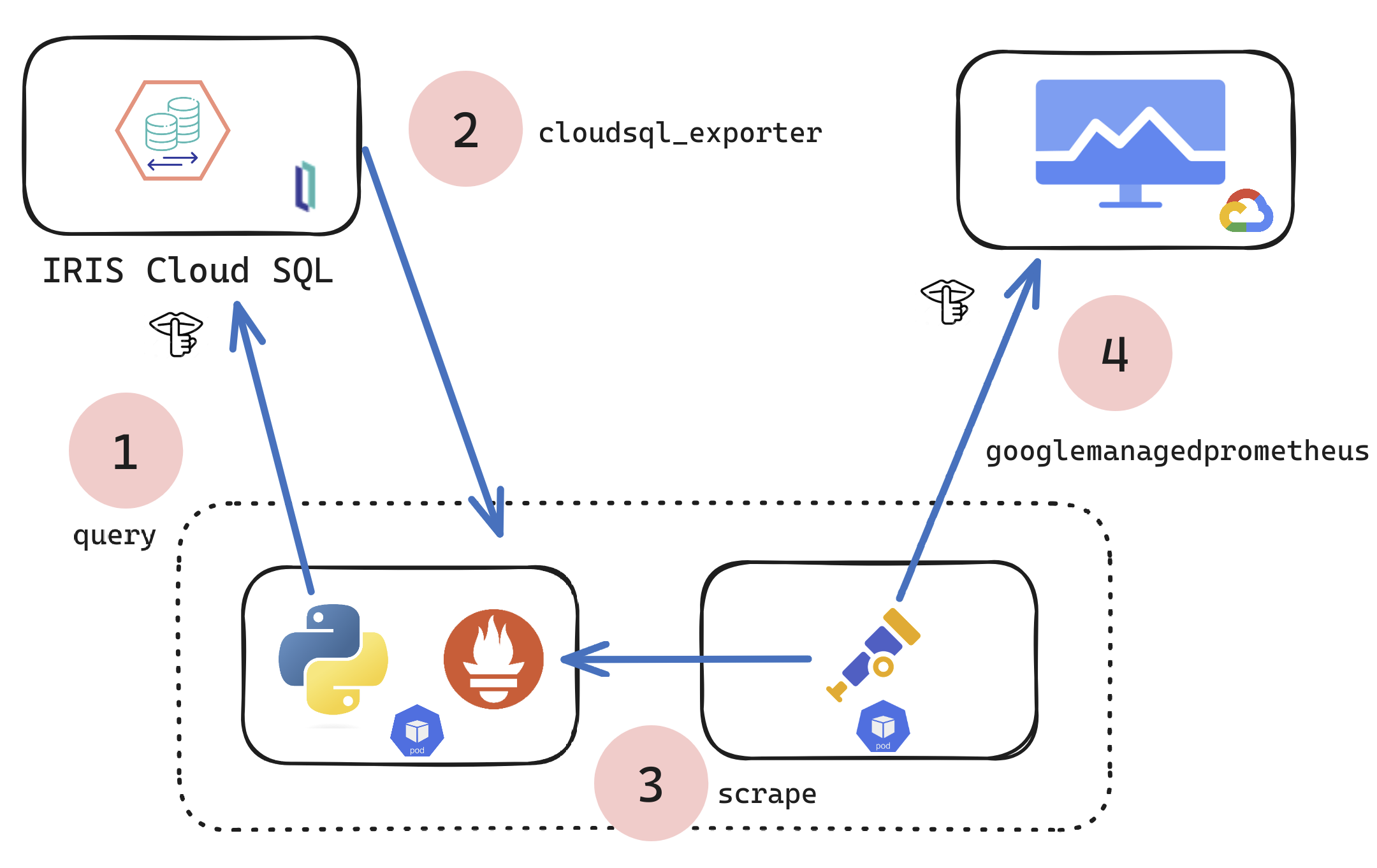
If you are a customer of the new InterSystems IRIS® Cloud SQL and InterSystems IRIS® Cloud IntegratedML® cloud offerings and want access to the metrics of your deployments and send them to your own Observability platform, here is a quick and dirty way to get it done by sending the metrics to Google Cloud Platform Monitoring (formerly StackDriver).

1
2 386
Article Yuri Marx · Jan 31, 2022 8m read

From IRIS 2021.2 is possible write Class Methods using the Python Language. I used this new feature to detect persons and objects into images, using ImageAI (https://github.com/OlafenwaMoses/ImageAI). The ImageAI creator defines it as: "An open-source python library built to empower developers to build applications and systems with self-contained Deep Learning and Computer Vision capabilities using simple and few lines of code." In this article you will learn how to apply AI Computer Vision to detect object and persons inside images.

0
2 379
Article Ashok Kumar T · Sep 2, 2024 4m read

In the preceding section, we explored the installation process and initiated the writing of the IRIS in native Python. We will now proceed to examine global traversal and engage with IRIS class objects.

 get: this function is used to get values from the traversal node.

def traversal_firstlevel_subscript():
    """
    ^mygbl(235)="test66,62" and ^mygbl(912)="test118,78"
    """
    for  i in irispy.node('^mygbl'):
        print(i, gbl_node.
0
1 376
Article Dmitry Maslennikov · Mar 2, 2025 5m read

After so many years of waiting, we finally got an official driver available on Pypi

Additionally, found JDBC driver finally available on Maven already for 3 months,  and .Net driver on Nuget more than a month.

 As an author of so many implementations of IRIS support for various Python libraries, I wanted to check it. Implementation of DB-API means that it should be replaceable and at least functions defined in the standard. The only difference should be in SQL.

And the beauty of using already existing libraries, that they already implemented other databases by using DB-API standard, and these libraries already expect how driver should work.

I decided to test InterSystems official driver by implementing its support in SQLAlchemy-iris library.

7
4 374
Article Renato Banzai · Jul 17, 2020 3m read

This is the second post of a series explaining how to create an end-to-end Machine Learning system.

Exploring Data

The InterSystems IRIS already has what we need to explore the data: an SQL Engine! For people who used to explore data in csv or text files this could help to accelerate this step. Basically we explore all the data to understand the intersection (joins) which should help to create a dataset prepared to be used by a machine learning algorithm.

0
1 372
Article Muhammad Waseem · Apr 1, 2025 7m read

Hi Community,
In this article, I will introduce my application iris-AgenticAI .

The rise of agentic AI marks a transformative leap in how artificial intelligence interacts with the world—moving beyond static responses to dynamic, goal-driven problem-solving. Powered by OpenAI’s Agentic SDK , The OpenAI Agents SDK enables you to build agentic AI apps in a lightweight, easy-to-use package with very few abstractions. It's a production-ready upgrade of our previous experimentation for agents, Swarm.
This application showcases the next generation of autonomous AI systems capable of reasoning, collaborating, and executing complex tasks with human-like adaptability.

Application Features

  • Agent Loop 🔄 A built-in loop that autonomously manages tool execution, sends results back to the LLM, and iterates until task completion.
  • Python-First 🐍 Leverage native Python syntax (decorators, generators, etc.) to orchestrate and chain agents without external DSLs.
  • Handoffs 🤝 Seamlessly coordinate multi-agent workflows by delegating tasks between specialized agents.
  • Function Tools ⚒️ Decorate any Python function with @tool to instantly integrate it into the agent’s toolkit.
  • Vector Search (RAG) 🧠 Native integration of vector store (IRIS) for RAG retrieval.
  • Tracing 🔍 Built-in tracing to visualize, debug, and monitor agent workflows in real time (think LangSmith alternatives).
  • MCP Servers 🌐 Support for Model Context Protocol (MCP) via stdio and HTTP, enabling cross-process agent communication.
  • Chainlit UI 🖥️ Integrated Chainlit framework for building interactive chat interfaces with minimal code.
  • Stateful Memory 🧠 Preserve chat history, context, and agent state across sessions for continuity and long-running tasks.
0
0 368
Article Guillaume Rongier · Jul 26, 2024 5m read

It's been a long time since I didn't write an update post on IoP.

image

So what's new since IoP command line interface was released?

Two new big features were added to IoP:

  • Rebranding: the grongier.pex module was renamed to iop to reflect the new name of the project.
  • Async support: IoP now supports async functions and coroutines.

Rebranding

The grongier.pex module was renamed to iop to reflect the new name of the project.

The grongier.pex module is still available for backward compatibility, but it will be removed in the future.

5
0 361
Article Renato Banzai · Jun 5, 2020 3m read

Hi everyone! If it doesn't bother you, could you help me teach my bots to talk?

Open my chatbot here: Help my chatbots to talk!

What? Aren't your chatbots smarts?

Smart isn't the best term for this scenario. They are trained but with little data! Most of chatbot solutions uses Machine Learning to create a way to talk with people and Machine Learning needs one important thing to performs well: DATA

How does it work?

A simple way to explain: imagine someone who has a brain but dont have any experience in his life he just born.

3
0 357
Article Kate Lau · Oct 28, 2024 8m read

I am just writing something to share what I encountered last night, which is the IRIS 2024.3 does not comes with Python by default any more!!!

Which means that I need to install it by myself!!😅 The pros is, I can select my python version😁🤭💃 The trouble is.... at the first place.... I don't know what I should do😥. By going through the community (I am much more prefer than the official document, sorry InterSystems document team😓 ), I found the following piece 

https://docs.intersystems.com/iris20242/csp/docbook/DocBook.UI.

0
0 355
Article Muhammad Waseem · Jan 20, 2025 9m read

Hi, Community!

In the previous article, we introduced the Streamlit web framework, a powerful tool that enables data scientists and machine learning engineers to build interactive web applications with minimal effort. First, we explored how to install Streamlit and run a basic Streamlit app. Then, we incorporated some of Streamlit's basic commands, e.g., adding titles, headers, markdown, and displaying such multimedia as images, audio, and videos.

Later, we covered Streamlit widgets, which allow users to interact with the app through buttons, sliders, checkboxes, and more. Additionally, we examined how to display progress bars and status messages and organize the app with sidebars and containers. We also highlighted data visualization, using charts and Matplotlib figures to present data interactively.

In this article, we will cover the following topics:

1
0 353
Article sween · Mar 31, 2025 8m read

Vanna.AI - Personalized AI InterSystems OMOP Agent


Along this OMOP Journey, from the OHDSI book to Achilles, you can begin to understand the power of the OMOP Common Data Model when you see the mix of well written R and SQL deriving results for large scale analytics that are shareable across organizations. I however do not have a third normal form brain and about a month ago on the Journey we employed Databricks Genie to generate sql for us utilizing InterSystems OMOP and Python interoperability.

1
1 351
Article Niels Genne · Nov 24, 2023 4m read

How can IRIS productions be deployed more quickly and with greater peace of mind?

The aim of interoperability productions is to enable you to connect systems in order to transform and route messages between them. To connect systems, you develop, configure, deploy and manage productions that integrate several software systems.

That’s what the InterSystems documentation on its reference website tells us, but what do you actually have to do to deploy a production ?

Go for it !

Productions can be composed to connect external systems to the IRIS Data Platform.

1
0 348