JSON
JSON (JavaScript Object Notation) is a lightweight, text-based format designed for structured data interchange. It represents data objects consisting of key–value pairs and arrays, and it is entirely language-independent.
Fast Healthcare Interoperability Resources (FHIR, pronounced "fire") is a draft standard describing data formats and elements (known as "resources") and an application programming interface (API) for exchanging electronic health records
JSON
JSON (JavaScript Object Notation) is a lightweight, text-based format designed for structured data interchange. It represents data objects consisting of key–value pairs and arrays, and it is entirely language-independent.
Hello everyone,
I am André from MedVertical. We are exploring InterSystems-native ways to operationalize continuous FHIR conformance: repeatable regression runs, baseline/delta comparisons, and evidence-style reporting to detect drift after releases and IG changes.
In many FHIR implementations, validation is done “point-in-time” in pre-prod, but conformance degrades in production due to IG/profile updates, terminology changes, mapping evolution, upstream releases, and configuration drift.
Hello Community,
We are excited to announce that registration is now open for the second cohort of the course:
🧑💻 Developing FHIR Applications Using Python 🧑💻
This hands-on program is designed for developers who want to build real-world FHIR applications using Python and InterSystems IRIS for Health.
👉 Watch 5-minute course overview
📅 Second cohort starts March 29, 2026
In the modern healthcare landscape, finding clinically similar patients often feels like looking for a needle in a haystack. Traditional keyword searches often fail because medical language is highly nuanced; a search for "Heart Failure" might miss a record containing "Congestive Cardiac Failure."
I am excited to share iris-medmatch, an AI-powered patient matching engine built on InterSystems IRIS for Health. By leveraging Vector Search, this tool understands clinical intent rather than just matching literal strings.
Hi Community!
We’re excited to announce the launch of a new, hands-on training program:
🧑💻 Developing FHIR Applications Using Python 🧑💻

This cohort-based course takes developers from FHIR fundamentals to advanced, real-world healthcare interoperability solutions, with deeper, more practical coverage than typical industry offerings and a strong focus on production-ready skills using InterSystems technology.

You’ve seen how tools like Lovable are shaking up web development. People are spinning up entire apps just by talking to an AI, almost like pair‑programming on steroids.
Now imagine bringing that same “vibe coding” experience into healthcare. know, it sounds crazy. Healthcare is complex, full of regulations, and usually gives us a headache just thinking about the interoperability rules.
That’s exactly the space where withLove lives: an AI‑Native, Low‑Code platform built entirely on InterSystems IRIS for Health.
Hi, Community!
👩⚕️If you need to access clinical data at scale, the InterSystems Bulk FHIR Coordinator can help!
Using the InterSystems Bulk FHIR Coordinator to Extract Clinical Data
Hey Developers,
Watch this video to learn about automating the provisioning and management of FHIR services:
⏯ Automating Provisioning and Management of FHIR Services @ Ready 2025
Hi,
I need to create a bundle of synthetic data in order to populate FHIR servers (not mine).
Can I use a predefined ids, or is it possible the one of the servers will not allow using my IDs and replace them with it's automatic numbering?
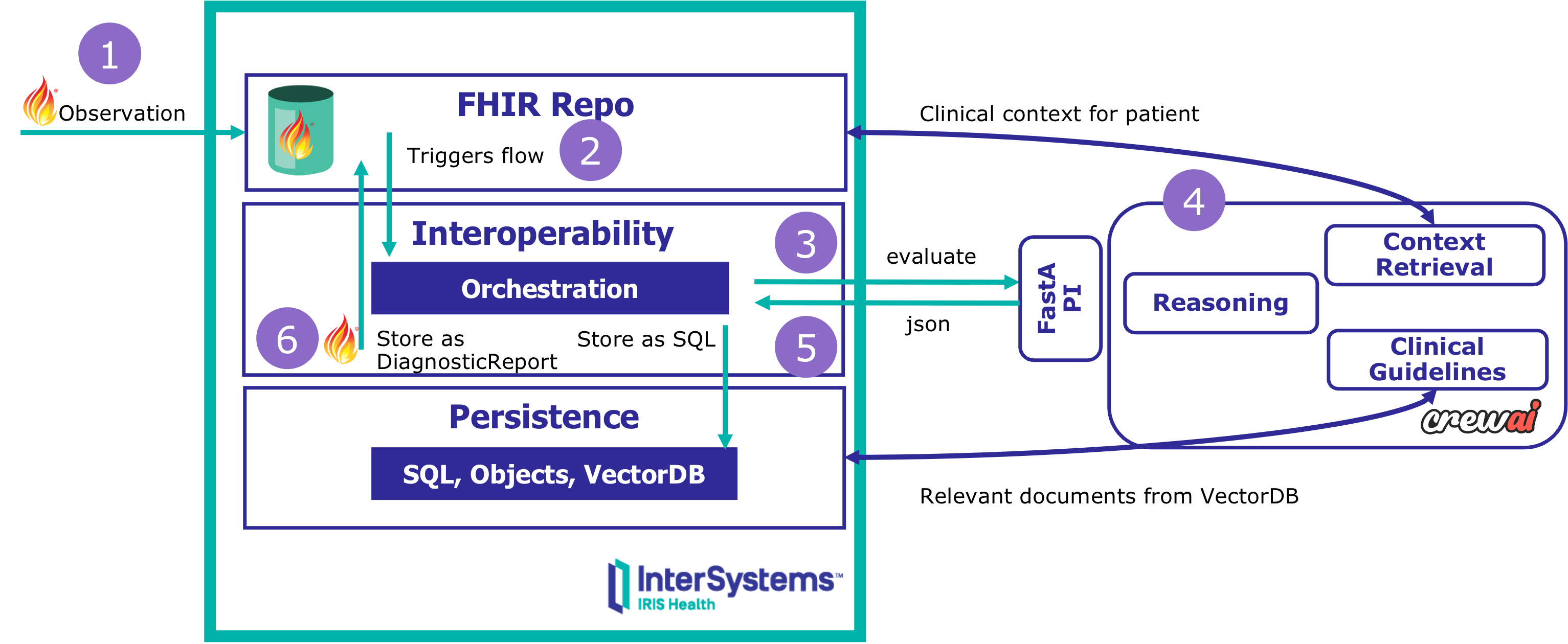
10:47 AM — Jose Garcia's creatinine test results arrive at the hospital FHIR server. 2.1 mg/dL — a 35% increase from last month.
What happens next?
No chatbot. No manual prompts. No black-box reasoning.
This is event-driven clinical decision support with full explainability:

✅ Triggered automatically by FHIR events ✅ Multi-agent reasoning (context, guidelines, recommendations) ✅ Complete audit trail in SQL (every decision, every evidence source) ✅ FHIR-native outputs (DiagnosticReport published to server)
Built with:
You'll learn: 🖋️ How to orchestrate agentic AI workflows within production-grade interoperability systems — and why explainability matters more than accuracy alone.
<iframe width="560" height="315" src="https://www.youtube.com/embed/43Vl7cU_uNY?si=o3NZ3AqPOdFkCn9w" title="YouTube video player" frameborder="0" allow="accelerometer; autoplay; clipboard-write; encrypted-media; gyroscope; picture-in-picture; web-share" referrerpolicy="strict-origin-when-cross-origin" allowfullscreen></iframe>Hey Community!
We're happy to share a new video from our InterSystems Developers YouTube:
⏯ Taking the Fear out of FHIR - Fast Tracking Organizational FHIR Readiness @ Ready 2025
Currently in the health connect code, we are using Epic FHIR API Patient.Create, code return 200 or 201 status values, we process the message based on this return values.
Now I need to use Epic FHIR Patient.$match API, need to check FHIR Error code 4101 for this API. I looked for FHIR statndard return code, but this this seems not standard code, please advice how can I check 4101 value?
I'm using this service to create a FHIR facade.
I want to return OperationOutcome to the calling application when I detect an error.
My code at present is :
set quickStreamOut=##class(HS.SDA3.QuickStream).%New()
set operationOutcome = ##class(HS.FHIR.DTL.vR4.Model.Resource.OperationOutcome).%New()
s issue = ##class(HS.FHIR.DTL.vR4.Model.Element.OperationOutcome.issue).%New()
s issue.severity = "error"
s issue.code = "exception"
s issue.details = ##class(HS.FHIR.DTL.vR4.Model.Datatype.CodeableConcept).%New()
try {
s issue.details.text = exception.Hey Community!
We're happy to share a new video from our InterSystems Developers YouTube:
⏯ Practical Approches to Transforming Your Data Into FHIR @ Ready 2025
What is a FHIR Profile?
A FHIR profile is a collection of rules and constraints used to customize and refine a base Fast Healthcare Interoperability Resources (FHIR) resource. Profiling is a vital process that adapts the base FHIR resource standard to satisfy the unique requirements of a specific use case, geographic region, medical institution, or clinical workflow.
While the base FHIR specification provides generic, flexible definitions for resources (such as Patient, Observation, or Medication), profiles transform these generic resources into more precise ones. This ensures consistent and interoperable data exchange tailored for a particular community or implementation.
FHIR is designed to cover various healthcare scenarios globally. Profiles allow implementers to adapt this general platform without losing the benefits of standardization.
Needs some help with FHIR return code 200 or 201 when processing HL7 messages in HealthConnect.
Issue:
1. If FHIR code is 200 or 201, HealthConnect keep processing HL7 messages
2. If FHIR code is NOT 200 or 201, HealthConnect keep suspend the HL7 messages in the messages queue, then keep processing NEXT subsequent HL7 messages in the TEXT file if the FHIR code is 200 or 201
3. I am also using following "Reply Code Actions" in Operation settings (:?R=S,:?E=S,:~=S,:?A=C,:*=S,:I?=W,:T?=C)
Please advice if I have a "if condition check" for FHIR codes 200 or 201, what "Reply Code Actions" I should use?
We are hiring! 100% Remote W2 Contract | 3-6+ Months (numerous extensions likely)
Two Roles:
🔹InterSystems Engineer
🔹Epic Bridges Certified/InterSystems Engineer
Having solid experience with the below:
Hi, now I would like to continuous on the topic that we talk about previously
Using Postman for testing the OAuth2.0 of the InterSystems FHIR repository - Part1
.png)
Question 1: Where is my client_id and client_secret come form?
Short answer: Authentication Server.
If you don't have an Authentication Server, you may set up one as following
.png)
Provide the hostname (the host must support Https), at least 1 grand type (we choose client credential here), and SSL/TSL configuration
.png)
Input the scopes (here we input user/*.read and user/*.
Hey Community,
Enjoy the new video on InterSystems Developers YouTube:
Earlier this year, I set about creating kit to introduce young techy folk at a Health Tech hackathon to using InterSystems IRIS for health, particularly focusing on using FHIR and vector search.
I wanted to publish this to the developer community because the tutorials included in the kit make a great introduction to using FHIR and to building a basic RAG system in IRIS.
Hey Community,
Enjoy the new video on InterSystems Developers YouTube:
⏯ Advancing Healthcare Interoperability - Strategy and Vision @ Ready 2025
Sometimes it is more convenient, more efficient, and more secure, to limit FHIR Searches per pre-defined "Lists" of Resources.
Since v2025.1 we support several List-related features in our FHIR Server.
I will highlight these here, and provide some samples.
Hey Community,
Enjoy the new video on InterSystems Developers YouTube:
Hi all, it's me again for sharing what I am studying recently.😓
Recently, I am studying how to setup OAuth2 authentication for the InterSystems FHIR repository. And I found the following articles are very good and easy to follow.😁
SMART on FHIR EHR Launch with IRIS for Health
For me, as a user who do not have much knowledge about OAuth2.0. I think it quite difficult to understand how to setup the whole OAuth2.0 environment before knowing how's it look like (what is it?
I have been struggling sometime with trying to take a FHIR Bundle Response, extract the "entry.resourceType", extract the MRN and Name from the Patient FHIR Response...
Going through learning.intersystems.com, it suggested that I try using fhirPathAPI to parse and search my response for certain values, however I am not sure my syntax is correct. Using the AI code, it suggested to set my tree = "Bundle.entry.resource.resourceType"
ClassMethod Transform(source As HS.FHIRServer.Interop.Response, target As osuwmc.Epic.FHIR.DataStructures.I was wondering if anyone had a way to automate creating the Query String for a FHIR Request?
Using HS.FHIRServer.Interop.Request in my development I have to specify the following...
.png)
I was wondering.... if my source had variable number of fields if there was a way to automate the build for the QueryString when doing a Patient Search?
I am trying to replicate a way to use FHIR as a way to query the EMR instead of using a MS SQL Stored Procedure that is populated via HL7 ADT to query.
I'm new to HealthShare. I've installed a demo using the HS.Util.Installer helper, now I'm playing with its FHIR Gateway (which is the HSFHIR namespace). When I try to create a new resource of type Patient using HTTP POST, HealthShare responses with
{
"resourceType": "OperationOutcome",
"issue": [
{
"severity": "error",
"code": "not-supported",
"diagnostics": "<HSFHIRErr>InteractionNotSupported",
"details": {
"text": "Interaction 'create' is not supported for resource type 'Patient'.I built a BP, that every time that a message is received from a BS, it executes
set isAuth=##class(%SYS.OAuth2.AccessToken).IsAuthorized("EpicFHIRPOC",,,.accessToken,.idtoken,.responseProperties,.error)
if 'isAuth {
set tSC=##class(%SYS.OAuth2.Authorization).GetAccessTokenClient("EpicFHIRPOC", "*",, .error)
set isAuth=##class(%SYS.OAuth2.AccessToken).IsAuthorized("EpicFHIRPOC",,,.accessToken,.idtoken,.responseProperties,.error)
}To save time, I was thinking of just creating a BS that goes out and gets the Authorization Token every hour.
As I am iterating through the FHIR JSON Response from a Patient Search, I am running into an issue where the extracted values are not being popualted into the Response object that I have created. If I do a $$$LOGINFO on them they will show up in the Object log, however if I try the following for example I get an error.
set target.MRN = identifier.value
|
Here is my Ens.DataTransform
Class osuwmc.Epic.FHIR.DTL.I am trying to centralize our FHIR queries into a single BP object that would send the FHIR query to the EMR, interpret the response into a %Persistent structure that could be sent back to the requestor. In theory it seemed like it would work but I am running into an issue..
"Warning on Message body 5@osuwmc.Epic.FHIR.DataStructures.PatientSearch.Record'
/ 229 because Status 'ERROR <Ens>ErrException: <PROPERTY DOES NOT EXIST>Transform+3 ^osuwmc.Scott.FHIR.DemoOutboundHL7Message.1 *DocType,osuwmc.Epic.FHIR.DataStructures.PatientSearch.Record -- logged as '-'
number - @'