I guess DC AI bot takes only the post body into the consideration thinking the title is a summary of the post. I this case title is one question and post body is another one.
- Log in to post comments
I guess DC AI bot takes only the post body into the consideration thinking the title is a summary of the post. I this case title is one question and post body is another one.
Thanks for this great contribution, @David McCaldon ! Could you please also publish at Open Exchange?
In anyways, there are folks on the community that can help even with these already undocummented stuff )
$zel, $zlp - two new ObjectScript functions in one day after more than 10 years in InterSystems... Love this community! )
Great app, @Raj Singh ! thanks for the contribution!
Adding two more "cents" for different LOAD DATA usage options:
1. csvgen app, which allows you to create a table and import data automatically as simply as:
do ##class(community.csvgen).Generate("/home/irisowner/dev/data.csv",",","package.class")
It will guess datatypes and use LOAD DATA under the hood.
2. And csvgen-ui - a web UI for csvgen by @Guillaume Rongier
Also, if you are into embedded Python, take a look at csvgenpy, which uses not LOAD DATA, but sqlalchemy.
Thank you, @John Murray, for what you did and keep doing for this community! Well deserved!
It works because you published a question on Developer Community :) (Joking, of course :)
Jokes aside - a very helpful discussion! Thanks @Sylvain Guilbaud !
a really helpful repo, @Sylvain Guilbaud ! do you want to publish it on OEX? Please? )
Hi Paul!
I suggest to take a look two mechanisms:
1. merge cpf - you can list the configuration changes made to vanilla iris/or your custom image.
2. IPM
with IPM you can deploy classes, web apps, files and production elements, run install scripts and version product changes.
I see, makes sense
I see that coding guidlines for ObjectScript linter should be a document (json? yaml?) you include in your code repository or reference any file in a github/gitlab and VSCode linter follows it on-the-go.
Or as some ObjectScript.Quality like ruleset, is it possible @Daniel Tamajon ?
Or as a codetidy feature by @Timothy Leavitt, but it's not easy to use.
This is great, @Ben Spead! Could you please provide an example of how any developer can leverage the code guidelines @Robert Barbiaux suggests in this post?
Voted.
Rebuild indices, this could be the case.
Great points, Dima. But I think any discussions make sense - this is how people communicate and exchange ideas, as you did in your post as well. We could request ObjectScriptQuality to add a profile that will enforce the rule and also, there is a linter in VSCOde ObjectScript - maybe it is possible to request the change in it too.
The idea of an open-source parser for ObjectScript - a good one, do we have it published on the ideas portal?
Are you sure you want to see that many rectangles on a treemap?
Thank you, @Jonathan Lent ! Pleasure to hear we are still better in some spaces than bots :)
Hi @Jonathan Lent !
Great question!
It is supported. You can take a look at the Interoperability template on Open Exchange.
Here is the line of code in a module.xml file.
Great example of custom class queries, @Timothy Leavitt !
I wonder if the recursion with ..AllFetch() is necessary here and in every case?
Very useful article, a lot of use-cases and examples! Thank you @Ashok Kumar Thangavel !
Exciting initiative!
I think this line in Update is "orphaned":
set myobj = ##class(%Library.DynamicObject).%FromJSON(%request.Content) @Justin Millette, there are more settings to enable in the system to allow delegated access, e.g. a system-wide setting, mentioned in this great @Pravin Barton's article , also there is another one from @Yuri Marx
Also, I don't recommend using the WebApplication tag as it is not working properly yet; there is at least one important bug not solved: for example , CSPApplication works quite well.
Also, I see %all - I hope this is for development/demo usage only, as it is quite a generous role to use.
Great stuff!
Made an example in ObjectScript Docker template:
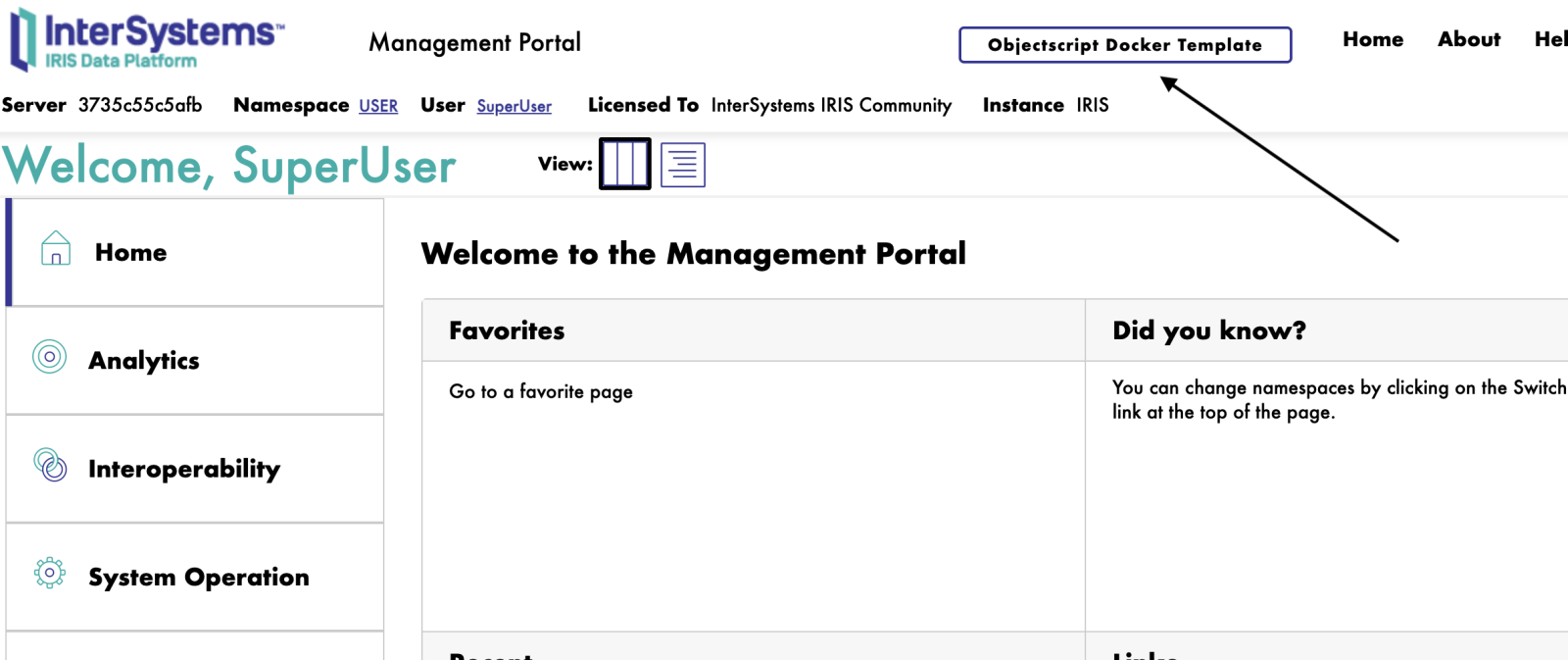
@Thomas Wuppermann, you can add an env variable in docker-compose.yml to make merge cpf be implied, and the merge.cpf with the name you prefer.
On a side note, have you tried ObjectScript Quality for the same linting purpose? It is very naturally connected to GitHub Actions - you can add this file to any open-source GitHub repository with objectscript to see it in action, with examples.
I think it's worth pinging CodeTidy's author @Timothy Leavitt
I agree. I changed it to "not read-only" as I wasn't to manage unit-tests without it :)
Don't know how to mark an object "modified" - otherwise, %Save() doesn't trigger the calculated property to update.
But I agree - read only is much better.
Thank you, Kai! Do you have any examples where the case-sensitive principle can be used, e.g., with C++ or C# and InterSystems ObjectScript class properties?
Right. So, what is the reason, or if you may, what are the benefits of properties to be case sensitive?
Exactly. And as I mentioned above, you cannot compile such a class with properties that differ only in case. What are the benefits of properties being case sensitive? Don't see any.
How do you mean "use case"? You just shouldn't bother about the case of property names in IRIS while sending a JSON from your frontend to the IRIS REST-API. Like you don't care while sending it vs any SQL engine backend.