#Contest

3 Followers · 424 Posts

Contest tag unites posts that are related to any coding competition taking place on InterSystems Developer Community.

Announcement Anastasia Dyubaylo · Oct 23, 2018

Hi Community!

Would you like to work on the next big game-changing idea in healthcare? How about partnering with healthcare innovation center where selected projects gain access to a unique pool of worldwide expertise? Or how about redefining usage of big data in diagnostics with the world’s fastest supercomputer? Or you might fancy changing the future of hospitals with your own new company?

So, meet InterSystems at the CEEHACKS Smart Health Hackathon Prague 2018!


0
0 375
Announcement Evgeny Shvarov · Dec 26, 2017

Hey guys!

Thanks for participating in our small but productive COS marathon on behalf Adventofcode 2017!

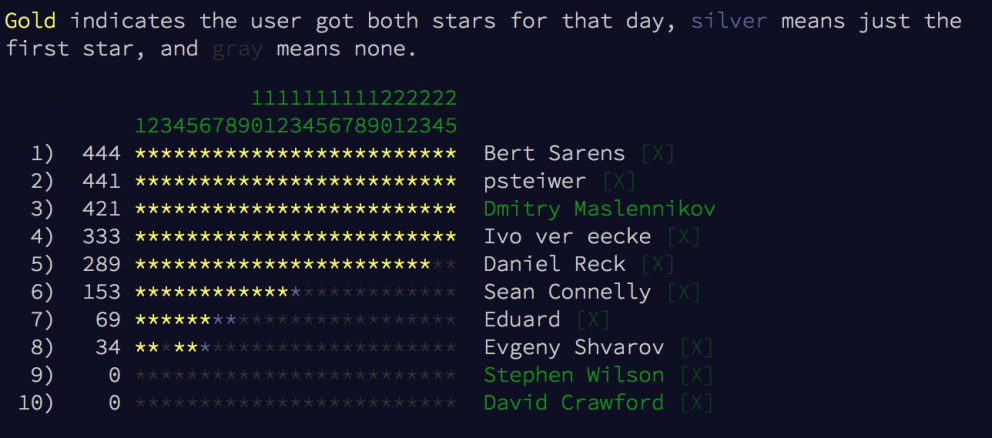
The leaderboard is here:

And we are ready to announce the winner but need your public repositories with COS solutions inside. Please share it below in comments.

We have results!

1st place: Bert Sarens!  Repository.

2nd place: Peter SteiwerRepository.

3rd place: Dmitry MaslennikovRepository.

Congratulations Bert! 

You get 10,000 Global Masters points and the title of the AdventOfCode champion in Caché ObjectScript at least until December 2018! 

Peter and Dmitry!

10
0 680
Announcement Bert Sarens · Dec 1, 2017

Hello everyone,

From now till the 25th of december each day 2 programming problems to sharpen your programming skills.

http://adventofcode.com/

Theme this year:

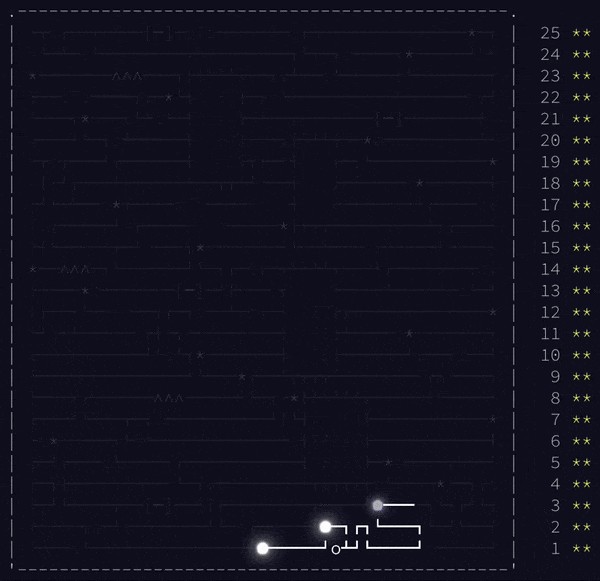
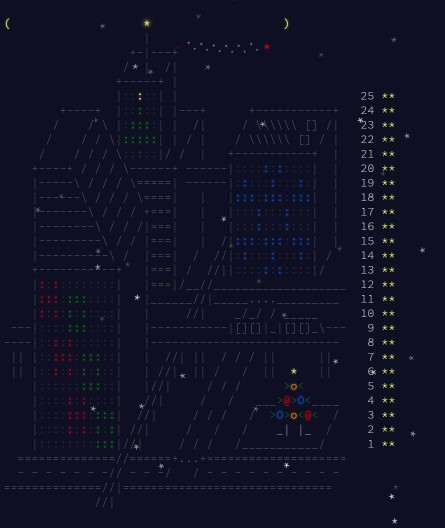
The night before Christmas, one of Santa's Elves calls you in a panic. "The printer's broken! We can't print the Naughty or Nice List!" By the time you make it to sub-basement 17, there are only a few minutes until midnight. "We have a big problem," she says; "there must be almost fifty bugs in this system, but nothing else can print The List.Stand in this square, quick!

68
0 1376
Article Danny Wijnschenk · Nov 25, 2017 4m read

This is (the end) of a series of programming challenges for beginners and experienced Caché programmers.

For an introduction : go to article https://community.intersystems.com/post/advent-code-2016-day1-no-time-t…

This is the 25th and last challenge of the 2016 series of Advent of Code.

In this challenge,  you have to send a signal out,  using the assembunny code interpreter that  we had to make in earlier challenges.

There is one extra instruction added to the assembunny language, which outputs a value (out x).

Using the instructions as input (see http://adventofcode.com/2016/day/25 for the

1
0 582
Article Danny Wijnschenk · Nov 24, 2017 11m read

This is a series of programming challenges for beginners and experienced Caché programmers.

For an introduction : go to article https://community.intersystems.com/post/advent-code-2016-day1-no-time-t…


Today, you need to find your way through a maze (again). There are 8 points of interest in the maze, and you have to visit them all, starting with point 0.
You may visit some points more than once, in random order. The challenge is to find the shortest path through the maze while visiting all points.

The maze looks a bit like this : 

###############################################################
0
0 313
Article Danny Wijnschenk · Nov 23, 2017 4m read

This is a series of programming challenges for beginners and experienced Caché programmers.

For an introduction : go to article https://community.intersystems.com/post/advent-code-2016-day1-no-time-t…
 

Remember the assembunny language we had to code on day 12 (https://community.intersystems.com/post/advent-code-2016-day12-leonardo…)?

There is a new instruction we have to implement which toggles an instruction x lines away (further or back).

  • For one-argument instructions, inc becomes dec, and all other one-argument instructions become inc.
  • For two-argument instructions, jnz becomes cpy
0
0 399
Article Danny Wijnschenk · Nov 22, 2017 5m read

This is a series of programming challenges for beginners and experienced Caché programmers.

For an introduction : go to article https://community.intersystems.com/post/advent-code-2016-day1-no-time-t…


The goal of today's challenge is to copy data from one disk to another, problem is that the disks are not directly connected. Luckily they are in a huge grid, and you have to find a way to copy the data through adjacents disks, while honoring the disk usage (you cannot copy to a disk where data is already stored).


The input is a df-like disk usage listing.

The first challenge is to calculate a

0
0 675
Article Danny Wijnschenk · Nov 21, 2017 5m read

This is a series of programming challenges for beginners and experienced Caché programmers.

For an introduction : go to article https://community.intersystems.com/post/advent-code-2016-day1-no-time-t…
 

The challenge of day 21 is about scrambling passwords.

There are a few functions you need to implement that will do operations on a string :

- swap position X with position Y : means that the letters at indexes X and Y (counting from 0) should be swapped.
- swap letter X with letter Y  : means that the letters X and Y should be swapped (regardless of where they appear in the string).
- rotate
0
0 487
Article Danny Wijnschenk · Nov 20, 2017 3m read

This is a series of programming challenges for beginners and experienced Caché programmers.

For an introduction : go to article https://community.intersystems.com/post/advent-code-2016-day1-no-time-t…

We are almost there : after this challenge, only 5 days left till the end of this advent of code (I cannot wait to get my life back !) .

The challenge of day 20 is about a list of integer ranges. Some ranges overlap,  but there are also values that are outside any range.

You have to find out what is the lowest integer that is outside any range.
 

More explanation (there is not much more to say)

0
0 436
Article Danny Wijnschenk · Nov 19, 2017 3m read

This is a series of programming challenges for beginners and experienced Caché programmers.

For an introduction : go to article https://community.intersystems.com/post/advent-code-2016-day1-no-time-t…

Today's challenge is a variation on the White Elephant gift exchange (https://en.wikipedia.org/wiki/White_elephant_gift_exchange), in this case, by a bunch of Elves where only one can have all gifts.


Each Elf brings a present.They all sit in a circle, numbered starting with position 1.Then, starting with the first Elf, they take turns stealing all the presents from the Elf to their left.

0
0 541
Article Danny Wijnschenk · Nov 18, 2017 4m read

This is a series of programming challenges for beginners and experienced Caché programmers.

For an introduction : go to article https://community.intersystems.com/post/advent-code-2016-day1-no-time-t…

You walk into a room, step on a tile and hear a loud click...

Traps !

The challenge is about avoiding traps.

You can recognise if a tile is a trap by following scheme :

The first row is a given : a safe tile is shown as . and a trap is shown as ^
For the next rows, the state of a tile is calculated related to the tiles in the previous row (same position, tile left and tile right).
If the tile is

0
0 296
Article Danny Wijnschenk · Nov 17, 2017 4m read

#########
#S| | | #
#-#-#-#-#
# | | | #
#-#-#-#-#
# | | | #
#-#-#-#-#
# | | |  
####### V

<!--break-->

This is a series of programming challenges for beginners and experienced Caché programmers.

For an introduction : go to article https://community.intersystems.com/post/advent-code-2016-day1-no-time-t…


The challenge today is again a-maze-ing (as a wellknown president would say).


The maze has a bunch of doors ( | and - on the drawing), but they can be locked depending on a hash that you need to calculate every step.

0
0 458
Article Danny Wijnschenk · Nov 16, 2017 6m read

This is a series of programming challenges for beginners and experienced Caché programmers.

For an introduction : go to article https://community.intersystems.com/post/advent-code-2016-day1-no-time-t…

The challenge of day 16 is about generating random data using a modified version of a dragon curve (you can find more info on fractal curves like Dragon here : https://en.wikipedia.org/wiki/Dragon_curve).

First you need to generate data in a loop as follows :

Call the data you have at this point "a".Make a copy of "a"; call this copy "b".
0
0 396
Article Danny Wijnschenk · Nov 15, 2017 3m read

This is a series of programming challenges for beginners and experienced Caché programmers.

For an introduction and an index of all articles: go to article https://community.intersystems.com/post/advent-code-2016-day1-no-time-t…

The challenge for today consists of capsules that bounce through a maze of spinning discs.
The capsule can fall through a hole of each disc if they hit the disc at position 0,  each disc has a fixed amount of positions that rotate every second.
The distance between the release and the first disc is one second, as is the distance between each consecutive disc as well.
Y

0
0 377
Article Danny Wijnschenk · Nov 14, 2017 5m read

This is a series of programming challenges for beginners and experienced Caché programmers.

For an introduction : go to article https://community.intersystems.com/post/advent-code-2016-day1-no-time-t…

The challenge today is about some basic cryptography : you will have to generate data for a one-time pad (OTP) (see https://en.wikipedia.org/wiki/One-time_pad for more info).

You need to generate keys by taking the MD5 of a pre-arranged salt (your puzzle input), and an increasing integer index starting with 0.

Only those keys are valid which have :

- three the same characters in a row (consider
0
0 512
Article Danny Wijnschenk · Nov 13, 2017 5m read

This is a series of programming challenges for beginners and experienced Caché programmers.

For an introduction : go to article https://community.intersystems.com/post/advent-code-2016-day1-no-time-t…

Today, you have to find a path through a maze. To know if a coordinate is a wall or an open space, you will have to do a calculation like this :

Add the office designer's favorite number (your puzzle input).Find the binary representation of that sum; count the number of bits that are 1.  - If the number of bits that are 1 is even, it's an open space.
0
0 378
Article Danny Wijnschenk · Nov 12, 2017 3m read

This is a series of programming challenges for beginners and experienced Caché programmers.

For an introduction : go to article https://community.intersystems.com/post/advent-code-2016-day1-no-time-t…

Today, you need to make a compiler for the language assembunny.
Luckily, this language has only 4 instructions :

cpy x y copies x (either an integer or the value of a register) into register y.
inc x increases the value of register x by one.
dec x decreases the value of register x by one.
jnz x y jumps to an instruction y away (positive means forward; negative means backward), but only if x
1
0 485
Article Danny Wijnschenk · Nov 11, 2017 9m read

This is a series of programming challenges for beginners and experienced Caché programmers.

For an introduction : go to article https://community.intersystems.com/post/advent-code-2016-day1-no-time-t…

The challenge today is about microchips and generators. A microchip belongs to one particular generator, and the two can be on the same floor, or in the same elevator. But if a microchip is with another generator on the same floor or elevator, it will get toasted, except if his own generator is also on the same floor/elevator.
The elevator has only room for two items (can be mix of

0
0 732
Article Danny Wijnschenk · Nov 10, 2017 4m read

This is a series of programming challenges for beginners and experienced Caché programmers.

For an introduction : go to article https://community.intersystems.com/post/advent-code-2016-day1-no-time-t…

In today's challenge, you have to execute instructions that control how bots are handling microchips.

The input contain instructions that can be something like this :

value 5 goes to bot 2
bot 2 gives low to bot 1 and high to bot 0
value 3 goes to bot 1
bot 1 gives low to output 1 and high to bot 0
bot 0 gives low to output 2 and high to output 0
value 2 goes to bot 2

Initially, bot 1

1
0 448
Article Danny Wijnschenk · Nov 9, 2017 4m read

This is a series of programming challenges for beginners and experienced Caché programmers.

For an introduction : go to article https://community.intersystems.com/post/advent-code-2016-day1-no-time-t…

Today's challenge is about decompressing input that is compressed in an experimental format.
In the format, markers indicate how much time a number of characters need to be repeated.

For example :

A(1x5)BC repeats only the B a total of 5 times, becoming ABBBBBC for a decompressed length of 7.
(3x3)XYZ becomes XYZXYZXYZ for a decompressed length of 9.
A(2x2)BCD(2x2)EFG doubles the BC and EF,
3
0 658
Article Danny Wijnschenk · Nov 4, 2017 6m read

This is a series of programming challenges for beginners and experienced Caché programmers.

For an introduction : goto to article https://community.intersystems.com/post/advent-code-2016-day1-no-time-t…

The input in today's challenge consists of an encrypted name, a dash, a sectorID, a dash and a checksum between brackets.
A name is real if the checksum is equal to the five most common letters in the encypted name.


For example : 
aaaaa-bbb-z-y-x-123[abxyz] is a real name because the most common 5 leters are a,b,x,y,z (sorted by numer of occurences and alphabetically)

The challenge is to output

1
0 568
Article Danny Wijnschenk · Nov 5, 2017 4m read

This is a series of programming challenges for beginners and experienced Caché programmers.

For an introduction : goto to article https://community.intersystems.com/post/advent-code-2016-day1-no-time-t…

The challenge of day 5 is to calculate a password of 8 characters by finding the MD5 hash of the input and an increasing integer index.
The password is constructed by taking the 6th character of the first 8 hashes that start with 5 zeroes (in hex representation).

For example : if the input would be 'abc', the first hash that has 5 zeroes would be by MD5 hashing abc3231929 : the hex

1
0 527
Article Danny Wijnschenk · Nov 6, 2017 3m read

This is a series of programming challenges for beginners and experienced Caché programmers.

For an introduction : goto to article https://community.intersystems.com/post/advent-code-2016-day1-no-time-t…

In today's challenge, you have to repair the communication with Santa : messages are coming in, but jammed.
By using repetition code (see also https://en.wikipedia.org/wiki/Repetition_code), you can find out what's in the message : by sending the same message a number of times, you can calculate which characters are most frequent on each position and find the most likely message.

For example,

1
0 477
Article Danny Wijnschenk · Nov 8, 2017 3m read

This is a series of programming challenges for beginners and experienced Caché programmers.

For an introduction : go to article https://community.intersystems.com/post/advent-code-2016-day1-no-time-t…

The challenge of today has nothing to do with real two-factor authentication ! (sorry if you came to this article by searching the real thing)

For the complete explanation of the challenge, go to http://adventofcode.com/2016/day/8.

Your input (http://adventofcode.com/2016/day/8/input) consists of a series of three basic instructions to control the display of a screen.
The goal of the first part

1
0 333
Article Danny Wijnschenk · Nov 7, 2017 5m read

This is a series of programming challenges for beginners and experienced Caché programmers.

For an introduction : goto to article https://community.intersystems.com/post/advent-code-2016-day1-no-time-t…

Today's challenge on http://adventofcode.com/2016/day/7 is about checking for valid IPv7 addresses with TLS support. (No, it has nothing to do with real ip addresses which are at most ipV6 or real TLS, but just a way to keep you busy coding & hacking!)

The imaginary ipV7 addresses support TLS if they contain an ABBA sequence outside square brackets and no ABBA sequence inside brackets.

2
0 513
Article Danny Wijnschenk · Nov 3, 2017 4m read

This is a series of programming challenges for beginners and experienced Caché programmers.

For an introduction : goto to article https://community.intersystems.com/post/advent-code-2016-day1-no-time-t… or look at the http://adventofcode.com/ website.

In today's challenge, you have to find out how many 'valid' triangles you find on the walls of the Easter Bunny HQ.
(you can find the input on the adventofcode website : http://adventofcode.com/2016/day/3/input)

A sample of the input looks like this :

  810  679   10
  783  255  616
  545  626  626
   84  910  149
  607  425  901
  556
3
0 707
Article Danny Wijnschenk · Nov 2, 2017 4m read

Advent of Code is a series of programming challenges for beginners and experienced Caché programmers.

For an introduction : look  at article https://community.intersystems.com/post/advent-code-2016-day1-no-time-t…

In this challenge, you need to find a password using instructions to move on a keypad.
Instructions can be U(p), D(own), L(eft) and R(ight).

You start at button 5 on a keypad like

1 2 3
4 5 6
7 8 9

each line of instructions lead to one digit of the password.
Full description can be found at http://adventofcode.com/2016/day/2

For example : ULL leads to '1' (a move outside the keypad can

0
0 428
Article Danny Wijnschenk · Nov 1, 2017 8m read

Advent of Code is a series of 25 small programming challenges, it's an ideal way for beginners to start learning a computer language, and for advanced people to sharpen their programming skills.

There are small and bigger puzzles, which you can solve typically in half an hour to a few hours. (Looking at the leaderboard, the top aces can do them in less than 10 minutes.)

Advent of Code is created by Eric Wastl, you can find all info on https://adventofcode.com/.

To help you get trained for this year's challenges which start at December 1st, we* will try to solve and comment the puzzles from 2016.

0
1 1443
Question Eduard Lebedyuk · Jun 6, 2017

Hi, Community!

Last weekend we held the Final of InterSystems Contest on InterSystems Caché and DeepSee as a part of IT Planet Student Championship in Sochi. BTW, this year we had about 2 000 participants in InterSystems Contest.

One of the tasks for the finals was to solve the following  with Caché ObjectScript and use the minimum code. 

Problem description

Write a method that would return the string 9876543210, however cls code should not contain numbers 0-9.

The goal is to write the shortest method.

Here's a method signature (it can't be modified):

ClassMethod main() As %String
23
0 1244