# IRIS-Intelligent Butler
IRIS Intelligent Butler is an AI intelligent butler system built on the InterSystems IRIS data platform, aimed at providing users with comprehensive intelligent life and work assistance through data intelligence, automated decision-making, and natural interaction.
## Application scenarios
adding services, initializing configurations, etc.
Hello and welcome to the March 2025 Developer Community Recap.
General Stats
✓ 150 new posts published in March:
– 30 new articles
– 46 new announcements
– 70 new questions
– 4 new discussions
– 46 new announcements
– 70 new questions
– 4 new discussions
✓ 337 new members joined in March
✓ 14,726 posts published all time
✓ 15,711 members joined all time
If you want to know if a class about a topic already exists asking a simple natural language question, it is possible now. Download and run the application https://openexchange.intersystems.com/package/langchain-iris-tool to know all about your project classes in a Chat.
JSON Web Token (JWT) Authentication
Hi Everyone,
I would like to share the code and step-by-step instructions/or guideline for generating a JWT (JSON Web Token) signature, as well as how to test it using Postman / HealthConnect.
JWT is an open standard (RFC 7519) that defines a compact, URL-safe method for securely transmitting information between parties in the form of a JSON object.
Structure of a JWT:
A JWT consists of three parts, separated by dots (.):
|
Header |
. |
Payload |
. |
Hi all,
As part of the development an API to know what is the instance of IRIS is connected, I've found some methods to know information about the server that can help you.
Get the server name: $SYSTEM.INetInfo.LocalHostName()
Get the server IP: $SYSTEM.INetInfo.HostNameToAddr($SYSTEM.INetInfo.LocalHostName())
Get the instance name: $PIECE($SYSTEM,":",2)
So, I have created the following code as BS class:
ClassExtends%CSP.RESTCalling the method:
localhost:52773/common/api/check
{
  "ServerName": "LAPTOP-KURRO-3",
  "ServerIP": "11.52.197.99",
  "Instance": "HEALTHCONNECT"
}Hi Community!
Welcome to Issue #20 of the InterSystems Ideas newsletter! This edition highlights the latest news from the Ideas Portal, such as:
✓ General statistics
✓ Results of the "DC search" sweepstakes
✓ DC search ideas to vote for
.png)
When batch inserting data into a table via SQL, I can use the %NOCHECK keyword to avoid checking foreign key integrity. This would be appropriate for cases when the inserted data has been verified by some external process.
However, when inserting via objects, I don't see a way to get the same behavior. Are there any workarounds that use objects for this?
For this case, I have a tool (Tier 2 CCR) for loading many objects into a namespace. The referential integrity of these objects has already be confirmed in a source namespace.
I just realized I never finished this serie of articles!

In today's article, we'll take a look at the production process that extracts the ICD-10 diagnoses most similar to our text, so we can select the most appropriate option from our frontend.
Looking for diagnostic similarities:
From the screen that shows the diagnostic requests received in HL7 in our application, we can search for the ICD-10 diagnoses closest to the text entered by the professional.
To speed up the search process, we stored the vectorized text of the diagnosis received at the time of capturing the HL7 message in our database.
Hi,
I've a list of running scheduled task in task manger and would to crate a tasks to monitor if any of my tasks has stopped running, is there a function to check tasks status?
Thanks
Prompt
Firstly, we need to understand what prompt words are and what their functions are.
Prompt Engineering
Hint word engineering is a method specifically designed for optimizing language models.
Its goal is to guide these models to generate more accurate and targeted output text by designing and adjusting the input prompt words.
Hi Community!
It's time to celebrate our 25 fellow members who took part in the latest InterSystems Technical Article Contest and wrote
The competition was filled with outstanding articles, each showcasing innovation and expertise. With so many high-quality submissions, selecting the best was no easy task for the judges.
(2).jpg)
Let's meet the winners and look at their articles:
The complex record mapper can help you process text file data consisting of various types of records to persistent messages in IRIS. To gain a basic understanding of the complex record mapper and see an example implemented in the production, check out the learning services video below:
https://community.intersystems.com/post/video-using-complex-record-mapper
This article is going to help troubleshoot when you see <Method DOES NOT EXIST> when handling record objects.
Hi Community,
Enjoy the new video on InterSystems Developers YouTube:
⏯ Security - Granular Access Control to Files with Fapolicyd @ Global Summit 2024
Is there a File Service (or a way to define a RecordMap) to intake a file that contains records that are JSON object?I would like to have my Service route each record(object) to a Process one at a time.
.png)
Hi Community!
I'm very excited to share with you some highlights from yesterday, from UK&I Data Summit in Birmingham! There are exciting announcements, FREE tickets to the Summit and much more, so read on!
.png)
how can I get the classMethod name ?
like we get class name using "$CLASSNAME($THIS)", same way I need class Method ?
Now it is possible ask your IRIS server using an AI Chat or compose other agent applications to get:
- List the server metrics
- Return intersystems iris server information
- Save the global value Hello to the global name Greetings
- Get the global value Greetings
- Kill the global Greetings
- List the classes on IRIS Server
- Where is intersystems iris installed?
- Return namespace information from the USER
- List the CSP Applications
- List the server files on namespace USER
- List the jobs on namespace %SYS
To do it, get and install the new package langchain-iris-tool (https://openexchange.
I'd like to ask you for recommendations on how to properly use repository dependencies when using VSCode and Client-side editing. Suppose I have projects A, B and C, with A being independent, B depending on A, and C depending on A and B. I am currently working with the main project C, and I want to be able to contribute to all the other projects in a single VSCode window (instead of opening three instances). How do you solve this problem? Git submodules? ZPM? Something else?
If one of your packages on OEX receives a review you get notified by OEX only of YOUR own package.
The rating reflects the experience of the reviewer with the status found at the time of review.
It is kind of a snapshot and might have changed meanwhile.
Reviews by other members of the community are marked by * in the last column.
I also placed a bunch of Pull Requests on GitHub when I found a problem I could fix.
Some were accepted and merged, and some were just ignored.
So if you made a major change and expect a changed review just let me know.
I need to generate a DDL file from a .cls class that already exists, the idea is to create a mirror table in SQL. Is it possible to do this export or do I need to do the CREATE TABLE manually?
We are receiving the report in text format and it has special characters like ', - like that in the text. Source system is using the UTF8 encoding format hence the text is showing as ' � ' . Is there a way to convert the utf8 to actual character in the DTL.
Thank you,
I have a business service which is responsible for some batch operations with an SQL table. The process is generally slow but it is possible to scale the performance using multithreading and/or parallel processing and logical partitioning (postgres):
select id, col1, col2, mod(row_number() over (), 4) as partition from some_table;
Thus, a partition index will be assigned to each table row. The idea is to create several instances of my business service using pooling (e.g. Pool Size = 4) so each business service instance will be responsible to hande rows belonging to a certain partition, e.g.
This article shares analysis in solution cycle for the Open Exchange application TOOT ( Open Exchange application )
The hypothesis
A button on a web page can capture the users voice. IRIS integration could manipulate the recordings to extract semantic meaning that IRIS vector search can then offer for new types of AI solution opportunity.
.png)
The fun semantic meaning chosen was for musical vector search, to build new skills and knowledge along the way.
Hey Community,
It's time for the first programming contest of the year, and there's a surprise so read on! Please welcome:
🏆 InterSystems AI Programming Contest: Vector Search, GenAI, and AI Agents 🏆
Duration: March 17 - April 6, 2025
Prize pool: $12,000 + a chance to be invited to the Global Summit 2025!
.jpg)
Hi all,
I'm triying to create a SOAP Pass-through acording to Configuring Pass-through Business Services instructions, but I'm not able to run it 
I'm using the following WebService
As an IT and cloud team manager with 18 years of experience with InterSystems technologies, I recently led our team in the transformation of our traditional on-premises ERP system to a cloud-based solution. We embarked on deploying InterSystems IRIS within a Kubernetes environment on AWS EKS, aiming to achieve a scalable, performant, and secure system. Central to this endeavor was the utilization of the AWS Application Load Balancer (ALB) as our ingress controller.
Has anyone tried using Server-Sent Events with Caché/HealthShare/Ensemble and angularjs?
Hi Community,
Enjoy the new video on InterSystems Developers YouTube:
⏯ Rapidly Create and Deploy Secure REST Services on InterSystems IRIS @ Global Summit 2024
I have dynamic sql select query ,
Set resultset = ##class(%ResultSet).%New()
set sql = "SELECT COUNT(*) FROM "_tableName_" WHERE "_fieldName_">='"_fromDate_"' AND "_fieldName_"<='"_currentDate_"'"
SET SC = resultset.Prepare(sql)
SET SC = resultset.Execute(sql)
How can I print/view the count ?
Hi Team,
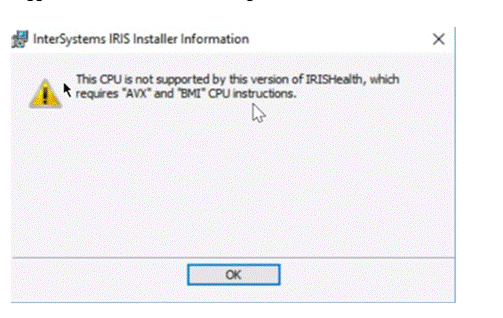
I’m looking for an API or command to determine if the supported CPU version exists on a Windows system.
Before installing IRIS, I would like to confirm whether the system/server has the supported CPU version. Do we have any API or command to check the details before starting the installation of IRIS 2024.1?