Now you need to create a Namespace that uses your RPMS database for routines and globals.
Refer to the doc link I sent earlier on Creating Namespaces.
- Log in to post comments
Now you need to create a Namespace that uses your RPMS database for routines and globals.
Refer to the doc link I sent earlier on Creating Namespaces.
Did you add a new local Database under Local Databases?
Ignacio-
You can find instructions on adding databases and creating namespaces in the online documentation. Please review the sections Configuring Data and Configuring Namespaces in the docs at the link below.
https://docs.intersystems.com/iris20193/csp/docbook/Doc.View.cls?KEY=GSA_config
No. You should place your FOIA CACHE.DAT into it's its own directory and then in the system management portal create a local database and namespace. When creating the database you will identify the directory where you placed your IRIS.DAT file.
Hi Ignacio
I think your next step is to get your CACHE.DAT that contains RPMS up and running on IRIS.
1. Copy your (dismounted) CACHE.DAT file to the cloud server
2. Rename the file to IRIS.DAT
3. Create a Database/Namespace in IRIS that uses this database file.
(dont forget to add all of the appropriate RPMS global and routine mappings)
Once you get to this point everything else is application related and the best source for information about that would be the Indian Health Service themselves.
further, the url you are using indicates that you are connecting thru the internal web server installed when you installed the instance which is intended for SMP access only and development. You should switch to a production quality web server for SSL support
Hi David
SSL for a web service hosted by ISC back-end is handled through the web server. You need to configure the web server to handle the SSL.
This procedure involves generating a certificate and setting up the ssl connection inside the web server software. That process varies based on the web server you are running.
I would do something like this.
if pVersion?1"v"1n.n {
// Parameter is well formed vnnn
} else {
// Parameter is not well formed
}
Oh, it must assume that you wouldn't need it for classes. :(

Interesting, what platform (win/linux, etc)
What version are you running?
Definately would always recommend full commands. I remember the day when we had to write code this way however it isn't the case anymore.
That said, it's good to be able to read code like this because it still exists out there.
This is referring to mapping between SDA and Health Insight cubes.
Please PM me so we can discuss your need further. I am one of the Sales Engineers working with the VA.
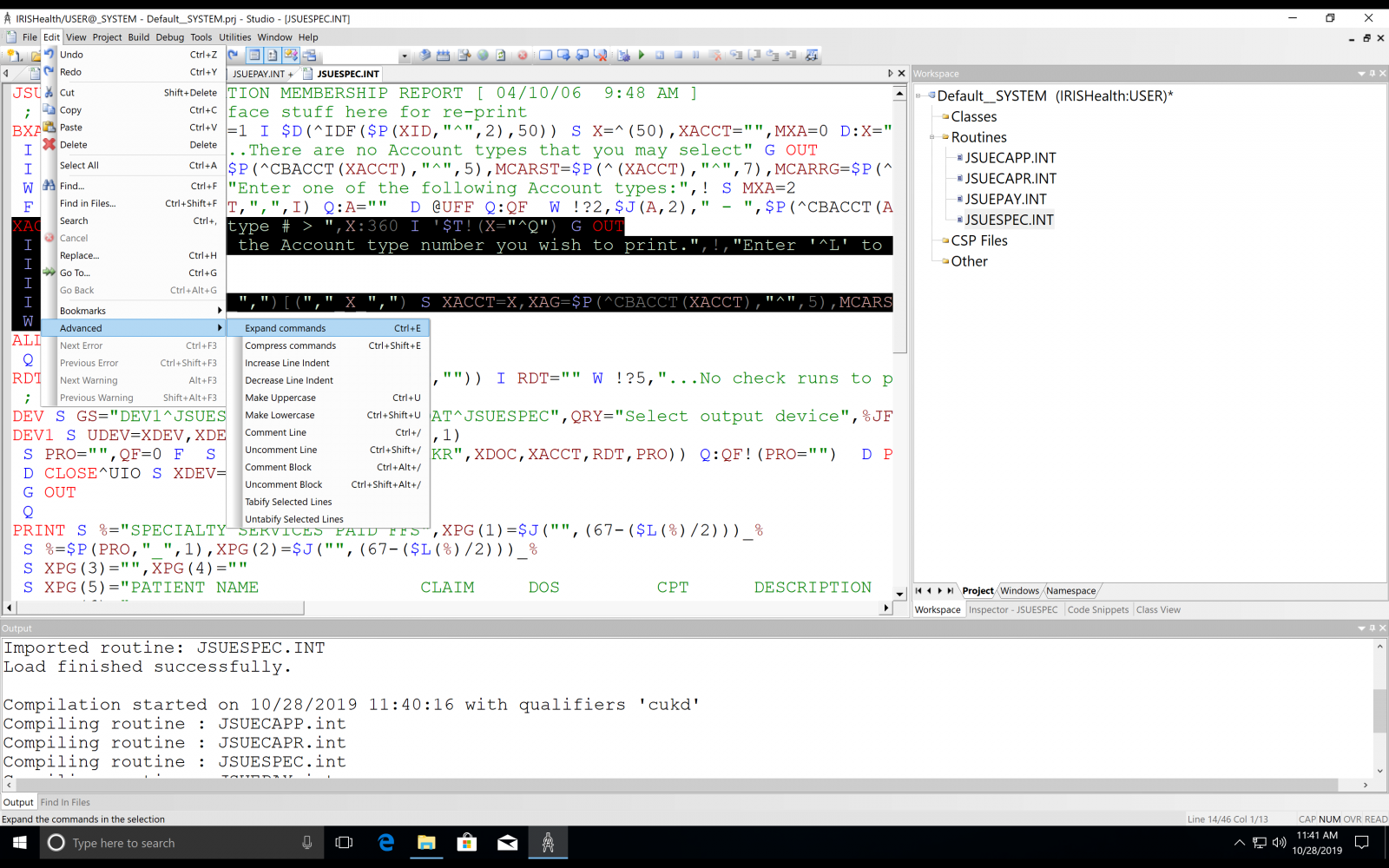
Simply select the code to convert and then select Edit -> Advanced -
And then either Expand or Compress Commands.
I think full commands are much easier to read for those that might be coming into your organization and will be taking over development of your projects in the future.
It's pretty easy to convert from one to the other using the Expand and Compress commands option in Studio.
For those that might be visually impaired, it would be a lot easier to dictate expanded commands than abbreviated versions.
Just my 2 cents
Hi Richard-
I'm assuming you are working for or with VA as the build you mention is a specific build provided to the VA. I don't believe that the FHIR annotations were released until version 2018.x of HealthShare.
If you can reach out to the VA sales engineers via email we'd be happy to get you a copy.
If you are running IRIS for Health
From the management portal, assuming you have a Foundation namespace created you can click Health -> <select foundation namespace> -> Schema Documentation -> FHIR Annotations
If you do not have a foundation namespace created, click
Health -> Install Wizard -> Configure Foundation
Enter the name for the Namespace, click Save and then click Activate
Once you have created a Foundation namespace you should be able to access the FHIR Annotations as mentioned above.
The same holds true for Health Connect instances as well, I believe.
ODS namespaces are applicable to HealthShare Unified Care Record instances and sounds like it's not applicable to your situation.
Neerav-
I'm not sure that you can. From within a production you can call from one host to another, e.g. bs->bp, bs->bo, bp->bp, bp->bo, bo->bp, bo->bo, etc.
From outside the production you cant really call a bp or a bo directly.
Why do you not want to setup a bs that can route your call to whatever bp or bo you want?
From a business host you would use the ..SendRequestSync or ..SendRequestAsync method call.
From outside of a business host you could create a business service that took a target configname and a request message as input and use the CreateBusinessService method in End.Director to iinstanciate and call it
Stephen
With regard to the name, it's just that, a name. It doesn't have any effect on what the production can and cant be used for.
You can use the foundation production as a router if you want, the difference is that in that scenerio you would be adding all of the components that you needed to the production manually. Configuring a routing production should give you the basic components needed, e.g., a service for input, a router for applying rules based routing and then an operation. It provides the basic building blocks needed to route messages.
A generic interoperability production can route messages as well.
A foundation production is a production that is created using the Install Wizard and when created will include some useful business hosts for integrations
Stephen
An Interoperability production is a general integration production, vs a routing production is one that automatically includes some basic business hosts needed for routing messages.
Typically you would use a routing production if you wanted to route HL7 messages, for example.
An Interoperability production is a blank slate allowing you to add whatever business hosts you need.
There is no real difference in capabilities other than what is automatically created as part of the production configuration when it is first created
I would think that would depend on a few things.
1. What is the size of files being sent?
2. How much bandwidth is available to handle multiple concurrent transfers
3. How many connections can the remote ftp server handle?
Hi
This can happen when you are doing class based CSP coding and forget to add the #(..HyperEventHead())# call to the header of your document
What does your full URL Map look like?
I would recommend getting your journal drive fixed, taking a full backup of your databases and then start journaling from there.
Whether or not you need the journals depends on how you might be using them
Obviously they are used to recover your databases since the last backup .
They are also used for shadowing and mirroring
What kind of error do you get when you try from a browser.
From a browser URL the method is Get. Is your service Method a Get?
Could also be licensing.
You could throw them out into a file and then use an external diff tool.
Jenna