Great article, Henry! I have a question: will it work with IRIS? E.g. with IRIS Community Edition?
- Log in to post comments
Great article, Henry! I have a question: will it work with IRIS? E.g. with IRIS Community Edition?
Happy to hear that! Let me know if that worked for you)
Hi Stella!
This is complicated cause the base class of a cube should contain the most granular records for the subject area being analyzed. Speaking with family terms children can analyze their dads in a cube but not vice versa. That means want to analyze Kids - build the cube for Kids.
There is one trick though which lets you analyze Kids from Dads assuming if your Dad is not very fruitful ;) I mean this will work if your Dad has less then 1,000 kids)
You can build the Kids dimension with a level which consists of a comma-separated list of Kids IDs or kids data - use ObjectScript expressions for this. And mark this dimension as comma-separated in Dimension settings.
If the ObjectScript expression is long, use %cube.Method to call the method of the cube where you can code the complex logic.
Then you are able to show in levels and properties in this dimension whatever data you want to calculate and aggregate from kids using ObjectScript expressions.
HTH
Hi Vincent!
One of the working examples of DeepSee Dashboard filters promoted via URL you can check here in Developer Community.
If you open your member's page you may click on View Analytics link and open the DeepSee Dashboard with filter parameters in URL, which shows this year postings filtered by Vincent Levesque.
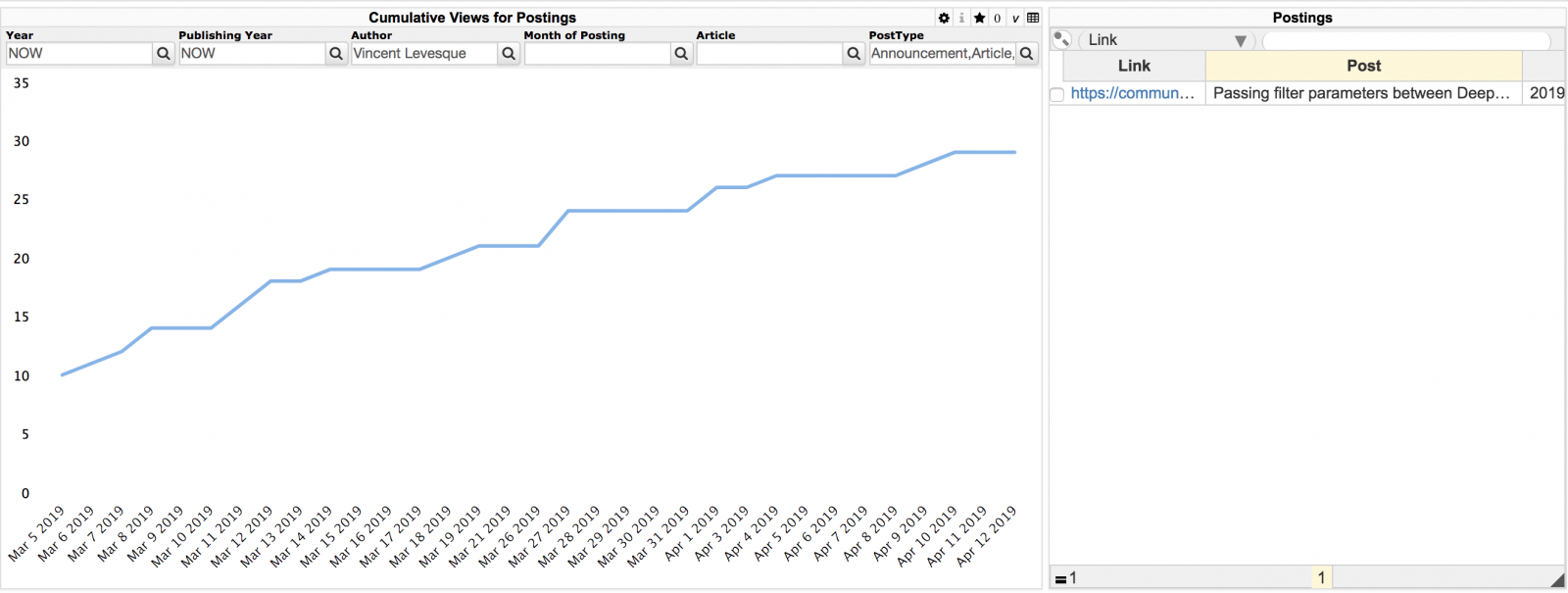
And you may check how this works and even install on your laptop using this repo.
Is it possible to introduce .vscode settings into the repo?
E.g. I want to checkout the repo, docker build, docker run, and then having VSCode connected to server, port and namespace, which are set in a dockerfile and docker-compose.yml?
And forgot to add, that to open IRIS terminal just call the following:
user$ docker-compose exec iris iris session iris
Would be great to see the paremeters of VSCOde current connection - what is the server, port, namespace.
Now I see only this:

and would be great to know, what is the namespace
Great news, Eduard!
I wonder - if Python Gateway works with IRIS Community Edition?
Thanks, John!
Your feedback is filed here.
Confirming that!

Really great news, Joe!
Is it only for the Management Portal? Or will influence any Zen apps too? e.g. DeepSee/IRIS Analytics UI?
I think it's better to show this famous window with the alert for better understanding. Do you have one? )
Hi Flavio!
Hope you are talking about Visual Studio Code, not Visual Studio.
There are at least two active approaches on coding and compiling ObjectScript from VSCode:
Also, check my video on how to compile from VSCOde
HTH
Anyway, was a good "1st april joke" approach ;) I like! Thanks, @Timur Safin !
BTW, where do you maintain local variables for each closure?
They have a separate memory page somehow, right? E.g. here we have separate pages for cnt1 and cnt2
Bravo, @Timur Safin !
And what about the performance? ;) Are closures just a "MIT student must" syntax sugar, or it gives you some boost in execution too? ;)
Nice post, Pravin. In bookmarks!
+1 to Alexander.
And I propose the new Warning rule for this:
Check for if SQLCODE after every &SQL() before the next &SQL() or before the end of the method.
Hi Oliver!
Could you please mark your answer as accepted? Thanks!
Thanks for sharing it, Lily! And now it's available on Open Exchange too.
Jeff, thank you for the great news!
When could we expect IRIS 2019 Release Community Edition available on cloud marketplaces?
Goran, please mark your answer as accepted - to let the question to be visible as closed and not appear in the "No accepted answer" filter. Thank you!
Thank you, Luca! Besides agility, I like the saving of the developer's time on environment setup. Docker IMHO is the fastest way for a developer to start compiling the code. And what's even better - it's a standard way from project-to-project:
docker-compose build   #(when needed)

docker-compose up -d  #(always)
If we talking about some InterSystems Community-wide coding guidelines my vote is for the second variant cause it's more readable.
Aha. You use Cache Studio Evaluation for development. Still have a question: why your employer doesn't give you the full version on Ubuntu which could be downloaded from WRC?
On the other hand, you don't need a cloud to develop on IRIS Community Edition. Check @Dmitry Maslennikov recent article. He develops locally on IRIS CE in docker using VSCode.
Hi Cole!
I don't have the answer on your question but why would you need Caché Free Evaluation on Ubuntu when you have the IRIS Community Edtion available on any of AWS, Google or Azure as a container?
I mean if you wanna try Caché today I'd recommend trying IRIS on public clouds or on InterSystems Labs and Quick Starts.
Hi Permo!
Could you please provide more details?