Article
· Dec 11, 2025 8m read
Supply Chain Orchestration for dummies

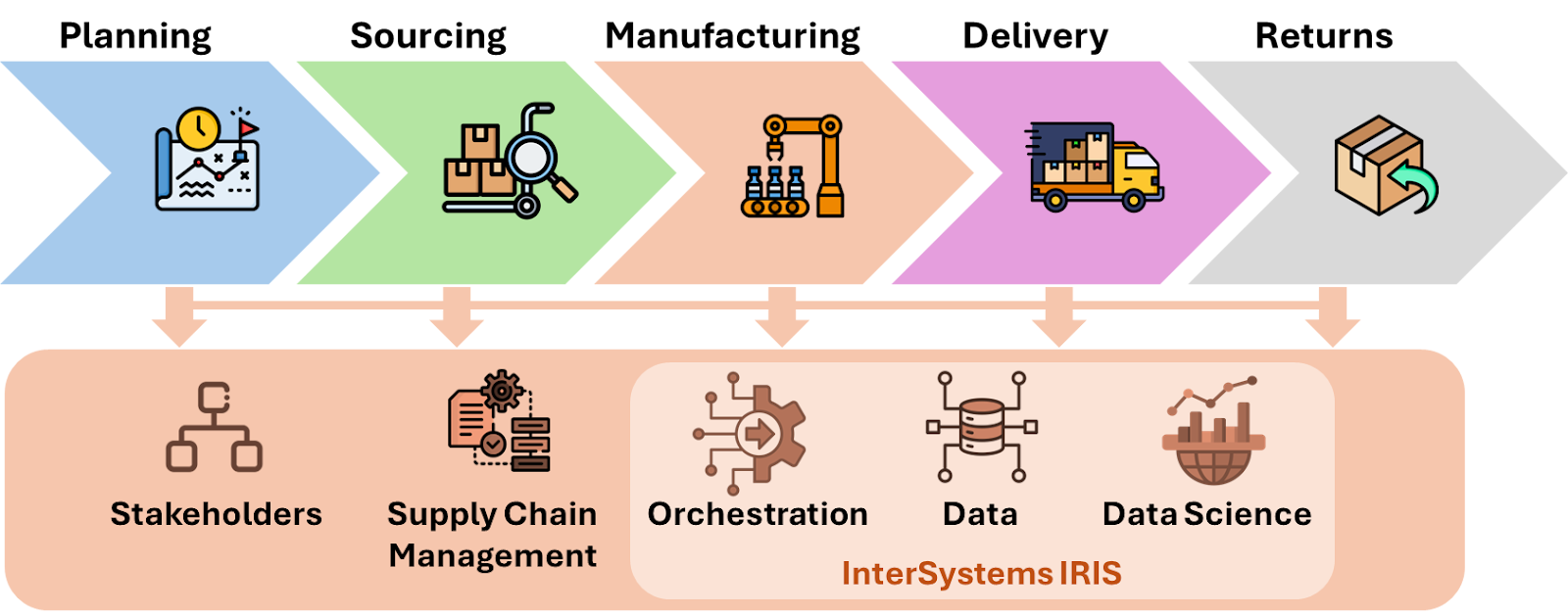
Supply Chain refers to a set of processes and activities performed by the company's business areas and its suppliers and partners (stakeholders), from the acquisition of raw materials, through production, to delivery to the end consumer. It can be better managed using SCM solutions with the orchestration of the InterSystems IRIS:

7 0
5 140

Modern data architectures utilize real-time data capture, transformation, movement, and loading solutions to build data lakes, analytical warehouses, and big data repositories. It enables the analysis of data from various sources without impacting the operations that use them. To achieve this, establishing a continuous, scalable, elastic, and robust data flow is essential. The most prevalent method for that is through the CDC (Change Data Capture) technique. CDC monitors for small data set production, automatically captures this data, and delivers it to one or more recipients, including analytical data repositories. The major benefit is the elimination of the D+1 delay in analysis, as data is detected at the source as soon as it is produced, and later is replicated to the destination.

This article will demonstrate the two most common data sources for CDC scenarios, both as a source and a destination. For the data source (origin), we will explore the CDC in SQL databases and CSV files. For the data destination, we will use a columnar database (a typical high-performance analytical database scenario) and a Kafka topic (a standard approach for streaming data to the cloud and/or to multiple real-time data consumers).

Overview

This article will provide a sample for the following interoperability scenario:

10 0
4 183

Hi everyone, on HealthShare Unified Care Record 2024.1.0 Build, we're using the Analytics section to create a dashboard containing a time chart showing a cumulative curve of the number of documents indexed in the registry for each documentSource of each repository. We tried the following steps: we created a cube whose dimensions are the CreationDate, SourceValue, and repositoryUniqueID of the HS_Registry.Document table; in the Analytics section, we created a pivot table that lists the document creation date on each row, along with as many columns as each repository's documentSources.

1 4
0 78
3 2
0 123
Article
· Sep 22, 2025 2m read
Dashboard of database free space

Finishing my previous example for multiple IRIS instances, I tried
to compose a local single instance version. The step from the external
Python app to a version using embedded Python seemed to be obvious.
This was a wrong assumption, as some Python libraries just refused installation
into my local Windows-based environment.

2 3
2 81
Announcement
· Sep 18, 2025
InterSystems IRIS BI Tips & Tricks!

Ready to elevate your Business Intelligence game?

We've got an engaging video, perfect for all skill levels.

Discover how to get started with IRIS BI, optimize cube performance, and drive analytics adoption. Plus, get a sneak peek at what's next!

https://www.youtube.com/embed/Ekjzny8zj98
[This is an embedded link, but you cannot view embedded content directly on the site because you have declined the cookies necessary to access it. To view embedded content, you would need to accept all cookies in your Cookies Settings]

6 3
0 130

Hello my friends,

I have a problem with Objectscript, why the value of address become like this ?

everything works fine except the Address,

this is my code, do I need something to make this into real address ? should I put something in my code ?

set paper=obj.PAADMPAPMIDR.PAPMIPAPERDR

if '$isobject(paper) continue

set Address=paper.PAPERStName

thank you for your help

Best Regards,

0 3
0 106