Working with $ZF function
Good morning,
I'm trying to understand $ZF function, but only documentation isn't enought in this way. So my question is is there any possibility to get enviroment variable by this function into ensemble?
I've tried this as example from ducumentation, but there is an error and I don't know why...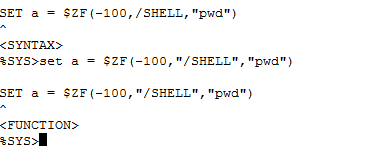
Thanks for your solutions.
Zdenek
Comments
Your sample works for me:
USER>s rc = $zf(-100,"/SHELL","pwd")
/cachesys/mgr/user

USER>w $zv
Cache for UNIX (Ubuntu Server LTS for x86-64) 2017.2.2 (Build 865U) Mon Jun 25 2018 10:48:26 EDT
What Caché version are you using? $zf(-100) was added in 2017.2.1 (Build 801_3). For older versions use $zf(-1 or -2), while upgrade to latest Caché (or even IRIS?) release would probably be the better choice.
I've got this version so it should be allright

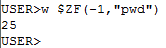
If i thy $ZF(-1) it's better but still not best.
I know about GetEnviron() but it's not working, let's see...
.png)
It set's me empty string into variable in Cache and I don't know how to fix it. I've got export variable in bash script, but this method doesn't see that. If I use system varieble in windows it's working fine, but I need to use only user/enviroment variables... That's why I'm trying to use $ZF function.. but it doesn't work to..
Ok thanks, but "problem" with function $ZF I've fixed, but as I mentioned higer my biggest problem now is with enviroment variables and their usage in menifest.
But thanks so much for your time.
After cheching my großbuch I found that I was wrong with starting version: $zf(-100) is available since 2017.2.1 (Build 801_3), while your build hasn't got this "_3" suffix.
Zdeněk,
I'm just curious: are you intentionally testing $zf() stuff on command (`pwd`) that doesn't exist in your particular OS?
Sorry, didn't mentioned your *new* quesion about environment variables.
It's ok but do you have any idea just a little?
I'm confused a bit. Do you keep asking on this issue? If not, please describe your situation in details.
More or less yes.. It's still problem for me..
Yes ok I understand, now I can succesfuly execute script.sh by $ZF(-1) but still I don't know if it's wothit for me, how can I get my variables from script into Cache?
Yes ok, this working me too that's not problem, but... I want to set variable in, like in your example, but then I want to run script by this comand
./csession Cache -U "%SYS" <".....\run.script"
But when I started this script it hasn't access to setted variable from cmd. But if I saw your example it gives me some idea, which I need to try.
Seems to work. Please provide small standalone example, so that we can reproduce
C:\InterSystems\ENSEMBLE2017x2x2\bin>set AA=22

C:\InterSystems\ENSEMBLE2017x2x2\bin>echo %AA%
22

C:\InterSystems\ENSEMBLE2017x2x2\bin>cache -s ..\mgr

Узел: ru-akoblovW10VM, Экземпляр: ENSEMBLE2017X2X2

USER>w $system.Util.GetEnviron("AA")
22
To get environment variable you can use $System.Util.GetEnviron().
And to get current folder -- $system.Process.CurrentDirectory().
Your problem is that "pwd" is not a valid command in WINDOWS !!!
use instead "echo ^%cd^%"
ref: https://stackoverflow.com/questions/921741/windows-equivalent-to-unix-pwd
this works:
USER>s a=$zf(-100,"/SHELL","echo %cd%")
d:\database\www17\userif you can't use the required version of $ZF(-100.....)
you still may try CPIPE as described here
Execute Server Commands from Caché / Ensemble / IRIS
Zdenek, following up with our offline conversation, I made small change to my installer manifest, so PerformUpgrade() method contains something like this:
s ^dk="Upgrade to version "_..#VERSION_" performed OK"
s ^dk("aux")=pAux
s ^dk("MYVAR")=$System.Util.GetEnviron("MYVAR")
// a nyni muzeme volat kod v manifestu, a nebo taky ne a vse muzeme provest rovnou v teto metode
set pVars("IsUpgrade")=1
set pVars("AppVersion")=..#VERSION
set tSC=..setup(.pVars,3)
return tSC
my simple installer script (CentOS7) - that I sent you offline - needs no changes, but before I call it, I do this:
[root@localhost install-scripts]# export MYVAR="kutac"
[root@localhost install-scripts]# echo $MYVAR
kutac
[root@localhost install-scripts]# ./silent-setup.sh 1
about to run only upgrade
then, looking at %SYS namespace what comes into ^dk global:
[root@localhost ~]# csession ens1
Node: localhost.localdomain, Instance: ENS1
Username: root
Password: ********
USER>zn "%sys"
%SYS>zw ^dk
^dk="Upgrade to version 1.2 performed OK"
^dk("MYVAR")="kutac"
^dk("aux")="toto je test"
%SYS>
--- as you can see, it works just fine. perhaps your problems are due to security / permissions rather then anything else.
feel free to contact me directly.
Dan