Hello!!!

Data migration often sounds like a simple "move data from A to B task" until you actually do it. In reality, it is a complex process that blends planning, validation, testing, and technical precision.

Over several projects where I handled data migration into a HIS which runs on IRIS (TrakCare), I realized that success comes from a mix of discipline and automation.

Here are a few points which I want to highlight.

1. Start with a Defined Data Format.

Before you even open your first file, make sure everyone, especially data providers, clearly understands the exact data format you expect. Defining templates early avoids unnecessary bank-and-forth and rework later.

While Excel or CSV formats are common, I personally feel using a tab-delimited text file (.txt) for data upload is best. It's lightweight, consistent, and avoids issues with commas inside text fields.

PatID   DOB Gender  AdmDate
10001   2000-01-02  M   2025-10-01
10002   1998-01-05  F   2025-10-05
10005   1980-08-23  M   2025-10-15

Make sure that the date formats given in the file is correct and constant throughout the file because all these files are usually converted from an Excel file and an Basic excel user might make mistakes while giving you the date formats wrong. Wrong date formats can irritate you while converting into horolog.

4 12
2 220

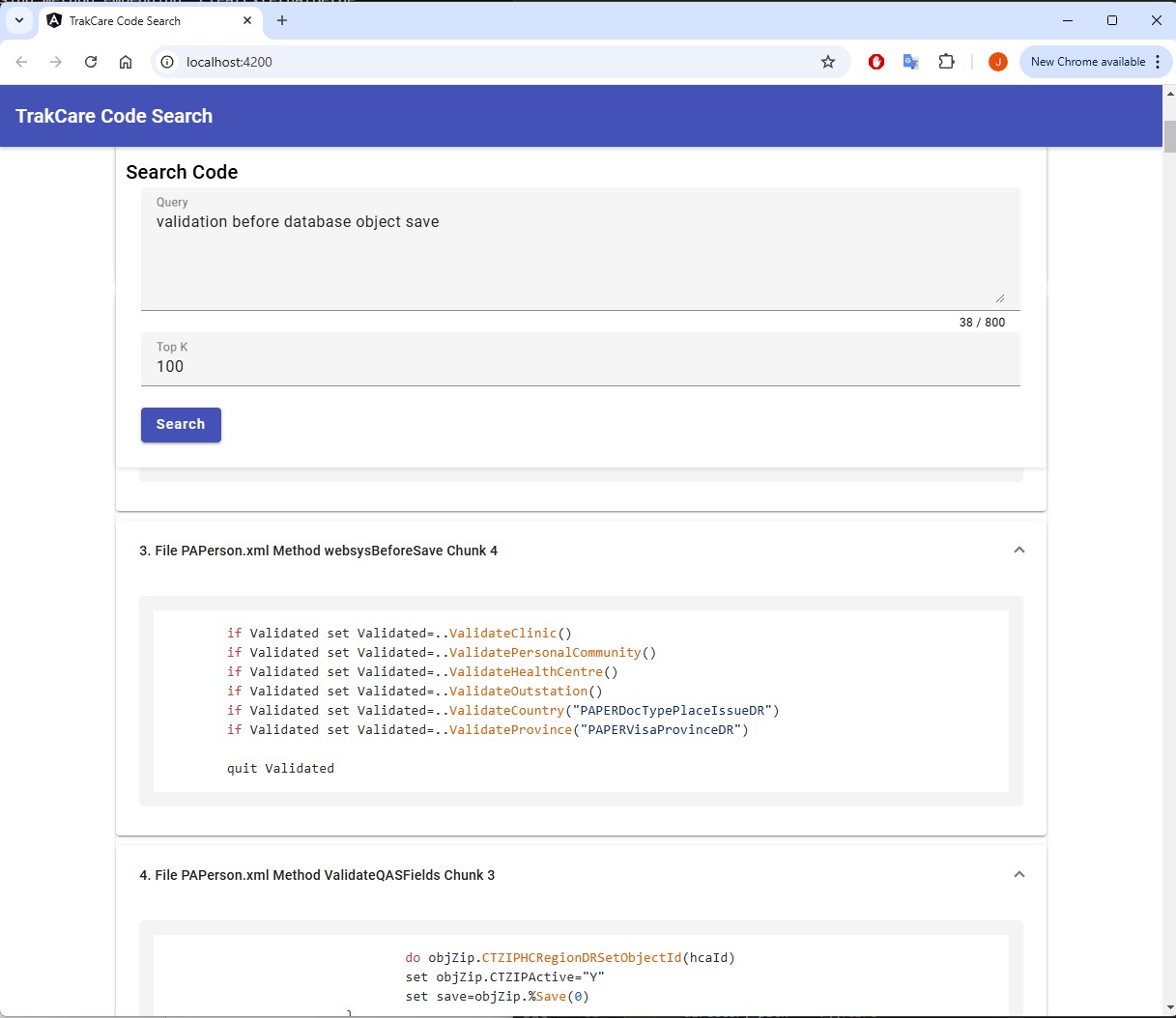
This article presents a potential solution for semantic code search in TrakCare using IRIS Vector Search.

Here's a brief overview of results from the TrakCare Semantic code search for the query: "Validation before database object save".

  • Code Embedding model

There are numerous embedding models designed for sentences and paragraphs, but they are not ideal for code specific embeddings.

6 0
1 303

I am regularly contacted by customers about memory sizing when they get alerts that free memory is below a threshold, or they observe that free memory has dropped suddenly. Is there a problem? Will their application stop working because it has run out of memory for running system and application processes? Nearly always, the answer is no, there is nothing to worry about. But that simple answer is usually not enough. What's going on?

13 2
7 252

While starting with Intersystems IRIS or Cache, developers often encounter three core concepts: Dynamic Objects, Globals & Relational Table. Each has its role in building scalable and maintainable solutions. In this article, we'll walk through practical code examples, highlight best practices, and show how these concepts tie together.

1. Working with Dynamic Objects:

2 2
4 192

Working in healthcare IT as a young developer, especially on InterSystems TrakCare, you quickly realize one thing: it’s not just about HL7 messages or backend integrations. A huge part of making TrakCare work smoothly for hospitals comes down to how it’s configured, customized, and supported on the application side.

3 1
2 128

What is a FHIR Profile?

A FHIR profile is a collection of rules and constraints used to customize and refine a base Fast Healthcare Interoperability Resources (FHIR) resource. Profiling is a vital process that adapts the base FHIR resource standard to satisfy the unique requirements of a specific use case, geographic region, medical institution, or clinical workflow.

While the base FHIR specification provides generic, flexible definitions for resources (such as Patient, Observation, or Medication), profiles transform these generic resources into more precise ones. This ensures consistent and interoperable data exchange tailored for a particular community or implementation.

FHIR is designed to cover various healthcare scenarios globally. Profiles allow implementers to adapt this general platform without losing the benefits of standardization.

2 2
1 97

Hola amigo! 😊 Cómo estás hoy,

I would like to share a small part of my learnings from my first ever official project: POS/EDC machine integration with our billing system. This was an exciting challenge where I got hands-on experience working with APIs and vendors.

How does a Payment Machine actually work?

It's simple, start by initiating/creating a transaction, then retrieve its payment status.

Here, initiate/create refers to POST method and Retrieve refers to GET.

1 0
2 115

Embeddedpy-bridge: A Toolkit for Embedded Python

Overview

Embedded Python is a game-changer for InterSystems IRIS, offering access to the vast Python ecosystem directly within the database. However, bridging the gap between ObjectScript and Python can sometimes feel like translating between two different worlds.

2 1
2 87

FastJsonSchema: High-Performance JSON Validation in IRIS

Validating JSON data against JSON Schema is a common requirement for modern applications. FastJsonSchema brings this capability natively to InterSystems IRIS, combining speed, simplicity, and full schema compliance.

Unlike traditional validation approaches, FastJsonSchema generates native ObjectScript code from your JSON Schemas and compiles it directly to iris object code, enabling idiomatic performance without relying on external libraries or runtimes.

1 1
0 78