#Failover

4 Followers · 17 Posts

High Availability Failover is the ability for client connections to migrate from one server to another in the event of server failure so client applications can continue to operate.

See more on Failover strategies.

Article Bob Binstock · Sep 6, 2016 19m read

Mirroring 101

Caché mirroring is a reliable, inexpensive, and easy to implement high availability and disaster recovery solution for Caché and Ensemble-based applications. Mirroring provides automatic failover under a broad range of planned and unplanned outage scenarios, with application recovery time typically limited to seconds. Logical data replication eliminates storage as a single point of failure and a source of data corruption. Upgrades can be executed with little or no downtime.

22
3 7957
Article Anton Umnikov · Jan 21, 2021 26m read

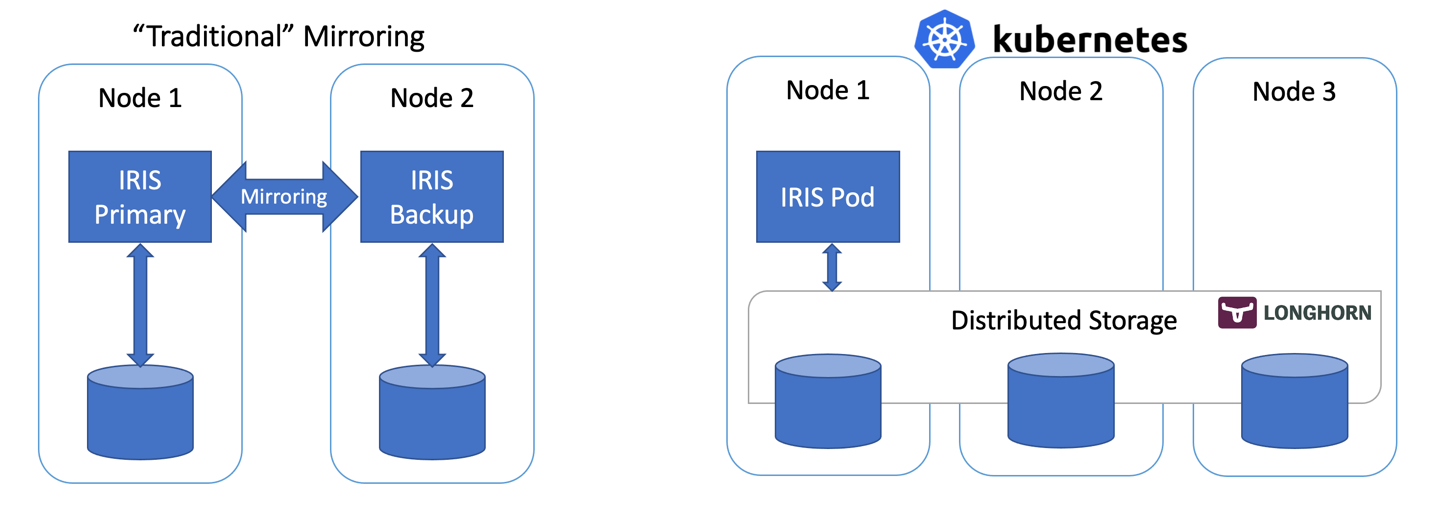
In this article, we’ll build a highly available IRIS configuration using Kubernetes Deployments with distributed persistent storage instead of the “traditional” IRIS mirror pair. This deployment would be able to tolerate infrastructure-related failures, such as node, storage and Availability Zone failures. The described approach greatly reduces the complexity of the deployment at the expense of slightly extended RTO.

16
8 4088
Article Oliver Wilms · Aug 4, 2021 3m read

I have been working on redesigning a Health Connect production which runs on a mirrored instance of Healthshare 2019. We were told to take advantage of containers. We got to work on IRIS 2020.1 and split the database part from the Interoperability part. We had the IRIS mirror running on EC2 instances and used containers to run IRIS interoperability application. Eventually we decided to run the data tier in containers as well. Later we switched from using EC2 instances to Fargate “server-less” compute.

14
2 1044
Article Mark Bolinsky · Mar 18, 2016 9m read

++ Update: August 1, 2018

The use of the InterSystems Virtual IP (VIP) address built-in to Caché database mirroring has certain limitations. In particular, it can only be used when mirror members reside the same network subnet. When multiple data centers are used, network subnets are not often “stretched” beyond the physical data center due to added network complexity (more detailed discussion here). For similar reasons, Virtual IP is often not usable when the database is hosted in the cloud.

Network traffic management appliances such as load balancers (physical or virtual) can be used to achieve the same level of transparency, presenting a single address to the client applications or devices. The network traffic manager automatically redirects clients to the current mirror primary’s real IP address. The automation is intended to meet the needs of both HA failover and DR promotion following a disaster. 

12
6 7069
Article Ariel Glikman · Jan 13, 2025 3m read

You may have noticed that to configure a mirror for InterSystems IRIS for Health and HealthShare® Health Connect there is a special requirement. I wanted to go through it step by step in this article.

This assumes you have already configured the second failover member and confirmed a successful failover member status in the mirror monitor:

Step 1: Enable HS_Services user (on backup and primary

Step 2: Switch to Namespace HSSYS and go to Interoperability > Configure > Credentials.

5
6 634
Article Bob Binstock · Sep 7, 2016 6m read

Mirror Outage Procedures

Caché mirroring is a reliable, inexpensive and easy to implement high availability and disaster recovery solution for Caché and Ensemble-based applications. This article provides an overview of recommended procedures for dealing with a variety of planned and unplanned mirror outage scenarios. (For detailed information about mirroring and a wide range of mirror-related procedures, see Mirroring 101.)

A Caché mirror typically consists of two Caché instances on physically independent hosts, called failover members

0
1 1254
Article Oliver Wilms · Aug 22, 2021 2m read

I have described my efforts to optimize IRIS Mirror deployment in AWS ElasticContainer Service (ECS) in my prior article.

IRIS Mirror in the cloud (AWS) | InterSystems Developer Community | AWS
 

I have come to the opinion that IRIS Mirror is not as reliable as needed when deployed in ECS. The root of the problem is the fact that ECS randomly assigns one of the available IP addresses to each EC2 host or Fargate task it starts.

These get stored in iris.cpf file in MapMirrors section as shown here:

[MapMirrors.IRISMIRROR]

FAILOVER1=10.2ab.1cd.146,2188,,10.2ab.1cd.

0
0 492