#Encryption

5 Followers · 58 Posts

In cryptography, encryption is the process of encoding a message or information in such a way that only authorized parties can access it and those who are not authorized cannot.

Question sjbttt sjbttt · Apr 8, 2020

Now I want to return a large amount of data to the front end. The string length has reached 40000 +, and the returned data needs to be encrypted by AES + Base64. I can convert the string into a stream. AES can use the AESCBCEncryptStream method to encrypt, but Base64 has no stream method。Anyone who get the solution  would you kindly share the solution please。

Any help would be appreciated. Thanks!

10
0 15269
Question Laura Cavanaugh · Nov 3, 2017

Hello; We are managing several Ensemble instances on several servers.  One server has 4 instances, and two other servers have one instance each (those are production servers).  We encrypt all instances using the Caché encryption in the management portal.

Currently we are using two different encryption keys: 1 key on the server with 4 instances, which is used for all 4 instances, and a second key on single-instance server. ( I'm installing the newest production server now.)

What I'd like to know is what are the best practices for managing encryption keys for separate servers.

1
0 788
Question Jim Lyons · Oct 16, 2024

Working on a project where I'm needing to make FHIR calls from my HealthConnect Interop production to Epic. 

My issue is I'm not able to construct a valid JWT for the OAuth token retrieval that Epic will accept. I have the below code where I'm able to create a valid header and payload that I'm base64URL encoding and then trying to sign with my .pem private key file. However, Epic is not liking the signature portion of my JWT.

As such, I wanted to present my code to see if I'm performing the signature steps correctly? I've seen some posts where the %Net.

1
0 247
Question Nael Nasereldeen · Oct 27, 2019

Hi,

We wanted to use the MD5Hash function,

And had trouble understanding it's return value , as documented:

"Return value: 16-byte MD5 hash."

The value we wanted should have been a simple string, and we did not know how to convert the output to string.

Searching for a solution we found this article:

https://groups.google.com/forum/#!msg/intersystems-public-cache/FdkHIgS9PkQ/P7s-92kN70UJ

That had this solution that works:

"If you know what this gibberish stuff is about, it can be very simple ;)

USER> s h = ##class(%SYSTEM.Encryption).MD5Hash("f.

8
0 1724
Question David Marinkovic · May 16, 2024

Hi guys,

I try to make a test of encryption, decryption of a simple text.

I can crypt my text, but I can't decrypt it, do you see somewhere a dummy error of my part ?

Thanks for help

ClassMethod UnitTest()

{

  set inputPlainText = "David"

  // get private key

  set privKeyFileName = "C:\temp\toto.pem"

  set privobjCharFile = ##class(%Stream.FileCharacter).%New()

  set privobjCharFile.Filename = privKeyFileName

  set privKey = privobjCharFile.Read()

  set Inputbase64 = $SYSTEM.Encryption.Base64Encode(inputPlainText)

  // encrypte text using RSA

  set encryptText = $System.Encryption.

2
1 314
Question Stefan Cronje · Jul 17, 2017

Hi,

I have a situation where I write a character stream to a file. The file content gets signed and the signature is sent to a service provider together with the file content.

The signing is done using openssl.

This works perfectly on a dev PC, which is runnning Windows and has a little-endian architecture.

The problem is as soon as I do this on the server, which has a big-endian architecture, the signed value is incorrect according to the service provider.

The content is signed using RSA SHA256 with PSS padding.

I've had a look at $nconvert, $sconvert, etc., but can't get to a solution.

8
0 3504
Question Dale Gravatt · Jul 15, 2021

Can the built-in $System.Encryption.TOTP() function be used in conjunction with Authenticator Apps (e.g. Google, Microsoft, and so on)?

Providing the same secret/key to a variety of authentication apps, they all return the same synchronized value. However, passing the same secret/key to $System.Encryption.TOTP() is generating a different value (with all instances executing at the same time for comparison).

All of the reference material I have found so far mentions RFC4226 or RFC6238 or both, including the Intersystems documentation.

1
0 342
Question Laura Blázquez García · Feb 18, 2020

Hello.

We have to call a service, and we have to encrypt the request using a public key. We have an example of how to make the call in PHP. Also we have the public key and all the parameters that we need. The example in PHP is this (it uses openssl):

$url = "https://XXXXX/";
$json = '{"api_key":"XXXXX", "id":"1"}';
$jsonEncrypt, = '';
$publicKey = file_get_contents("public.key");
openssl_get_publickey($publicKey);
openssl_public_encrypt($json,  $jsonEncrypt,  $publicKey);
$jsonEncrypt = base64_encode($jsonEncrypt);

We need to do the same in Ensemble.

7
0 916
Question David Marinkovic · May 21, 2024

Hi guys,

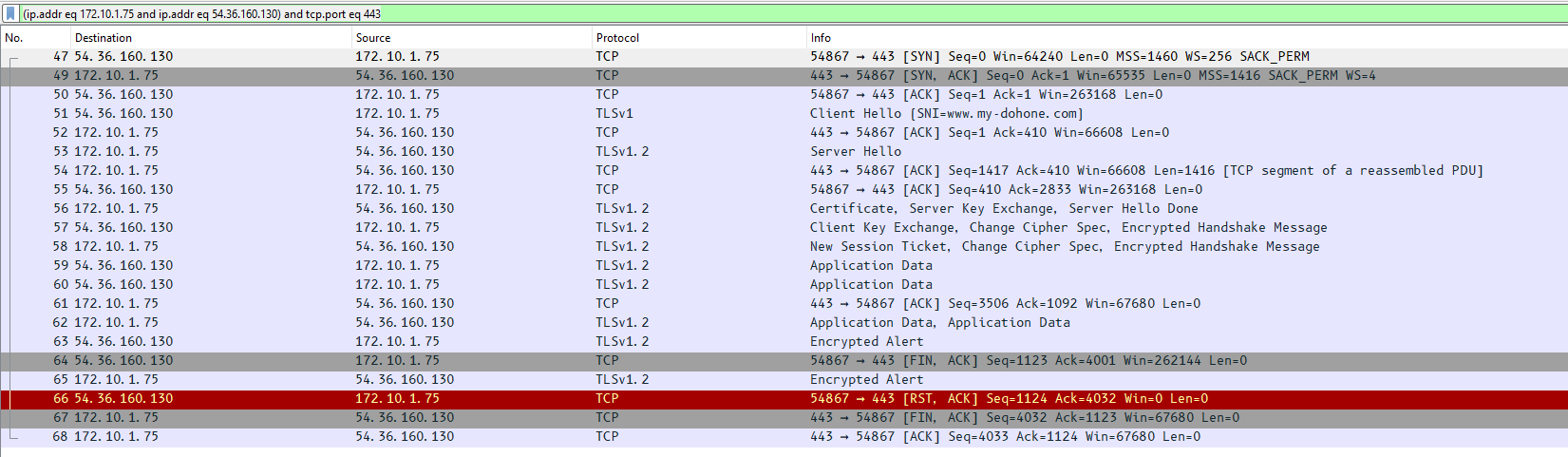
I need to check my HTTPS POST REQUEST, in order to do this I try to catch it by using wireshark.

I can't see anything because of the encryption.

I try unsuccefully to use the SSLKEYLOGFILE key (windows 11), but the generated file did not increase when I trigger my code OR postman, it grows only by the action of the web browser.

My question is so simple :

1°) How have a clear view of the HTTPS request from IRIS code in wireshark

2°) Why the keylog file did not increase when trigger the code from IRIS ?

2
0 541
Question William Vorhees · Aug 4, 2017

Trying to use AES encryption for a url.  I have a plain text string, a 16-byte key and a initialization vector.  I am trying to match a C# implementation that uses RijndaelManaged class with a  BlockSize = 128, Mode = CipherMode.CBC, Padding = PaddingMode.PKCS7.  The output of the $SYSTEM.Encryption.AESCBCEncrypt(text,key,IV), doesn't match what is coming out of C#.  All inputs into the $SYSTEM.Encryption.AESCBCEncrypt(text,key,IV) are converted to UTF8 as in the documentation.

5
0 1873
Question Norman W. Freeman · Oct 5, 2021

I would like to know if an encrypted caché database can run significantly slower than a normal "unencrypted" database, in a way that is noticeable to the end user (e.g. slower response time for most pages, especially the ones that rely on read/writing to globals).

I searched in Intersystems knowledge base and couldn't find anything related. I'm looking for possible before/after benchmarks.

3
0 427
Question Nicola Sartore · Dec 2, 2021

I need to store an equivalent of the SNN (Social Security number). I need it to be encrypted and I'll have to be able to search for it once stored.

For what I've seen my options are: 

- SHAHash from the %system.encryption library. Simple and easy to implement. My question is, might collisions be a problem? We are talking about a 10 millions entry.

- AES encryption. In this case I'd like to know if there is a standard way for key management in the InterSystems environment.

I can eventually get a certificate for this project to use other encryption function as well.

Open to suggestions.

2
0 415
Question Sébastien Demoustiez · Nov 10, 2017

Hello,

Sorry for my epic english :(

I have a strange issue.

I have generated an encryption key with the tool (UI.Portal.EncryptionCreate.zen).

Then  I activate my key for data encryption (UI.Portal.EncryptionManaged) and encryption work fine.

But when I reboot my server the key is removed from the data encryption key list (UI.Portal.EncryptionManaged) and I have to re-activate the key.

Perhaps somebody have an idee ?

Cache version : Cache for Windows (x86-64) 2016.2.2 (Build 853U)

Windows: Windows Server 2012 R2 Standard

Thanks

Sébastien

2
0 450
Question Joe Jung · Jan 26, 2022

Currently running Ensemble on Red Hat Enterprise Linux Server release 7.7

One of our clients is requesting files sent to their SFTP site be encrypted with their PGP public key and digitally signed with our PGP private key

We have created a custom class that includes the following command to encrypt the files

if (pAction = "Encrypt") {
// Find the Key ID from the Keyname
set tKeyId = ..GPGKeyLookup(pKeyName, ..#PUBLICKEYLUT)
set tCmdLine = "gpg --homedir "_pGPGhomedir_" --always-trust -r """_tKeyId_""" -o "_pOutFileName_" -e "_pInFileName
}
// Execute the command to generate the output file

2
0 642
Question Chris Stewart · Jan 5, 2017

I'm currently re-engineering an application from CSP pages directly accessing COS Methods, to an Angular/Material front end accessing a REST DAL.  Both the Angular front end and REST services are hosted from the same Caché instance and the same namespace, but the REST services have their own CSP application, with all calls being routed through a Dispatch class.  

I've come across an architecture issue recently, and am trying to assess the options I have.  At present, we encode a call to a class which takes in an OID and returns the Stream to the browser.

5
0 647
Question Colin Parker · May 26, 2020

I am using the Java Binding to connect a Java Middleware Application to Cache.  Originally I was using a CacheListOfDataTypes (JAVATYPE = "java.lang.List") object to bring data back.  I was tasked with encrypting the data using AES and I was using the AESCBCEncrypt function on the List elements (up to 20k characters for each element) to bring it back before concatenating it on the middleware.  This almost worked.  Like 95% of the characters were being decrypted correctly but some text was coming back garbled.  I couldn't understand how this was happening.

3
1 603
Question Oliver Wilms · Nov 19, 2024

I need to create a JWT to connect to EPIC FHIRserver sandbox.

https://fhir.epic.com/Documentation?docId=oauth2&section=BackendOAuth2G…

You will generate a one-time use JSON Web Token (JWT) to authenticate your app to the authorization server and obtain an access token that can be used to authenticate your app's web service calls. There are several libraries for creating JWTs. See jwt.io for some examples.

The header and payload are then base64 URL encoded, combined with a period separating them, and cryptographically signed using the private key to generate a signature.

5
0 324
Question sween · Sep 6, 2018

Hello,

Looking for some help on how I actually set the properties to enable tracing for %Net.SSH.Session ?

The doc is here:

https://docs.intersystems.com/latest/csp/documatic/%25CSP.Documatic.cls…

The values look bitwise in their defaultness and I cant seem to figure out how to enable it in my object (or if I am going about this wrong altogether).  I am troubleshooting an elusive ssh error: unable to exchange encryption keys in a catch at the moment.

Would appreciate a clue if anybody has experience with it... thank you.

-Ron

3
0 534
Question Jukka Pitkänen · Mar 21, 2022

Hi! I'm banging my head to the wall with HMAC authentication. I have tried to implement this various ways but nothing seems to work.

If someone could help on this it would be great!

Here is a code that I have tried and working Javascript example, tested on Postman. 

Set Appid = "itsasecretid"
Set Appkey = "itsasecretkey"

Set requestTimeStamp = $ZDATETIME($HOROLOG,-2)
Set nonce = ..getRandomString()
Set signatureRawdata = Appid_requestTimeStamp_nonce
    
Set keyUTF8 = $zconvert(Appkey,"O","UTF8")
Set signatureRawdataUTF8 = $zconvert(signatureRawdata,"O","UTF8")
    
Set tSigningKey = $SYSTEM.

4
0 938
Question William Proctor · May 2, 2019

Thanks for all replies in advance.  We have a security vulnerability that we have to get rid of.  We use Putty software to connect to cache as a terminal allowing several users to do maintenance work in cache.  this uses telnet Plain text.  I know that we can configure telnet to be encrypted using the super server service and I'm looking for software that can work like Putty as a terminal using encryption compatible with cache telnet encryption.

5
0 964
Question Stefan Cronje · Jul 10, 2017

Hi everyone,

I have a project which requires the sending of JSON messages to an external service provider using REST. The service provider requires the message contents to be signed.

Their instructions:

  1. Add a header called "Date" with the the date and time in a specific format - done
  2. Add the client's certificate password in a field in the header - done
  3. Create a string which consist of the {Date}{newline}{Password}{newline}{etc}{Message Body}.
8
0 14524