#Security

5 Followers · 344 Posts

Security in IT is the protection of computer systems from the theft and damage to their hardware, software or information, as well as from disruption or misdirection of the services they provide.

See the InterSystems Documentation on Security.

New
Discussion Ethan Calloway · May 20

 What logging and auditing strategies are commonly recommended for InterSystems IRIS environments?

I’m interested in learning about best practices for tracking user activity, troubleshooting issues, monitoring integrations, and maintaining compliance in enterprise or healthcare systems.

Are there built-in tools or external integrations that work especially well for this purpose?
1
0 32
New
Discussion Ethan Calloway · May 20

 I’m currently working with REST APIs in InterSystems IRIS and would like to better understand the recommended security practices for production environments.

I’m especially interested in:

  • Authentication and authorization methods
  • Token management strategies
  • Role-based access control
  • API gateway recommendations
  • Encryption and secure communication practices
  • Monitoring and logging for API activity

I would also appreciate learning about common mistakes to avoid when deploying APIs publicly or integrating with external systems.

What approaches or tools have worked best in your environments?

1
0 27
New
Job Victor Gordillo · May 14

Key Responsibilities & Requirements

Core Infrastructure & Cloud Management

  • Full-Stack Administration: Maintain and optimize both Linux (Ubuntu/RHEL) and Windows Server environments.
  • Cloud Orchestration: Take full ownership of VM cloud infrastructure, including provisioning, health monitoring, backup and resource scaling.
  • Policy Governance: Design and enforce comprehensive SysAdmin and Deployment policies (CI/CD pipelines, automated provisioning, and security hardening).

InterSystems Database Administration

  • Platform Expertise: Expert-level administration of both InterSystems IRIS and Caché.
0
0 45
New
Article José Pereira · May 10 15m read

Data privacy regulations such as GDPR, LGPD, and HIPAA demand that organizations know exactly where Personally Identifiable Information (PII) lives inside their databases. Yet in practice, most teams rely on manual inventories, tribal knowledge, or external scanning tools that require data to leave the database engine — a process that itself creates privacy and security risks.

This article presents an MVP that takes a different approach: it runs PII detection inside InterSystems IRIS using Embedded Python, analyzing data where it lives and never exporting it to an external process.

3
0 102
Question John Murray · May 4

As an experiment in agentic coding in ObjectScript I'm using VS Code to try and create an implementation of an SFTP server.

SFTP is built on top of SSH, so the first phase involves implementing an SSH server. While working on the KEX part of that the agent (using GPT-5.3-Codex) reported:

  1. IRIS has what we already need for signing and hashing: RSASHASign, RSASHAVerify, RSAGetLastError, SHAHash, SHA1Hash, SHA3Hash.
  2. It does not list a Diffie-Hellman key exchange or modular exponentiation API in %SYSTEM.Encryption.

It then offered these options:

  1. Keep using IRIS APIs for cert/key/sign/hash.
1
0 71
Article David Hockenbroch · Apr 28 2m read

. . . you are not alone. 

Help is available.

This took me a while to figure out, and I assume there may be others struggling too. I made my way through all the Entra stuff to set up a client credentials workflow to send email through a Microsoft 365 account. I was able to successfully retrieve my token, but I couldn't ever get it to authenticate with the SMTP server using the %Net.SMTP class. There were two parts to fixing this.

First, the authenticator's access token needs to be more than JUST the access token. It has to be formatted as:

set smtp.authenticator.AccessToken = "user="_emailaddress_$C(1)_"auth=Bearer "_token_$C(1,1)
2
0 129
Article Tani Frankel · Apr 26 1m read

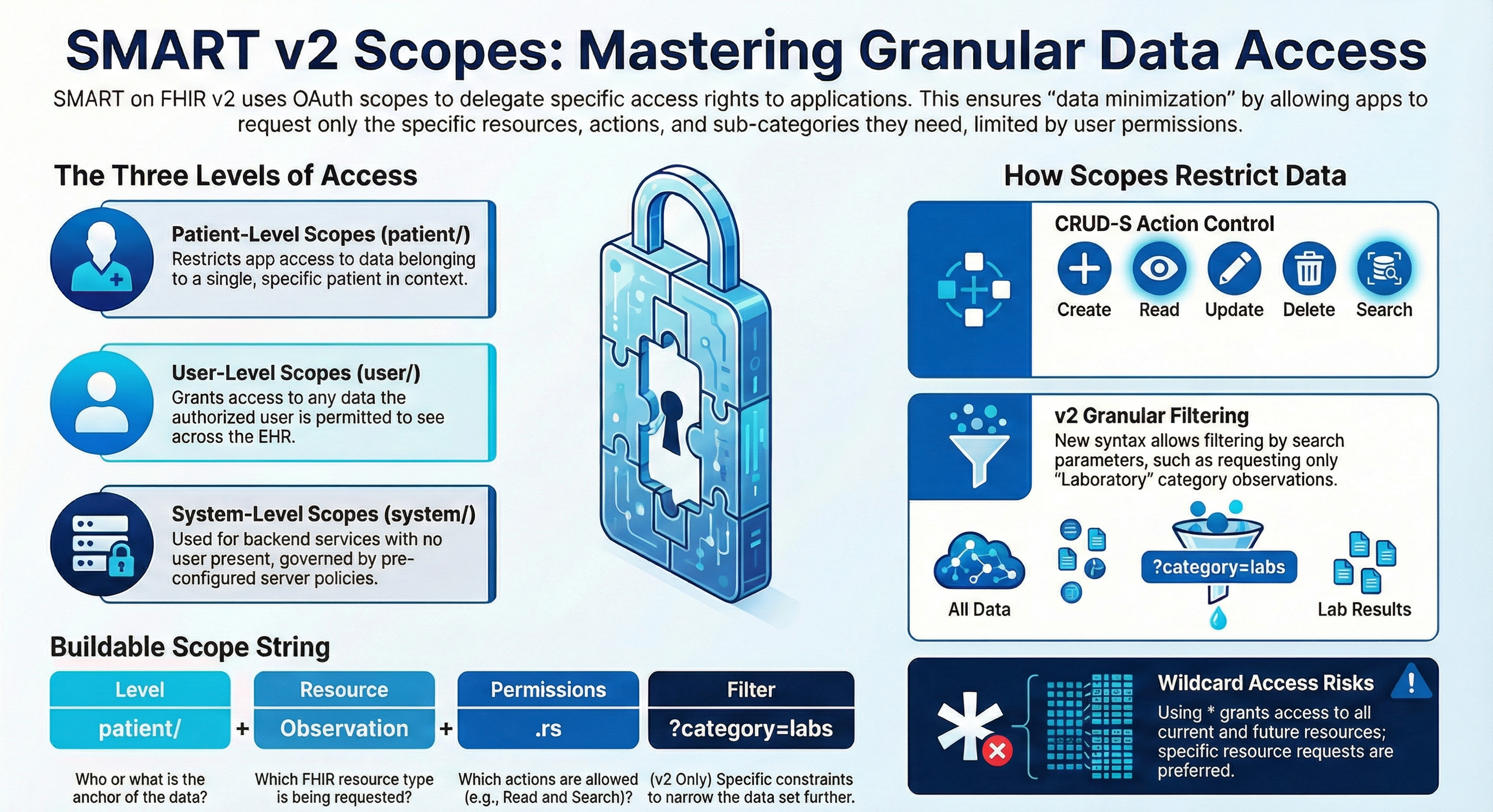
A very important feature for HL7 FHIR has been introduced with the release of v2026.1 - the support for SMART on FHIR v2 fine-grained granular Scopes.

This enables you to be much stricter and more accurate in the access you provide to the data in your FHIR repository.

Part of this new support is to refuse requests that don't match the scopes, but an even more interesting ability is to filter the results according to the provided scopes.

0
0 37