Supply Chain Orchestration for dummies
Supply Chain refers to a set of processes and activities performed by the company's business areas and its suppliers and partners (stakeholders), from the acquisition of raw materials, through production, to delivery to the end consumer. It can be better managed using SCM solutions with the orchestration of the InterSystems IRIS:
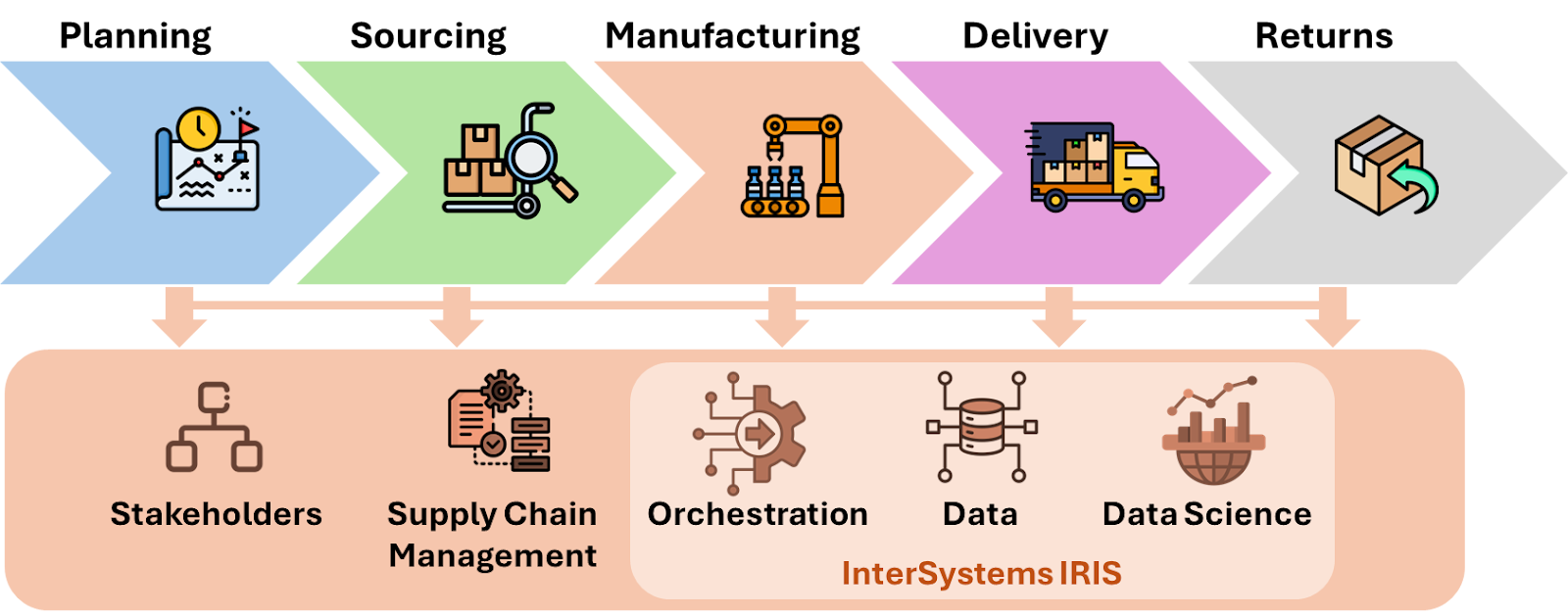
Planning process
All Supply Chain processes demand strong planning, always supported by data and analyses necessary to plan and execute activities in line with quality, accuracy, agility, and economy in the acquisition of raw materials, production, storage, delivery (logistics), and, if necessary, return (reverse logistics) of products to the end consumer. The InterSystems IRIS can support Supply Chain planning with its interoperability, database and analytics features:
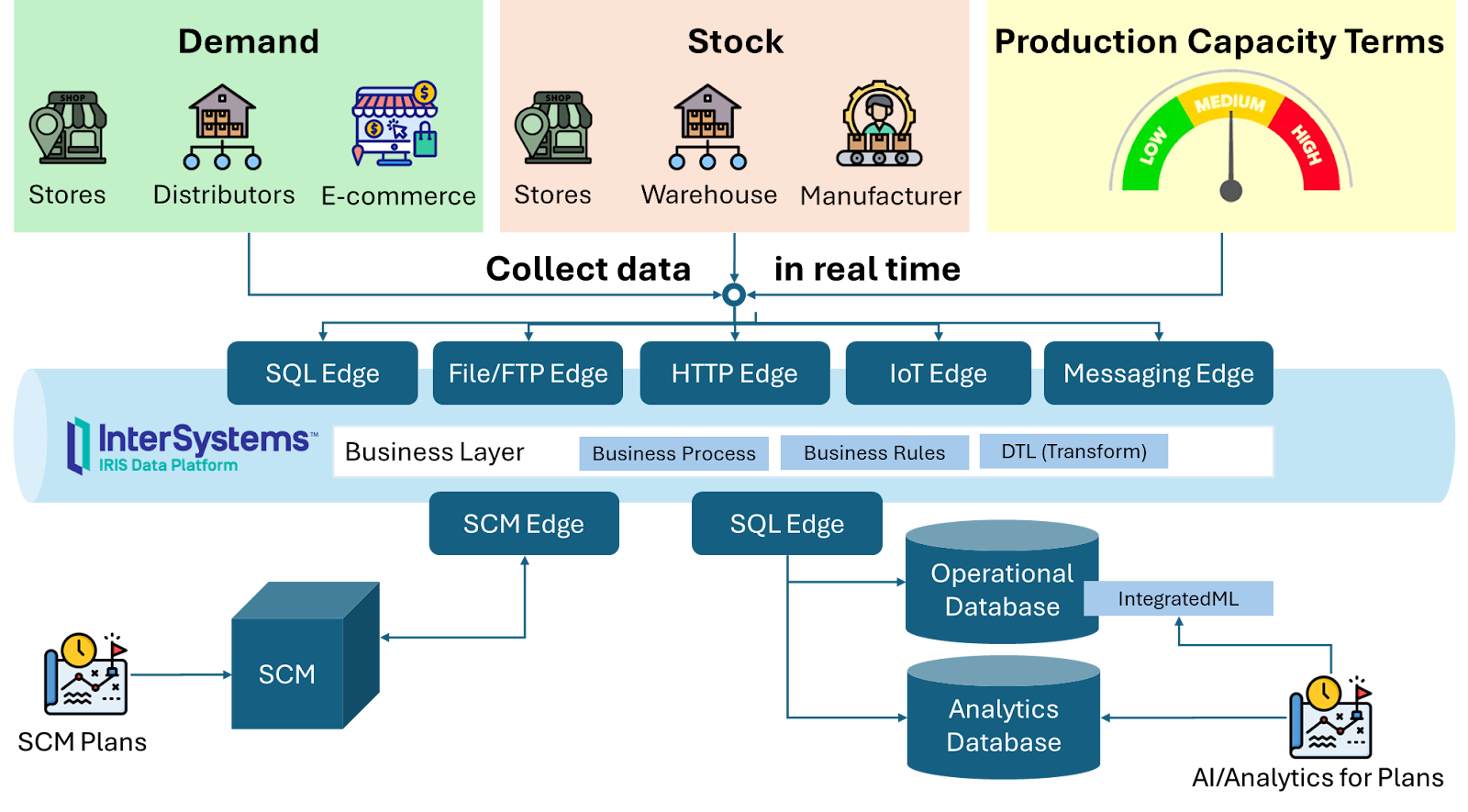
The InterSystems IRIS has some adapters available to capture data:
|
Adapter |
Edge |
Use case |
|
SQL Inbound Adapter |
SQL Edge |
Collects data about orders, inventory, and occupied capacity from SQL databases in the systems of stores, e-commerce platforms, warehouses, and factories. |
|
File and FTP Inbound Adapter |
File/FTP Edge |
Collects data on orders from stores and distributors submitted via files. |
|
REST, HTTP and SOAP Inbound Adapter |
HTTP Edge |
Collects data about orders, inventory, and occupied capacity from SOAP and REST services in the systems of stores, e-commerce platforms, warehouses, and factories. |
|
MQTT Adapter |
IoT Edge |
Collect sensor data about production capacity |
|
Kafka and MQ adapters |
Messaging Edge |
Collects data about orders, inventory, and occupied capacity from Kafka and MQ topics in the systems of stores, e-commerce platforms, warehouses, and factories. |
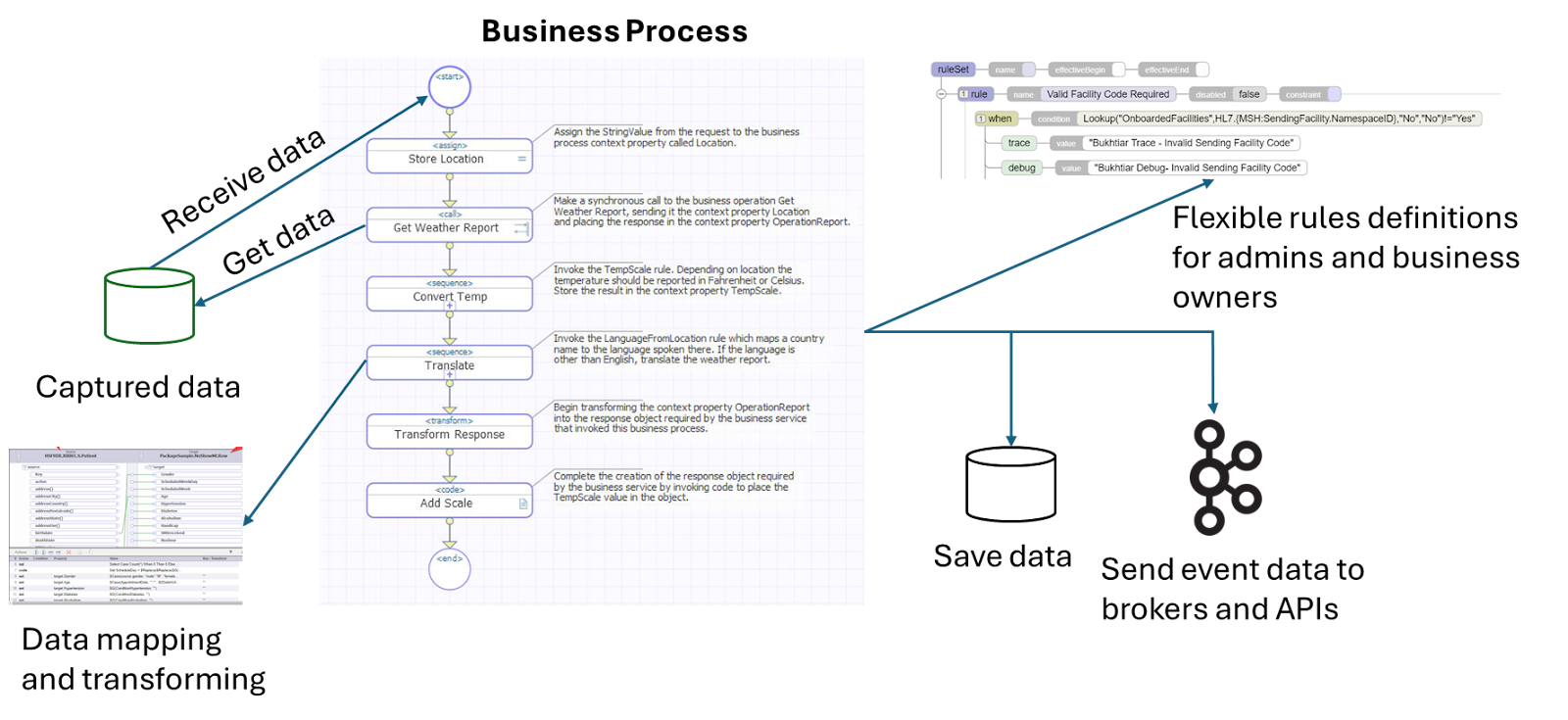
After capturing data, it is necessary to process the data using business processes, business rules, transformations and store the results into operational and analytics repositories:
In the context of Supply Chain, the following examples of information are generated for planning:
|
Data for Planning |
Term |
What does it help with planning? |
|
Number of orders per product and per location |
Next 1 to 3 months |
Quantity of raw materials to be used Factory production schedule Inventory schedule Delivery schedule |
|
Current and short-term inventory |
Next 1 to 4 weeks |
Factory production schedule Inventory schedule Delivery schedule |
|
Production capacity |
Next 1 to 3 months |
Quantity of raw materials to be used Factory production schedule Inventory schedule Delivery schedule Financial planning |
Sourcing Process
The sourcing process is fundamental for acquiring all the raw materials and other services and products necessary for the manufacturer's production from suppliers. This process requires integrating suppliers with the manufacturer to collect data and execute automated actions between systems to establish flows for price quotations, orders, purchases, deliveries, and continuous supplier evaluations, prioritizing economy, quality, and speed.
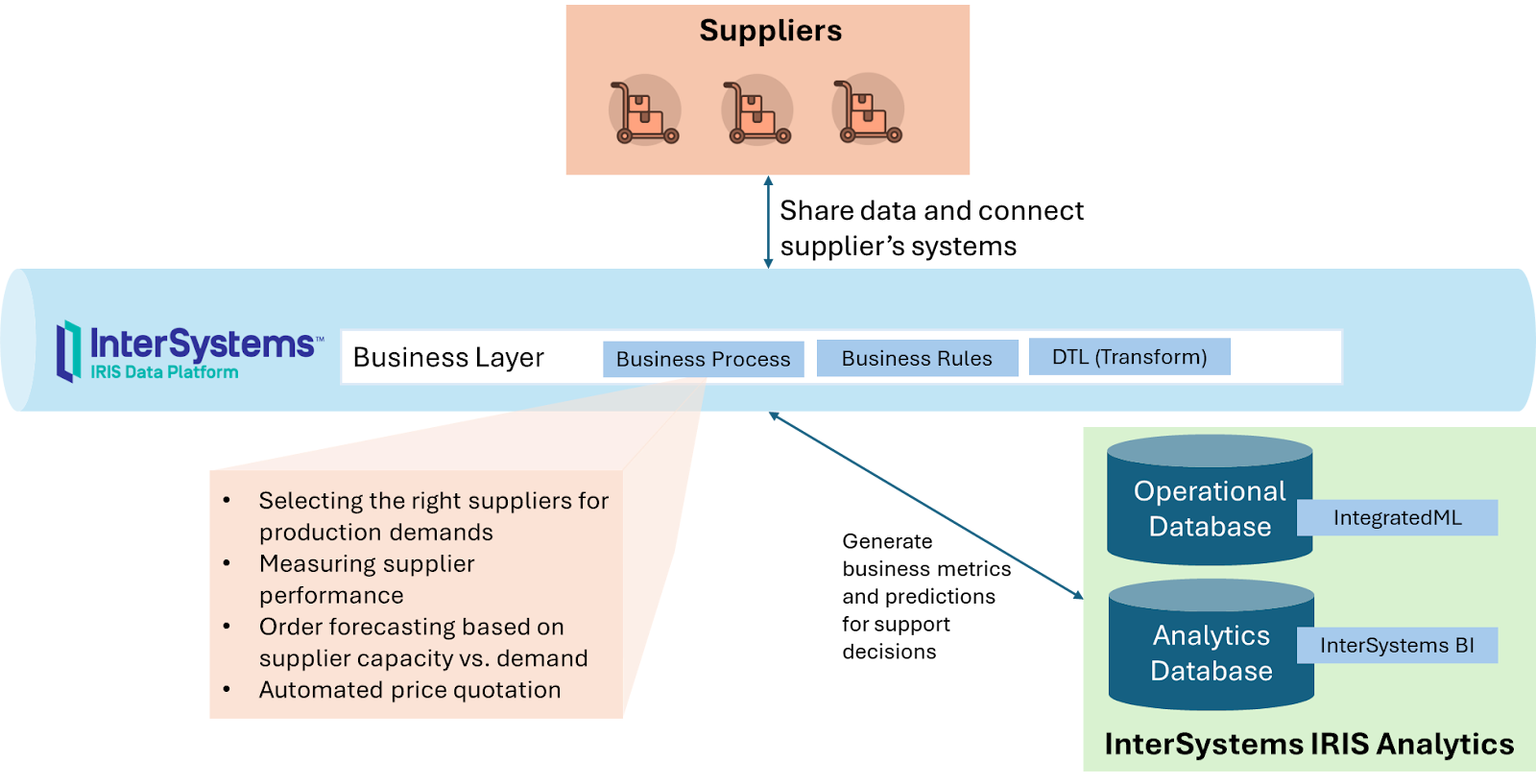
InterSystems IRIS operates at each stage according to the following table:
|
Sourcing step |
IRIS component |
Actions |
|
Price quotation |
REST, Kafka, HTTP Adapters Business Process IRIS database IRIS BI Integrated ML |
Get prices from suppliers Select best prices Store prices show price quotation dashboards Predict prices |
|
Select suppliers |
Business Process |
Analyze prices and demands and select right suppliers |
|
Order |
Business Process |
Send orders to SCM and ERPs |
Manufacturing process
The manufacturing process consists of activities necessary to transform raw materials into goods.
The main activities involve starting with production planning and then separating the raw materials, assembling the production line, preparing and maintaining the machinery, carrying out production, performing quality control, and packaging for delivery. These activities have a high degree of automation. In this way, InterSystems IRIS becomes fundamental:
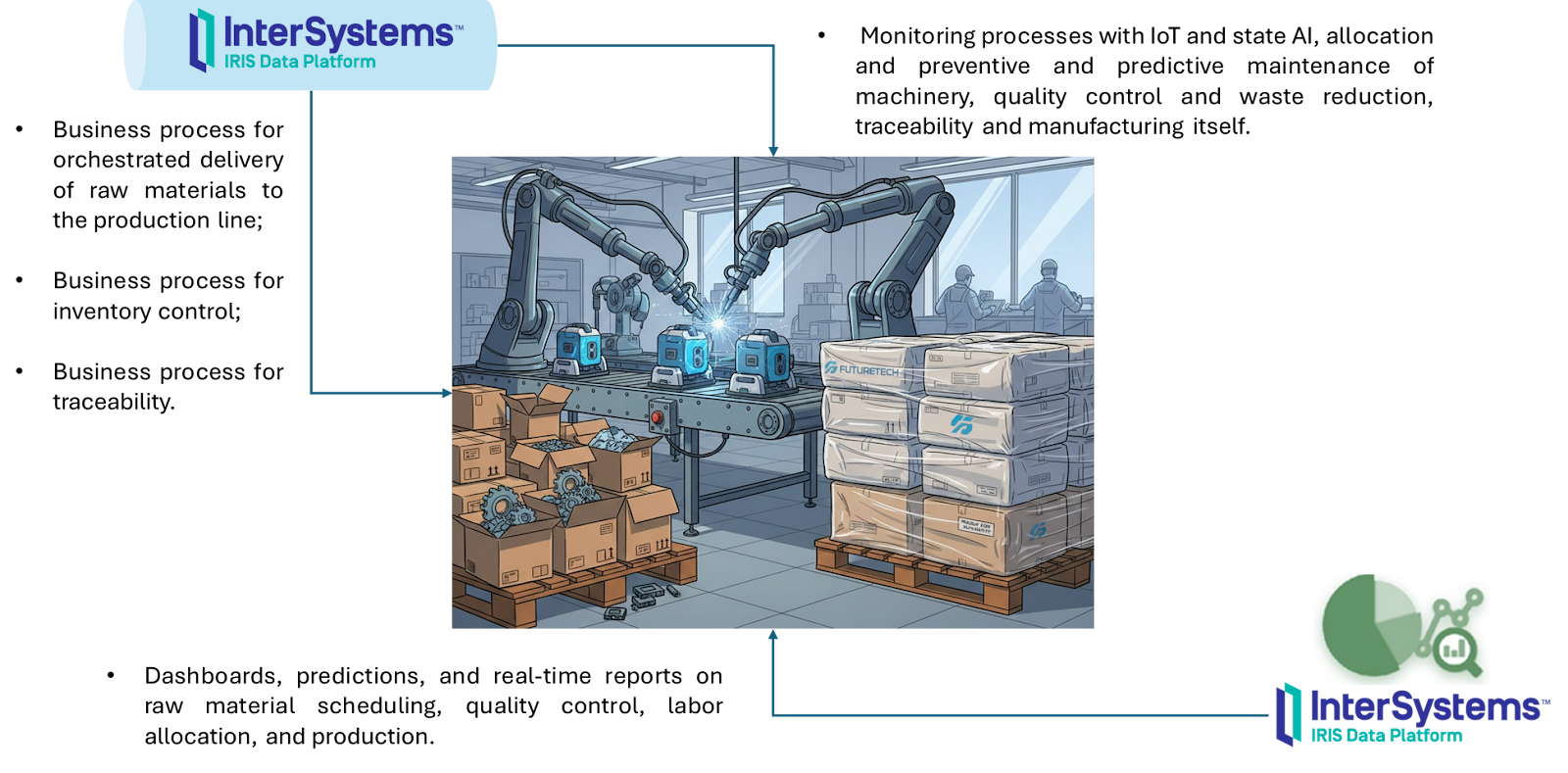
The following table details where the IRIS components operate to assist in the automation and improvement of the manufacturing process:
|
Manufacturing step |
IRIS component |
Actions |
|
Raw material allocation |
REST, Kafka, HTTP Adapters Business Process IRIS database IRIS BI Integrated ML |
Automated orders to SCM/ERP Orchestrate Production/SCM/ERP Store orders, traces, inventory Store, analyze and predict material allocation and quality analysis |
|
Monitoring and preventive and predictive maintenance of production line machines. |
REST, MQTT Adapters Business Process IRIS database IRIS BI Integrated ML |
Receiving data from machine sensors to control production and schedule maintenance. Automate parts requisition, maintenance requests, and production reporting to the ERP and SCM systems. Generate analytical reports and dashboards on productivity, material quality, machine monitoring, and maintenance. |
|
Labor allocation |
Business Process IRIS database IRIS BI Integrated ML |
Send labor allocation requisitions to ERP and HR systems Analyze and Predict labor workforce requirements |
|
Produce the goods |
REST, MQTT Adapters Business Process IRIS database IRIS BI Integrated ML |
Orchestrate data, requests and responses between manufacturing systems/ERP/SCM Produce production reports, analyzes and predictions |
Delivery and Return Processes
The delivery and return processes are challenging and complex, involving the formation of a network of stores, distributors, distribution centers, and air, land, and sea carriers at a national and international level to ensure the manufactured product arrives at the right time and place at the lowest possible cost. This requires integrating data and processes from all parties involved to synchronize production and delivery capacity, and short-, medium-, and long-term demand:
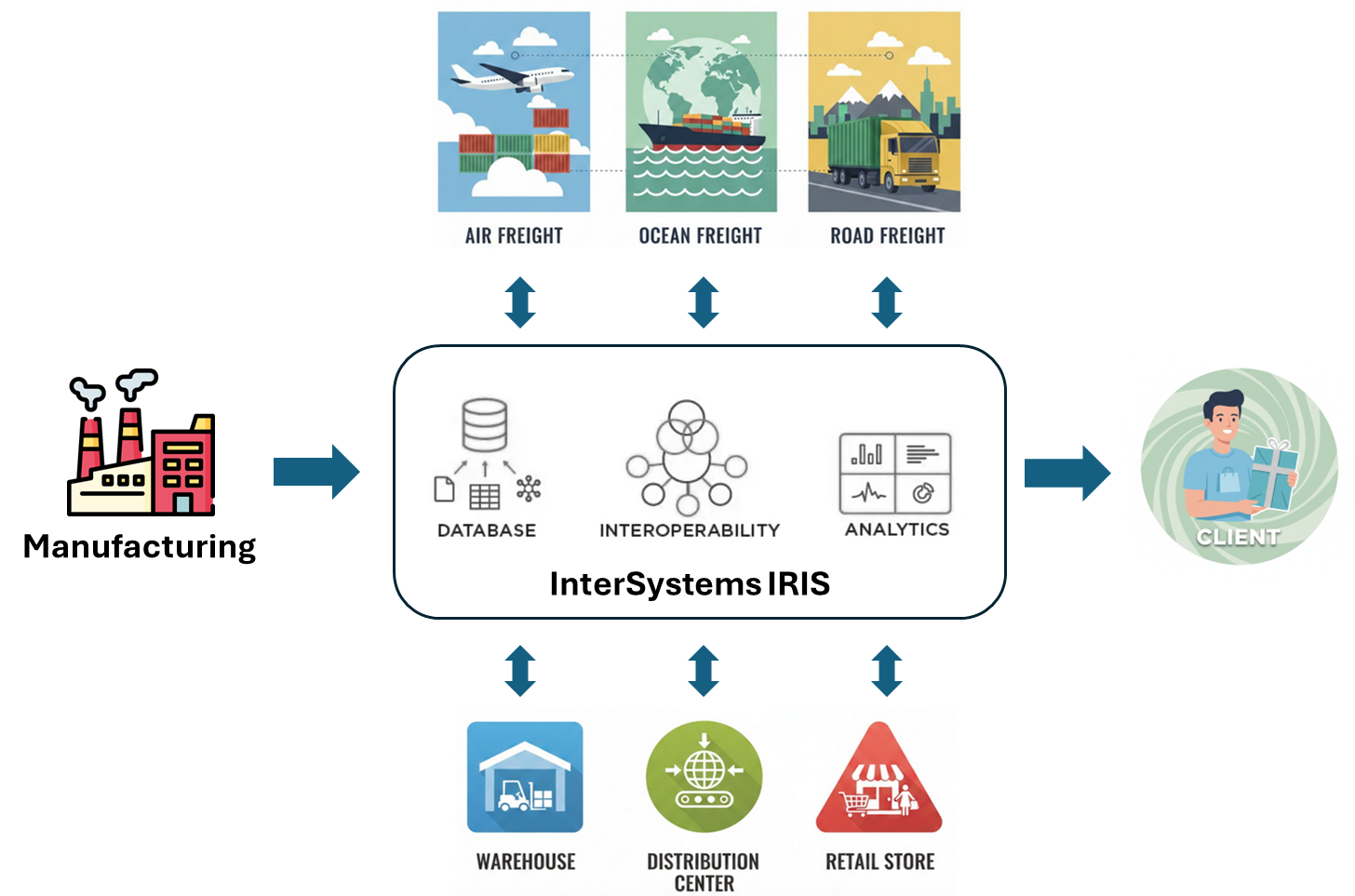
The following table details where the IRIS components operate to assist in the automation and improvement of the delivery and return processes:
|
Delivery/Return step |
IRIS component |
Actions |
|
Match orders and deliveries |
REST, Kafka, HTTP Adapters Business Process |
Sends order confirmation messages to the relevant internal and external systems |
|
Define the delivery route according to the desired destination, product, and shipping cost |
Business Process IRIS database IRIS BI Integrated ML |
It runs mathematical and AI models to refine air, sea, and land routes to all intermediate and final destinations of products and records the routes for all systems involved |
|
Maintain and communicate delivery traceability to all parties involved |
REST, Kafka, HTTP Adapters Business Process IRIS BI |
It updates every step in the delivery route and maintains traceability in the systems of all those involved, in addition to generating dashboards and monitoring reports |
|
Address and record deviations and failures in deliveries |
REST, Kafka, HTTP Adapters Business Process IRIS BI |
It detects route deviations and delivery failures and records them in the systems of all parties involved, allowing for autonomous (AI) or manual (BPL) decisions on how to correct the delivery |
|
Address and record successful deliveries |
REST, Kafka, HTTP Adapters Business Process IRIS BI |
It updates all systems involved in successful delivery and generates statistics and analyses that enable continuous process improvement |
|
Manage tax and transportation documentation. |
REST, Kafka, HTTP Adapters Business Process |
It works in conjunction with the ERP system to issue and synchronize data and documents necessary for the transportation and fiscal and legal registration of products being delivered |
|
Registers customer's return request |
REST, Kafka, HTTP Adapters Business Process |
It retrieves the return data, registers the return event in the systems of all parties involved, and correlates it with the delivery to maintain traceability |
|
Identifies delivery opportunities for another customer. |
REST, Kafka, HTTP Adapters Business Process |
It reviews orders to fulfill returned products that do not have quality issues and synchronizes with the systems of all parties involved to register delivery to another customer |
|
Generates reverse logistics for returned items in case of non-delivery to another customer. |
REST, Kafka, HTTP Adapters Business Process |
It generates the product return route, either to the factory (defect) or to store or distribution center stock. To do this, it updates the systems of all involved parties, in addition to generating analyses and follow-up reports. |
Compilation of IRIS components used in Supply Chain and how to learn to use them
Below is a table detailing each component of IRIS used in Supply Chain projects, with links to resources on how to use them: