New
Hi Community,
Enjoy the new video on InterSystems Developers YouTube:
Representational state transfer (REST) is a software architectural style that defines a set of constraints to be used for creating Web services. Web services that conform to the REST architectural style, called RESTful Web services (RWS), provide interoperability between computer systems on the Internet. RESTful Web services allow the requesting systems to access and manipulate textual representations of Web resources by using a uniform and predefined set of stateless operations. Other kinds of Web services, such as SOAP Web services, expose their own arbitrary sets of operations.
Hi Community,
Enjoy the new video on InterSystems Developers YouTube:
When I started building Smart Discharge Navigator, I faced a common challenge: FHIR data is stored as JSON bundles, but the analysis I needed required joining multiple resources together, the kind of thing SQL was built for.
InterSystems FHIR SQL Builder solved this completely. Instead of parsing JSON bundles in application code, I was able to write plain SQL directly against FHIR resource projections inside IRIS for Health. This article shows exactly how I used it to build the population-level readmission risk scoring engine at the heart of the application.
Hi all,
It's me again 😁. In the pervious article Writing a REST api service for exporting the generated FHIR bundle in JSON, we actually generated a resource DocumentReference, with the content data encoded in Base64
.png)
Question!! Is it possible to write a REST service for decoding it? Because I am very curious what is the message data talking about🤔🤔🤔
OK, Let's start!
1. Create a new utility class datagen.utli.decodefhirjson.cls for decoding the data inside the DocumentReference
ClassExtends%RegisteredObject2. Write a Python function decodebase64docref to
a. loop through the FHIR bundle
b.
Hi,
It's me again😁, recently I am working on generating some fake patient data for testing purpose with the help of Chat-GPT by using Python. And, at the same time I would like to share my learning curve.😑
1st of all for building a custom REST api service is easy by extending the %CSP.REST
Creating a REST Service Manually
Let's Start !😂
1. Create a class datagen.restservice which extends %CSP.REST
ClassExtends%CSP.REST2. Add a function genpatientcsv() to generate the patient data, and package it into csv string
ExtendsAsyou may test the function in the terminal by typing
.png)
3. Add a function
In our previous article, we explored the basics of unit testing in IRIS and the ways to apply it to a REST API. We even figured out how to test logic before finalizing network configurations and authentication, allowing us to focus solely on testing the API contents. Today, we will build upon that foundation and elevate our unit testing strategy by using another tool: %Populate .
At first glance, the %Populate class appears to be very simple. You can create a class that extends both %Persistent and %Populate and inherit a Populate method designed to generate randomized records.
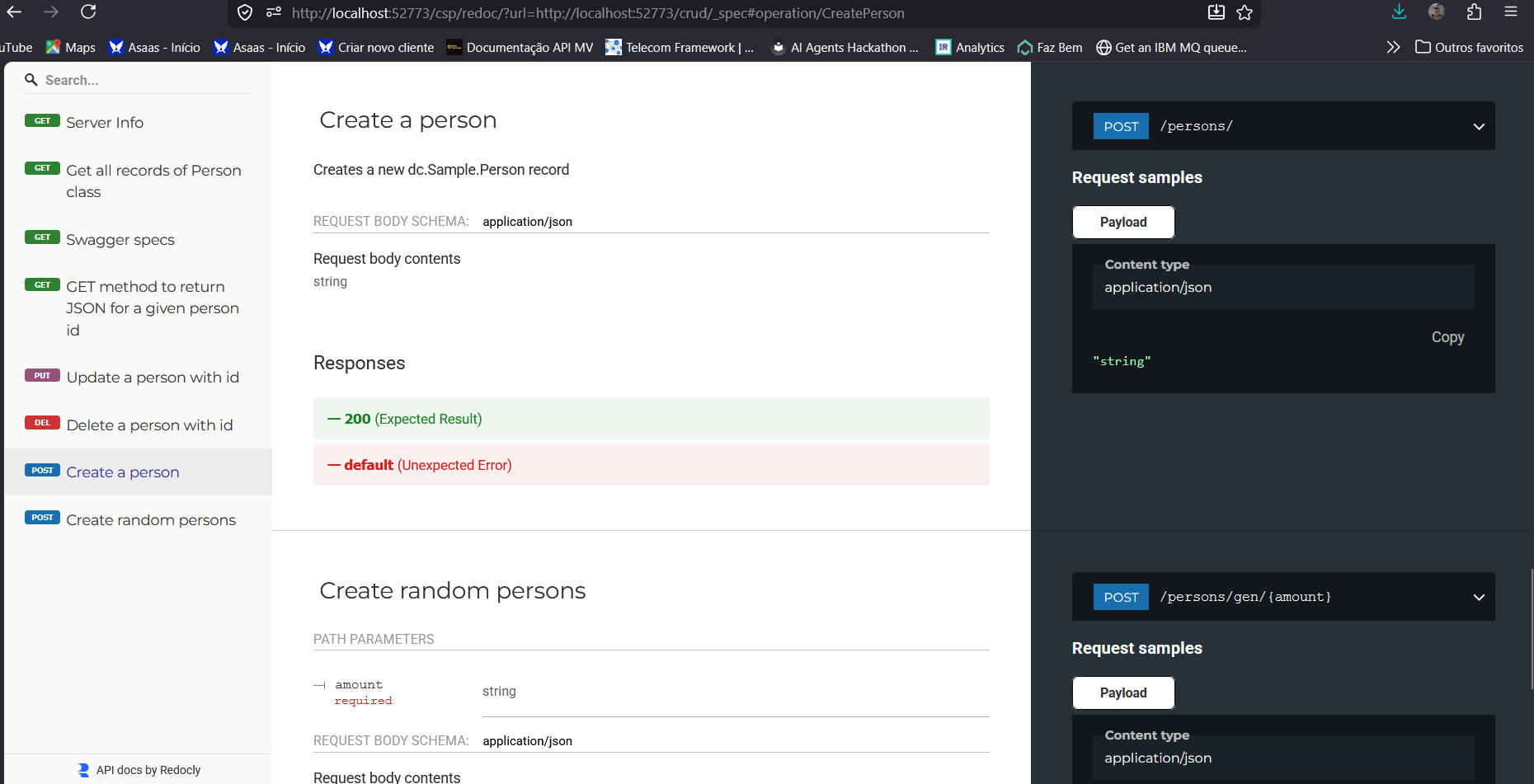
Redoc is an Open Source solution capable of rendering API specifications in OpenAPI 2.0 or 3.0+ as very beautiful and functional web portals. Currently, to have something similar, we need the ZPM SwaggerUI extension or we need to install IAM - InterSystems API Manager and then configure the IAM Developer Portal. Well, now the community has one more option, iris-redoc. This solution installs a web application on your IRIS instance that uses Redoc to present a beautiful web portal for your REST APIs:
I was really surprised that such a flexible integration platform with a rich toolset specifically for app connections has no out-of-the-box Enterprise Service Bus solution. Like Apache ServiceMix, Mule ESB, SAP PI/PO, etc, what’s the reason? What do you think? Has this pattern lost its relevance completely nowadays? And everybody moved to message brokers, maybe?
Wiki time: An enterprise service bus (ESB) implements a communication system between mutually interacting software applications in a service-oriented architecture (SOA) .
I want to develop a REST API for uploading PDF files. I started with OPENAPI spec file. When I test, I get error 8727 referencing missing required parameter file.
"{"$c(13,10,9)"""errors"":[ {"$c(13,10,9,9,9)"""code"":8727,"$c(13,10,9,9,9)"""domain"":""%ObjectErrors"","$c(13,10,9,9,9)"""error"":""ERROR #8727: Parameter required: file."","$c(13,10,9,9,9)"""id"":""RESTRequired"","$c(13,10,9,9,9)"""params"":[""file"""$c(13,10,9,9,9)"]"$c(13,10,9,9)"}"$c(13,10,9)"],"$c(13,10,9)"""summary"":""ERROR #8727: Parameter required: file.
A microservice is an architectural style that structures an application as a collection of small, autonomous services. Each component is developed around a specific business capability, can be deployed independently, and is typically managed by a miniature, specialized, self-governing team. (Source: https://microservices.io/)

I'm a huge sci-fi fan, but while I'm fully onboard the Star Wars train (apologies to my fellow Trekkies!), but I've always appreciated the classic episodes of Star Trek from my childhood. The diverse crew of the USS Enterprise, each masterminding their unique roles, is a perfect metaphor for understanding AI agents and their power in projects like Facilis. So, let's embark on an intergalactic mission, leveraging AI as our ship's crew and boldly go where no man has gone before

A question that quickly arises when configuring IAM (aka Kong Gateway) is how many routes should be created to reach all the business objects in an IRIS API.
A common mistake is to create one route per business object, unnecessarily multiplying the number of routes.
Hi folks!
Is there an easy setting, e.g., to merge.cpf so that it will disable the management portal on a deployed IRIS container?
The idea is to let only one of my particular web apps be available and everything else not even accessible on IRIS.
The standard %Net.HttpRequest library in InterSystems IRIS is powerful and comprehensive, but it can be verbose for simple operations. Writing an HTTP request often requires several lines of code to instantiate the class, configure the server, the port, HTTPS, add headers, and finally send the request.
When testing in the terminal, this configuration quickly becomes too heavy, and usually ends up with the creation of temporary methods...
FastHTTP
I may have mentioned this before: I believe the Visual Traces, these sequence diagrams with full content of each step, are a fantastic feature of the IRIS Data platform! Detailed information about how the API works internally, as a visual trace, can be very useful for projects on the IRIS platform. Of course, this applies when we are not developing a high-load solution, in which case we simply don't have time for saving/reading messages. For all other cases, welcome to this tutorial!
Hi, Community!
Want to try using Flask to expose InterSystems IRIS data over HTTP? This short video will get you started:
Building a REST API in Flask with InterSystems IRIS
👨💻Try it yourself in this hands-on exercise! (exercise, 30m).
I created iris-budget app for the InterSystems Full Stack Contest in 2026. By full stack, we mean a frontend web or mobile application that inserts, updates, or deletes data in InterSystems IRIS via REST API, Native API, ODBC/JDBC, or Embedded Python.
My app uses multiple REST APIs to add a new category or retrieve a list of categories of expenses and income.
I inherited /csp/coffee from module.xml in iris-fullstack-template.
For this project, I created a swagger file called "budget.json.
Hi Community,
In this article, I will introduce my application iris-CliniNote .
CliniNote is a full-featured clinical notes application that combines classic CRUD operations with **real-time AI-assisted notes matching** powered by **InterSystems IRIS native vector search**. The standout feature: while a doctor is writing or editing a clinical note, a side panel shows the **top 5 most similar notes** based on the semantic content of the note being written — **excluding the current patient** to avoid trivial matches. This gives clinicians immediate access to "patients like this one" — helping with differential diagnosis, treatment pattern recognition, and rare presentation detection.
https://irisclininote.sandbox.developer.intersystems.com/csp/clininote/login.html
InterSystems IRIS allows you to build REST APIs using ObjectScript classes and the %CSP.REST framework. This enables the development of modern services to expose data for web apps, mobile apps, or system integrations.
In this article, you'll learn how to create a basic REST API in InterSystems IRIS, including:
GET and POST methodsA full demonstration using Docker
Hi developers!
Observing the avalanche of AI-driven and vibe-coding developer tools that have been appearing lately almost every month with more and more exciting dev features, I was puzzled whether it is possible to leverage it with InterSystems IRIS. At least to build a frontend. And the answer - yes! At least with the approach I followed.
Here is my recipe to prompt the UI vs InterSystems IRIS Backend:
Here is the result of my own exercise - a 100% prompted UI vs IRIS REST API that allows to list, create, update delete entries of a persistent class (Open Exchange,frontend source, video):
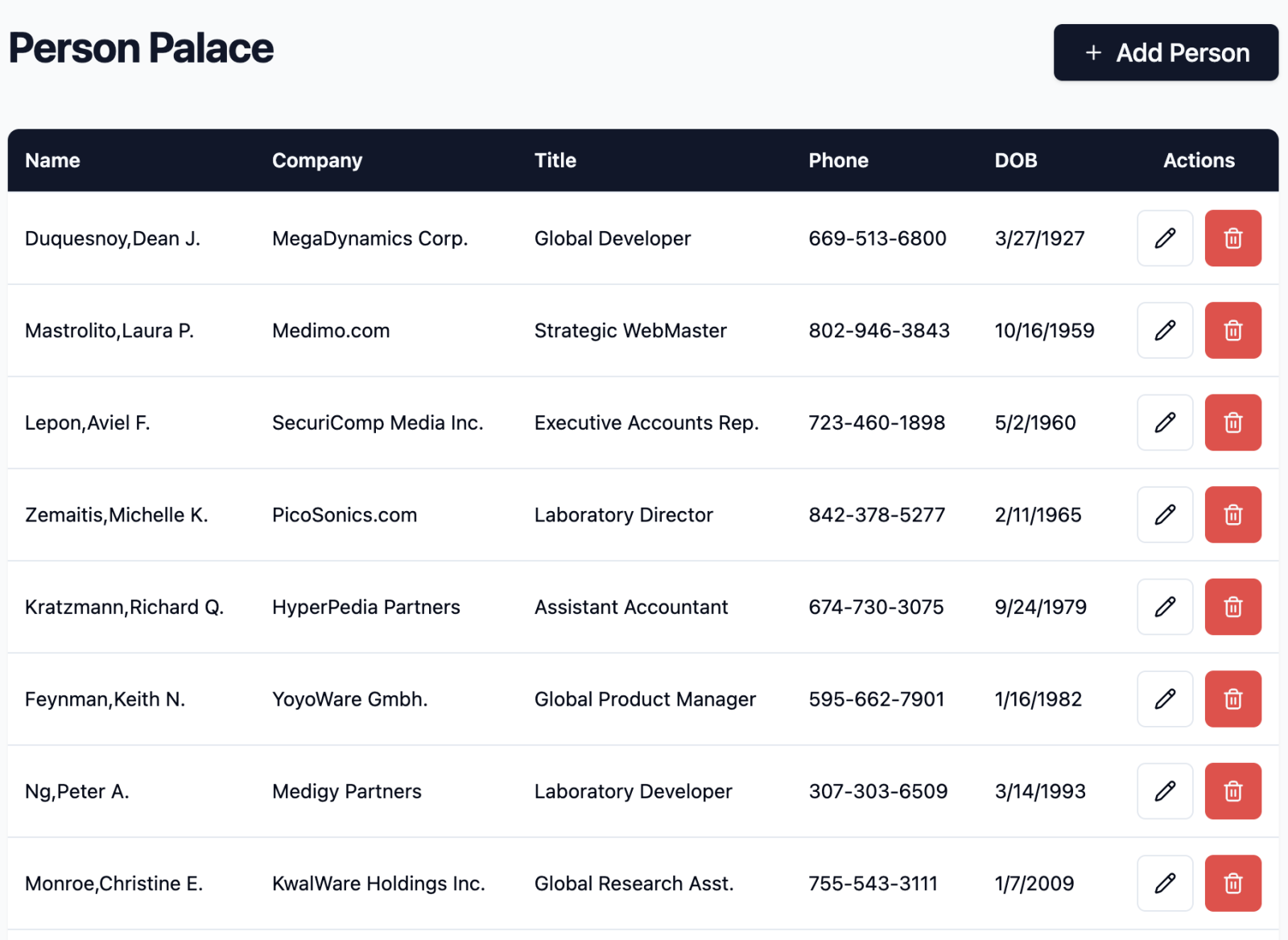
What is the recipe in detail?
Hi developers. Just want to share with you a finding that might save you a few important minutes of your developer life with InterSystems IRIS.
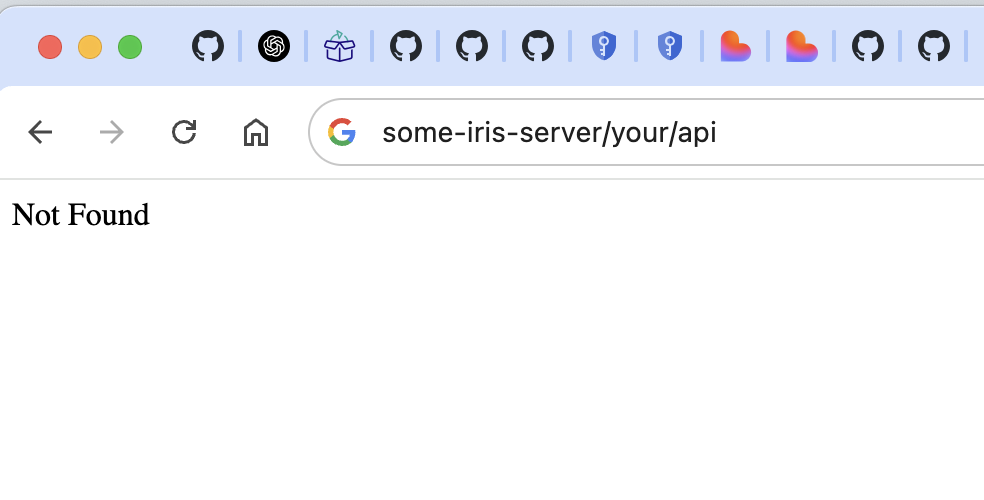
But!
It should work; you deployed the REST API correctly, and everything is just in place.
What can go wrong?
The Clinical Staff Master Data Management (CSMDM) system is a full-stack healthcare integration application built on InterSystems IRIS for Health. It centralizes and standardizes clinical staff metadata into a single authoritative repository, exposed through RESTful CRUD APIs and reusable backend methods.
The platform eliminates fragmented lookup tables and hardcoded mappings that commonly cause errors in HL7 and FHIR integration workflows, ensuring data consistency and interface reliability.
In the previous article, we examined how we can use the %CSP.Request and %CSP.Response classes to test a REST API without having the API fully set up and accessible across a network with an authentication mechanism. In this article, we will build on that foundation to perform some simple unit testing of one of our REST API methods.
The unit testing framework requires a couple of setup steps before we can use it. First, we have to ensure that the unit testing portion of the management portal is enabled so we can review the results of our tests.
I want to implement isc-rest in my new project iris-budget/module.xml at master · oliverwilms/iris-budget
I get this error:
#8 11.30 Building dependency graph...
#8 12.69 ERROR! Could not find satisfactory version of isc.rest in any repositories. Required by: iris-budget 0.0.1: ^2.0.0
#8 ERROR: process "/bin/sh -c iris start IRIS && \tiris session IRIS < iris.script && ([ $TESTS -eq 0 ] || iris session iris -U $NAMESPACE \"##class(%ZPM.PackageManager).Shell(\\\"test $MODULE -v -only\\\",1,1)\") && iris stop IRIS quietly" did not complete successfully: exit code: 1
In this article, I aim to demonstrate a couple of methods for easily adding validation to REST APIs on InterSystems IRIS Data Platform. I believe a specification-first approach is an excellent idea for API development. IRIS already has features for generating an implementation stub from a specification and publishing that specification for external developers (use it with iris-web-swagger-ui for the best results). The remaining important thing not yet implemented in the platform is the request validator. Let's fix it!
Hey everyone,
I'm just seeking some guidance and confirmation on what I'm doing for my production health monitoring.
We utilize Grafana to have reporting/monitoring dashboards and I have made a REST API to query the health of our productions. I believe I have everything figured out except for one thing that I'm uncertain about and that is the Production Item Color indicators:
.png)
Is there an easy way of being able to figure out the status of an item with the legend above? Ideally, I'd like to have this data in my JSON response.
I have always struggled with Iterating through a JSON response to pull out certain fields into a Data Class Structure to use to populate fields in a DTL. So I defined the whole structure for the following JSON, with the base structure extending Ens.Response, %XML.Adaptor, and %JSON.Adaptor.
In my previous HttpRequests, I have used Content-Type = application/json but I have a vendor that is requesting we send application/x-www-form-urlencoded. How would I go about formatting the Payload as x-www-form-urlencoded?
Thanks
I wanted to try vibecoding a real backend + frontend setup on InterSystems IRIS, ideally using something realistic rather than a toy example. The goal was simple: take an existing, well-known persistent package in IRIS and quickly build a usable UI and API around it — letting AI handle as much of the boilerplate as possible. Here is the result of the experiments.
There are numerous excellent tools available for testing your REST APIs, especially when they are live. Postman, various web browser extensions, and even custom ObjectScript written with %Net.HttpRequest objects can get the job done. However, it is often difficult to test just the REST API without inadvertently involving the authentication scheme, the web application configuration, or even network connectivity. Those are a lot of hoops to jump through just to test the code within your dispatch class. The good news is that if we take our time to understand the inner workings of the %CSP.REST class, we will find an alternative option suited for testing only the contents of the dispatch class. We can set up the request and response objects to invoke the methods directly.
What is JWT?
JWT (JSON Web Token) is an open standard (RFC 7519) that offers a lightweight, compact, and self-contained method for securely transmitting information between two parties. It is commonly used in web applications for authentication, authorization, and information exchange.
A JWT is typically composed of three parts:
1. JOSE (JSON Object Signing and Encryption) Header
2. Payload
3. Signature
These parts are encoded in Base64Url format and concatenated with dots (.) separating them.