InterSystems Programming Contest: AI Agents for FHIR
Hi Developers,
We are happy to announce the new InterSystems online programming contest:
🏆 InterSystems Programming Contest: AI Agents for FHIR 🏆
Duration: May 25 - June 14, 2026
Prize pool: $12,000
The topic
Develop an AI agent to be called in an interoperability FHIR solution.
Implement a suggested task to earn 5 bonus points (!) - once per application
- Smart Patient Summary Generator
- What it does: Creates a concise, clinician-friendly summary of a patient from FHIR data, including conditions, medications, allergies, recent encounters, labs, and care plans.
- FHIR resources: Patient, Condition, MedicationRequest, AllergyIntolerance, Observation, Encounter, CarePlan.
- Platform features to use: FHIR API, FHIR SQL Builder, AI Hub.
- 1–2 week MVP: Pick one patient, pull recent FHIR resources, generate:
- “current issues”;
- “recent changes”;
- “risks / follow-up items”.
- Nice twist: Generate different summaries for different roles: ED doctor, care manager, patient, or family caregiver.
- FHIR Prior Authorization Copilot
- What it does: Helps staff prepare prior auth requests by pulling diagnosis, medication history, procedures, and supporting evidence from FHIR data.
- FHIR resources: Patient, Coverage, Condition, MedicationRequest, Procedure, Observation, DocumentReference.
- Platform features to use: FHIR SQL Builder, Vector Search, AI Hub, AI Agents.
- 1–2 week MVP: Given a requested medication or procedure, the app:
- identifies likely supporting diagnoses;
- finds relevant recent observations or notes;
- drafts a justification summary.
- Nice twist: Add a “missing evidence” checklist.
- Gaps-in-Care Finder for Preventive Screening
- What it does: Identifies patients who may be overdue for screenings, vaccines, or chronic disease follow-ups.
- FHIR resources: Patient, Immunization, Observation, Condition, Procedure, Encounter.
- Platform features to use: FHIR SQL Builder, dashboards/analytics, optional AI Hub.
- 1–2 week MVP: Implement 2–3 rules such as:
- HbA1c follow-up for diabetes;
- mammogram screening window;
- flu/COVID vaccination reminder;
- blood pressure follow-up.
- Nice twist: Use AI to generate outreach messaging tailored to patient preference or risk level.
- Medication Safety and Interaction Assistant
- What it does: Builds a medication review app that flags possible duplication, interactions, allergy conflicts, or adherence issues using FHIR medication and allergy data.
- FHIR resources: MedicationRequest, MedicationStatement, AllergyIntolerance, Condition, Observation.
- Platform features to use: FHIR API, AI Hub, Vector Search.
- 1–2 week MVP: Show:
- active medication list;
- duplicate therapy detection;
- allergy cross-check;
- plain-language counseling summary.
- Nice twist: Use Vector Search over drug guidance content or patient education documents to return context-aware explanations.
- AI-Powered Care Plan Navigator
- What it does: Turns CarePlan and Goal resources into a guided experience for patients or care coordinators.
- FHIR resources: CarePlan, Goal, Task, Appointment, MedicationRequest, Observation.
- Platform features to use: AI Agents, AI Hub, FHIR API.
- 1–2 week MVP: The app answers:
- “What should this patient do next?”;
- “What tasks are overdue?”;
- “Which goals are off track?”.
- Nice twist: Add an agent that creates suggested Task resources based on changes in observations or missed appointments.
- Social Determinants and Community Referral Matcher
- What it does: Uses clinical and social data to recommend community resources for transportation, food insecurity, housing, or behavioral health support.
- FHIR resources: Condition, Observation, QuestionnaireResponse, ServiceRequest, CarePlan, Patient.
- Platform features to use: Vector Search, AI Hub, AI Agents.
- 1–2 week MVP: Given a patient profile plus a small directory of local services:
- identify possible needs;
- recommend relevant resources;
- generate a referral summary.
- Nice twist: Store community resources as semantically searchable content and use Vector Search to match needs to services.
- FHIR Clinical Trial Matcher
- What it does: Matches patients to trial eligibility criteria using their coded clinical data and relevant unstructured documents.
- FHIR resources: Condition, Observation, MedicationStatement, Procedure, Patient, DocumentReference.
- Platform features to use: Vector Search, AI Hub, AI Agents, FHIR SQL Builder.
- 1–2 week MVP: For a few mock trials:
- extract criteria;
- compare against patient profile;
- show “likely eligible / maybe / unlikely” with rationale.
- Nice twist: Agent asks follow-up questions like “latest eGFR?” or “prior therapy present?” if criteria are incomplete.
- Natural Language to FHIR Query Explorer
- What it does: Lets a user ask questions like “Show diabetic patients with A1c above 9 in the last 6 months” and translates that into structured FHIR queries or FHIR SQL.
- FHIR resources: Any relevant set, especially Patient, Condition, Observation, Encounter.
- Platform features to use: FHIR SQL Builder, AI Hub.
- 1–2 week MVP: Support 5–10 question patterns:
- cohort discovery;
- recent lab filters;
- medication-based populations;
- encounter recency.
- Nice twist: Show the generated SQL or FHIR search so judges can see the transparency.
- Hospital Readmission Risk Workbench
- What it does: Builds a prototype that estimates short-term readmission risk from recent utilization, diagnoses, meds, and labs, then proposes interventions.
- FHIR resources: Encounter, Condition, Observation, MedicationRequest, CarePlan, Patient.
- Platform features to use: FHIR SQL Builder, AI Hub, dashboards.
- 1–2 week MVP: Use rule-based or lightweight scoring instead of a true ML model:
- recent admissions;
- high-risk conditions;
- missed follow-ups;
- abnormal labs;
- polypharmacy.
- Nice twist: Generate recommended next steps as Task or CarePlan suggestions.
- Conversational FHIR Triage Assistant
- What it does: An AI agent asks patients structured triage questions, stores answers as QuestionnaireResponse, and creates a clinician handoff summary.
- FHIR resources: Questionnaire, QuestionnaireResponse, Condition, Observation, ServiceRequest, Encounter.
- Platform features to use: AI Agents, AI Hub, FHIR API.
- 1–2 week MVP: The prototype can:
- ask symptom questions;
- recommend urgency level;
- generate a structured handoff note;
- create a follow-up task or service request.
- Nice twist: Map the conversation into coded FHIR observations where possible.
- Imaging and Results Follow-Up Tracker
- What it does: Tracks abnormal results and ensures they have documented follow-up, making it easier to spot “closed-loop” care failures.
- FHIR resources: Observation, DiagnosticReport, ServiceRequest, Task, Encounter, Patient.
- Platform features to use: FHIR SQL Builder, AI Hub, AI Agents.
- 1–2 week MVP: Find abnormal results and show whether there is:
- a follow-up appointment;
- a repeat order;
- a task;
- a plan in notes.
- Nice twist: Use AI to draft an outreach or clinician reminder.
- Patient-Friendly Lab Explainer
- What it does: Converts lab results and trends into plain-language explanations for patients, with educational context and suggested questions for their doctor.
- FHIR resources: Observation, DiagnosticReport, Patient.
- Platform features to use: AI Hub, Vector Search.
- 1–2 week MVP: Select a few lab types such as CBC, A1c, lipids, or CMP and generate:
- what the result means;
- whether it changed over time;
- what to ask next.
- Nice twist: Use Vector Search over trusted educational content to ground the explanation.
*Implementation of these ideas guarantees additional bonuses.
*Full Technology Bonuses breakdown will be published soon.
General Requirements:
- An application or library must be fully functional. It should not be an import or a direct interface for an already existing library in another language (except for C++, there you really need to do a lot of work to create an interface for IRIS). It should not be a copy-paste of an existing application or library.
- Accepted applications: new to Open Exchange apps or existing ones, but with a significant improvement. Our team will review all applications before approving them for the contest.
- The application should work on either IRIS Community Edition or IRIS for Health Community Edition. Both could be downloaded as host (Mac, Windows) versions from Evaluation site, or can be used in a form of containers pulled from InterSystems Container Registry or Community Containers: intersystemsdc/iris-community:latest or intersystemsdc/irishealth-community:latest.
- The application should be Open Source and published on GitHub or GitLab.
- The README file to the application should be in English, contain the installation steps, and contain either the video demo or/and a description of how the application works.
- Only 3 submissions from one developer are allowed.
NB. Our experts will have the final say in whether the application is approved for the contest or not based on the criteria of complexity and usefulness. Their decision is final and not subject to appeal.
Prizes
1. Experts Nomination - a specially selected jury will determine winners:
🥇 1st place - $5,000
🥈 2nd place - $2,500
🥉 3rd place - $1,000
🏅 4th place - $500
🏅 5th place - $300
🌟 6-10th places - $100
2. Community winners - applications that will receive the most votes in total:
🥇 1st place - $1,000
🥈 2nd place - $600
🥉 3rd place - $300
🏅 4th place - $200
🏅 5th place - $100
❗ If several participants score the same number of votes, they are all considered winners, and the prize money is shared among the winners.
❗ Cash prizes are awarded only to those who can verify their identity. If there are any doubts, organizers will reach out and request additional information about the participant(s).
Who can participate?
Any Developer Community member, except for InterSystems employees (ISC contractors allowed). Create an account!
Developers can team up to create a collaborative application. 2 to 5 developers are allowed in one team.
Do not forget to highlight your team members in the README of your application – DC user profiles.
Important Deadlines:
🛠 Application development and registration phase:
- May 25, 2026 (00:00 EST): Contest begins.
- June 7, 2026 (23:59 EST): Deadline for submissions.
✅ Voting period:
- June 8, 2026 (00:00 EST): Voting begins.
- June 14, 2026 (23:59 EST): Voting ends.
Note: Developers can improve their apps throughout the entire registration and voting period.
Helpful Resources:
Contest participants can access select materials from the Developing FHIR Applications Using Python training program for free.
✓ Course Sessions:
- Introduction to using AI Agents with FHIR
- Foundational Concepts in using AI Agents
- Description of the FHIR Knowledge layer for using AI Agents
- How Terminology Tools are used to build FHIR queries
- Description of the architecture of an Agentic FHIR System
✓ Technical Demonstrations:
- Demonstration on using Agentic Tools with FHIR
- Demonstration of how an MCP server can help with terminology resolution
- Demonstration on how to construct a summary of a FHIR Bundle
- Looking at design patterns when building a FHIR Agentic System
✓ Documentation:
- InterSystems IRIS for Health FHIR Components documentation
- InterSystems Cloud FHIR Server documentation
- InterSystems Interoperability documentation
- Healthcare Data Transformations documentation
✓ Example applications:
- FHIR Server Template
- iris-healthtoolkit-template
- interoperability-embedded-python
- FHIR HL7 SQL DemoFHIR DropBox
- FHIR Interoperability Examples
- FHIR-Orga-dt
- FHIR Pseudoanonimisation Proxy
- FHIR-client-java
- FHIR-client-.net
- FHIR-client-python
- FHIR related apps on Open Exchange
- HL7 applications on Open Exchange
✓ Online courses:
- FHIR Data Architecture
- FHIR Integrations
- Learn FHIR for Software Developers
- Exploring FHIR Resource APIs
- FHIR Integration QuickStart
✓ Videos:
- 6 Rapid FHIR Questions
- SMART on FHIR: The Basics
- Developing with FHIR - REST APIs
- FHIR in InterSystems IRIS for Health
- FHIR API Management
- Searching for FHIR Resources in IRIS for Health
✓ For beginners with IRIS:
✓ For beginners with ObjectScript Package Manager (IPM):
- How to Build, Test and Publish IPM Package with REST Application for InterSystems IRIS
- Package First Development Approach with InterSystems IRIS and IPM
✓ How to submit your app to the contest:
Need Help?
Join the contest channel on InterSystems' Discord server or talk with us in the comments to this post.
We're waiting for YOUR project – join our coding marathon to win!
By participating in this contest, you agree to the competition terms laid out here. Please read them carefully before proceeding.
Comments
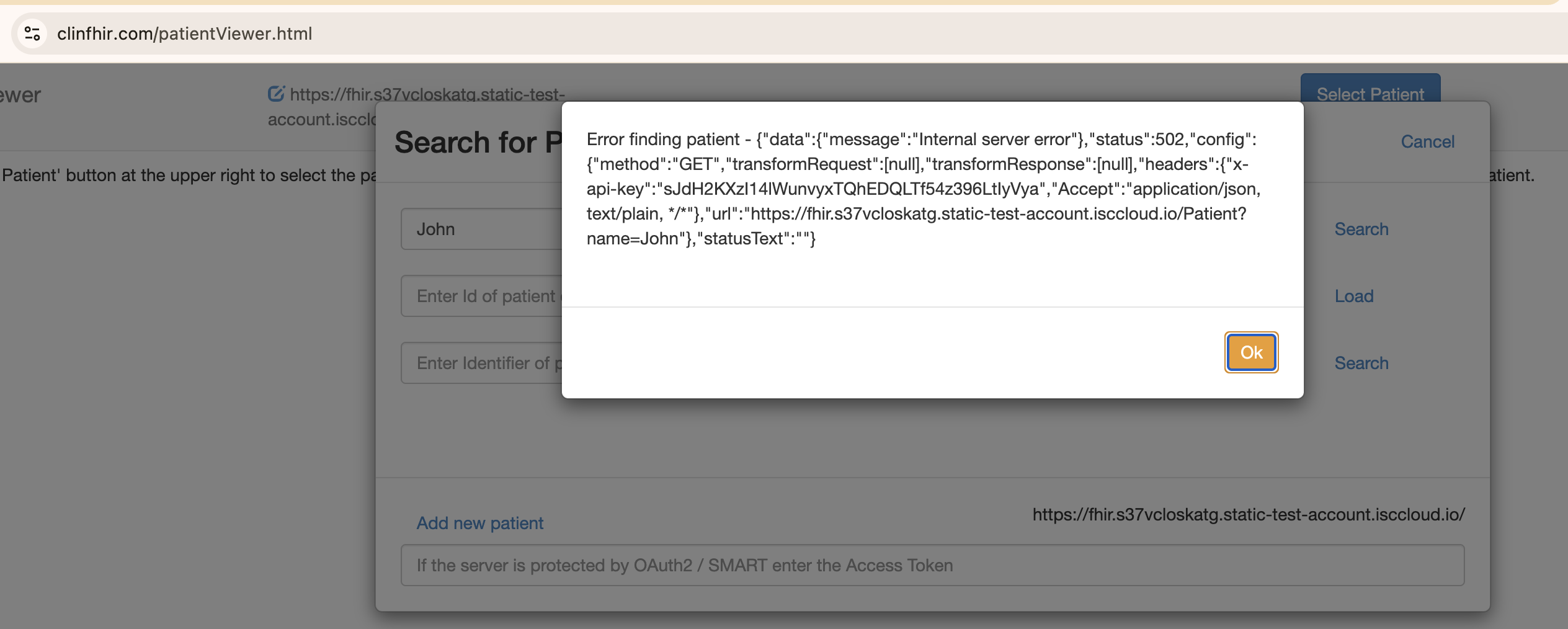
is clinfhir on IRIS even working?
getting status 502
Hi Dmitry!
Thank you for letting us know.
Our team will have a look at the issue and we will get back to you!
😊 Hi All!
Missed the Kick-off Webinar?
👉It’s now available on the InterSystems YouTube channel.
⏯️Enjoy the recording
🤩 Hi Devs!
The contest closes soon: submit your application before the end of the week.
⏰ Deadline: June 7, 2026.
🍀 Good luck!
Hi All!
🎉The first application is now live. Check it out!
smart-discharge-navigator by @CarlosEduardo.DiasDuarte
Hi Devs!
👏 The contest already received 8 applications in total!
Submit yours until the end of the weekend - deadline is June 7, 2026.
💸 Hurry for the prize and recognition 🏅
Hi, I signed up and was in the process of submitting an application and got an email saying "Oops! Your account has been temporarily suspended" is this a glitch? because I'm very confused now.
Could you try again?