Hey Developers,
In this video you will learn what Kubernetes is and how it can be beneficial for deploying containerized application workloads:
Containerization is a lightweight alternative to full machine virtualization that involves encapsulating an application in a container with its own operating environment.
Hey Developers,
In this video you will learn what Kubernetes is and how it can be beneficial for deploying containerized application workloads:
I get the error below when trying to login to an account i just created. Login details used is my email as username and a password. Any ideas?
##Error response from daemon: Get "https://containers.intersystems.com/v2/": unauthorized: BAD_CREDENTIAL##
Docker 20.10.14 (released March 23, 2022) changes the Linux capabilities given to containers in a manner that is incompatible with the Linux capability checker in InterSystems IRIS 2021.1 (and up) containers.
Users running Docker 20.10.14 on Linux will find that IRIS 2021.1+ containers will fail to start and the logs will incorrectly report that required Linux capabilities are missing. For example:
[ERROR] Required Linux capability cap_setuid is missing.
[ERROR] Required Linux capability cap_dac_override is missing.
[ERROR] Required Linux capability cap_fowner is missing.
[ERROR] Requir
For quite some time InterSystems IRIS supports such thing as Merging CPF. So, with help of this it should be possible to define only desired changes in configuration. And get them applied even with vanilla Docker image.

And I though it could be useful when used with Dockerfile. Use this way to configure IRIS during docker build instead of using Installer manifest.
InterSystems Developer Community analytics. Project made with InterSystems IRIS BI (DeepSee), Power BI and Logi Report Designer to visualize and analyze members, articles, questions, answers, views and other pieces of content and activity on InterSystems Developer Community.
You can see your own activity, articles and questions. Track how your contribution changes developer community.
Analyse statistics about you and your friends using IRIS BI, Adaptive Analytics, InterSystems Reports, Tableau and Power BI.
This project contains pre-configured IRIS and Atscale deployment in Docker container
I am new to using containers. I am working on trying to specify some of the SAM settings and wondered how to access the terminal while IRIS is running in a Container. Can someone help me out?
I would say it is a post of pain after years of using InterrSystems IRIS Docker images in many projects.
And I hope InterSystems will hear me and do something with it.
We have a lot of issues with Docker images, but I see no progress in solving them.
Hey Developers,
Learn about the changes we've made to InterSystems IRIS Containers, including security updates and the new web gateway container:
About a year ago I wrote some articles about the installation of the HAPI FHIRserver on a Raspberry Pi. At that time, I only knew the basics of the FHIR standard, little about the technology behind FHIR-servers and not much more about the Raspberry. By trying, failing, giving up and trying again I learned a lot.
The InterSystems Kubernetes Operation (IKO) version 3.3 is now available via the WRC download page and the InterSystems Container Registry.
IKO simplifies working with InterSystems IRIS or InterSystems IRIS for Health in Kubernetes by providing an easy-to-use irisCluster resource definition. See the documentation for a full list of features, including easy sharding, mirroring, and configuration of ECP.
IKO 3.3 Highlights:
irisClusteririsClusterWe are developing some containarized cloud application level iris instances and using CPF Merge to do a lot of the initial buildout for the iris instance (i.e. create databases, namespaces, map globals/routines, ecp setup, etc...)
I am trying to figure out how to get package mappings into a namespace config, via cpf merge if possible... ?
This is the document I am working from to develop the cpf merge file -
[Actions] - Configuration Parameter File Reference - InterSystems IRIS Data Platform 2020.4
Does anyone have a script for demo docker containers - to remove login prompt?
Essentially to make container behave as if it had minimal security.
If you're deploying to more than one environment/region/cloud/customer, you will inevitably encounter the issue of configuration management.
While all (or just several) of your deployments can share the same source code, some parts, such as configuration (settings, passwords) differ from deployment to deployment and must be managed somehow.
In this article, I will try to offer several tips on that topic. This article talks mainly about container deployments.
Hey Community,
Learn about the changes we've made to InterSystems IRIS Containers, including security updates and the new web gateway container:
Hi All! For those of you who attended experience labs at the 2021 Virtual Summit, you may recall that one of the lab sessions was around Kubernetes. We've now converted that lab to be fully on-demand. You can launch a small cluster of VMs and follow the exercise to manage your Kubernetes cluster, deploy InterSystems IRIS containers to it, and watch its self-healing nature when destroying a pod.
It's a great introduction to Kubernetes if you are interested! See here: Achieving High Availability with InterSystems IRIS and Kubernetes
Hi, everyone!
I want to share a personal project that started with a simple request at work:
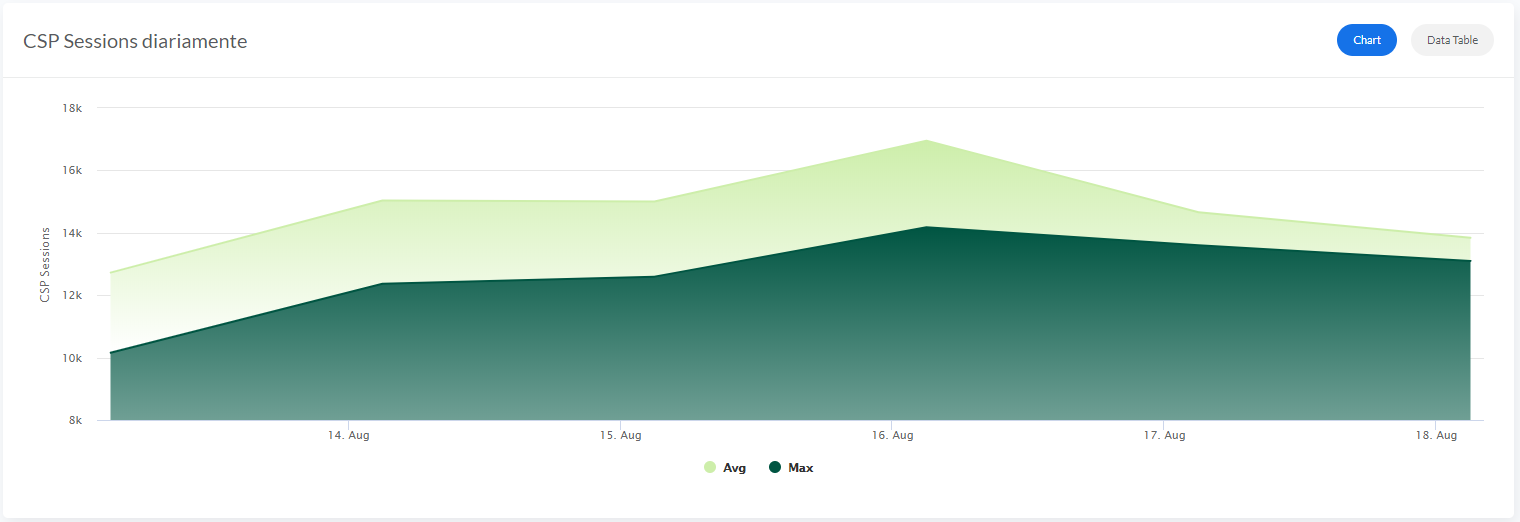
Is it's possible to know how many Caché licenses we are using?
Reading other articles here in the community, I found this excellent article by David Loveluck
APM - Using the Caché History Monitor
https://community.intersystems.com/post/apm-using-cach%C3%A9-history-monitor
So, using David's article, I started using Caché History Monitor and to show all that information.
When facing the question: Which cool tech should I use?
My decision was CSP, simple and powerful, so the customer that I'm working for ca
Hello,
I have a question about defining properties for various of services, operations and processes in Productions. Let’s say I have developed a container running an IRIS instance with a single namespace and a production with pre-defined set of components. I’m planning to deploy this container to dev, staging and production environments. These different environments use different settings for the operations, etc. For example, dev-environment could use some test endpoint for an HTTP component, e.g. https://testdomain.com/test and production environment https://proddomain.com/prod. Because t
For those that, at some point, need to test what means that of ECP for horizontal escalability (computing power and/or users and processes concurrency), but they're lazy o have no much time to build the environment, configure the server nodes, etc..., I've just published in Open Exchange the app/sample OPNEx-ECP Deployment .
I have just created a new Global Master Topic, "IRIS Cheatsheets". IRIS has introduced a lot of new functionality, especially in scripting languages, FHIR R4 support, enhanced Interoperability Tools, and IRIS Analytics. Having spent 35 years working on Windows-based PC's and Laptops, I have surprisingly little knowledge of Linux, Docker and Git. Furthermore, I have written almost every application and Interface in ObjectScript with splatterings of SQL, .Net, and Java Gateways and the most basic knowledge of WinSCP, Putty, SSH. All that changed when I received my first Raspberry Pi. I first had
I work as an Integration Engineer for United States Department of Veterans Affairs (VA). I work on a Health Connect production which processes many RecordMap files. I do not fully understand RecordMaps and I wanted to develop an application for the Interoperability contest where I could learn more about working with RecordMaps. I browsed InterSystems documentation for inspiration on how to start. I was happy to find CSV Record Wizard. I had created a CSV file for my Analytics contest entry. I wanted to use it to test the CSV Record Wizard. It was not obvious how to use it. The dialogue in Port
Hi Developers,
The new video from Global summit 2019 is already on InterSystems Developers YouTube:
Is there an InterSystems supported dotnet core library or community contributed repo on the horizon? At this time we are exploring installing the ODBC driver in our containers but would rather use more robust solution.
I wanted to write it as a comment to article of @Evgeny Shvarov . But it happens to be so long, so, decided to post it separately.

I would like to add a bit of clarification about how docker uses disk space and how to clean it. I use macOS, so, everything below, is mostly for macOS, but docker commands suit any platform.
Hi everyone,
Learn about iris-lockeddown, a version of the InterSystems IRIS data platform container designed to work with the most stringent container security policies:
⏯ Using Containers in Highly Secure Environments with IRIS Lockdown
I have described my efforts to optimize IRIS Mirror deployment in AWS ElasticContainer Service (ECS) in my prior article.
IRIS Mirror in the cloud (AWS) | InterSystems Developer Community | AWS
I have come to the opinion that IRIS Mirror is not as reliable as needed when deployed in ECS. The root of the problem is the fact that ECS randomly assigns one of the available IP addresses to each EC2 host or Fargate task it starts.
These get stored in iris.cpf file in MapMirrors section as shown here:
[MapMirrors.IRISMIRROR]
FAILOVER1=10.2ab.1cd.146,2188,,10.2ab.1cd.146,588E6700-DAB7-11EB-9
I have been working on redesigning a Health Connect production which runs on a mirrored instance of Healthshare 2019. We were told to take advantage of containers. We got to work on IRIS 2020.1 and split the database part from the Interoperability part. We had the IRIS mirror running on EC2 instances and used containers to run IRIS interoperability application. Eventually we decided to run the data tier in containers as well. Later we switched from using EC2 instances to Fargate “server-less” compute. A challenge was that each time AWS Elastic Container Service started a new container, it assi
All source code to the article is available at: https://github.com/antonum/ha-iris-k8s
In the previous article, we discussed how to set up IRIS on k8s cluster with high availability, based on the distributed storage, instead of traditional mirroring. As an example, that article used the Azure AKS cluster. In this one, we'll continue to explore highly available configurations on k8s. This time, based on Amazon EKS (AWS managed Kubernetes service) and would include an option for doing database backup and restore, based on Kubernetes Snapshot.
Let's get right to business. Fir

I am pleased to announce the availability of InterSystems Container Registry. This provides a new distribution channel for customers to access container-based releases and previews. All Community Edition images are available in a public repository with no login required. All full released images (IRIS, IRIS for Health, Health Connect, System Alerting and Monitoring, InterSystems Cloud Manager) and utility images (such as arbiter, Web Gateway, and PasswordHash) require a login token, generated from your WRC account credentials.
In this article, I am going to give some examples to get your own docker image with InterSystems Caché/Ensemble.
Over the last couple of weeks the Solution Architecture team has been working to finish off our 2019 workload: this included open-sourcing the Readmission Demo that was brought to HIMSS last year, so we could make it available to anyone looking for an interactive-way of exploring the tooling provided by IRIS.
While in the process of open sourcing the demo we were immediately hit hard with a showstopper. The underlying patient data that was used to build the demo could not be used as part of an open-source project because it was not owned by InterSystems; it was owned by our Partner Baystat