AI-Powered Clinical Matching: Introducing iris-medmatch
In the modern healthcare landscape, finding clinically similar patients often feels like looking for a needle in a haystack. Traditional keyword searches often fail because medical language is highly nuanced; a search for "Heart Failure" might miss a record containing "Congestive Cardiac Failure."
I am excited to share iris-medmatch, an AI-powered patient matching engine built on InterSystems IRIS for Health. By leveraging Vector Search, this tool understands clinical intent rather than just matching literal strings.
## The Core Innovation: Semantic Clinical Search
`iris-medmatch` bridges the gap between raw FHIR data and actionable AI insights. By utilizing the `all-MiniLM-L6-v2` model, the engine transforms clinical conditions into mathematical vectors.
While standard searches look for exact words, this engine understands **clinical context**. For example, it can match a patient with "Hypertension" to a search for "High Blood Pressure" using mathematical vector similarity.
✨ Key Technical Features
- Core: InterSystems IRIS , Embedded Python, InterSystems FHIR Server, Vector search
- AI: Python, ONNX Runtime, HuggingFace Transformers
- Frontend: Angular 18+
Technical Architecture
The strength of this solution lies in its architectural efficiency. By running Transformers via Embedded Python, we eliminate "data gravity" issues. The data stays in IRIS, and the AI processing happens where the data lives.
🚀 Application Walkthrough
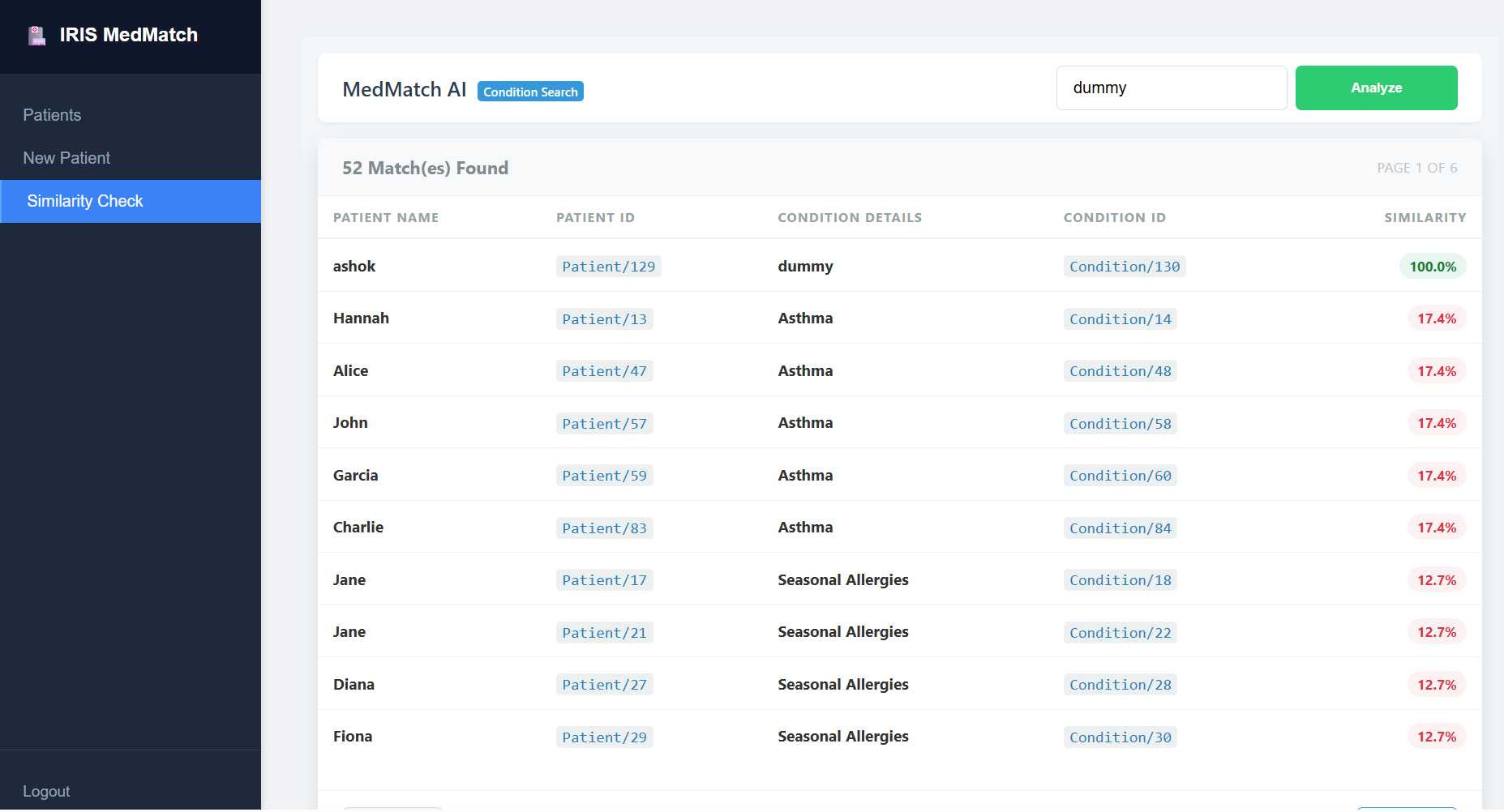
1. Semantic Similarity Search (The "Wow" Factor)
This module uses Vector Search to understand medical synonyms. A search for "Cardiac Issues" will mathematically find "Myocardial Infarction" by comparing their vector positions within IRIS. This is achieved using Native IRIS SQL to calculate similarity scores in sub-seconds.
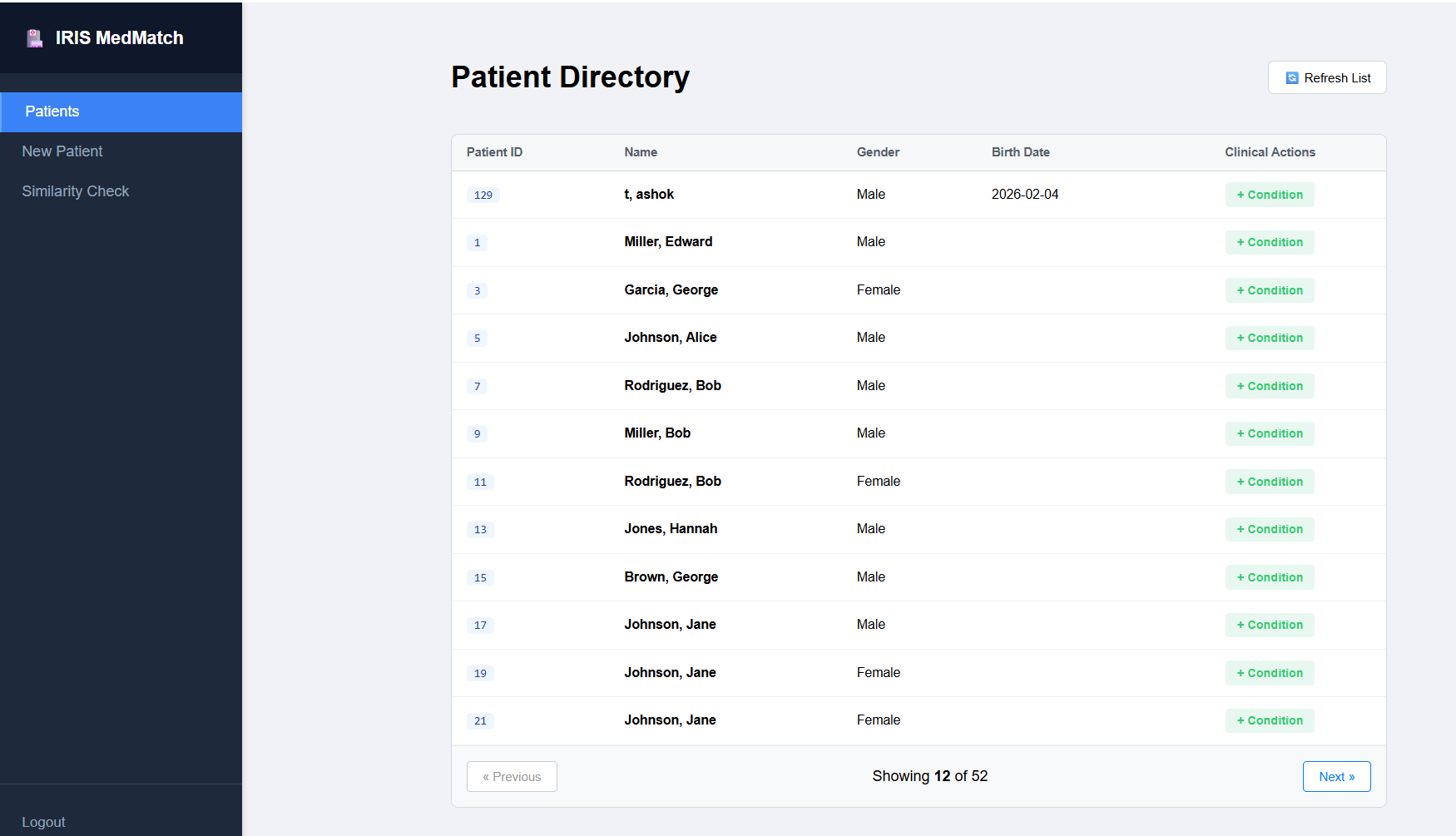
2. Patient Directory & Condition Enrichment
This module manages existing FHIR resources. Users can add new diagnoses through a high-performance modal, demonstrating real-time synchronization between standard FHIR data and AI-ready vector data.
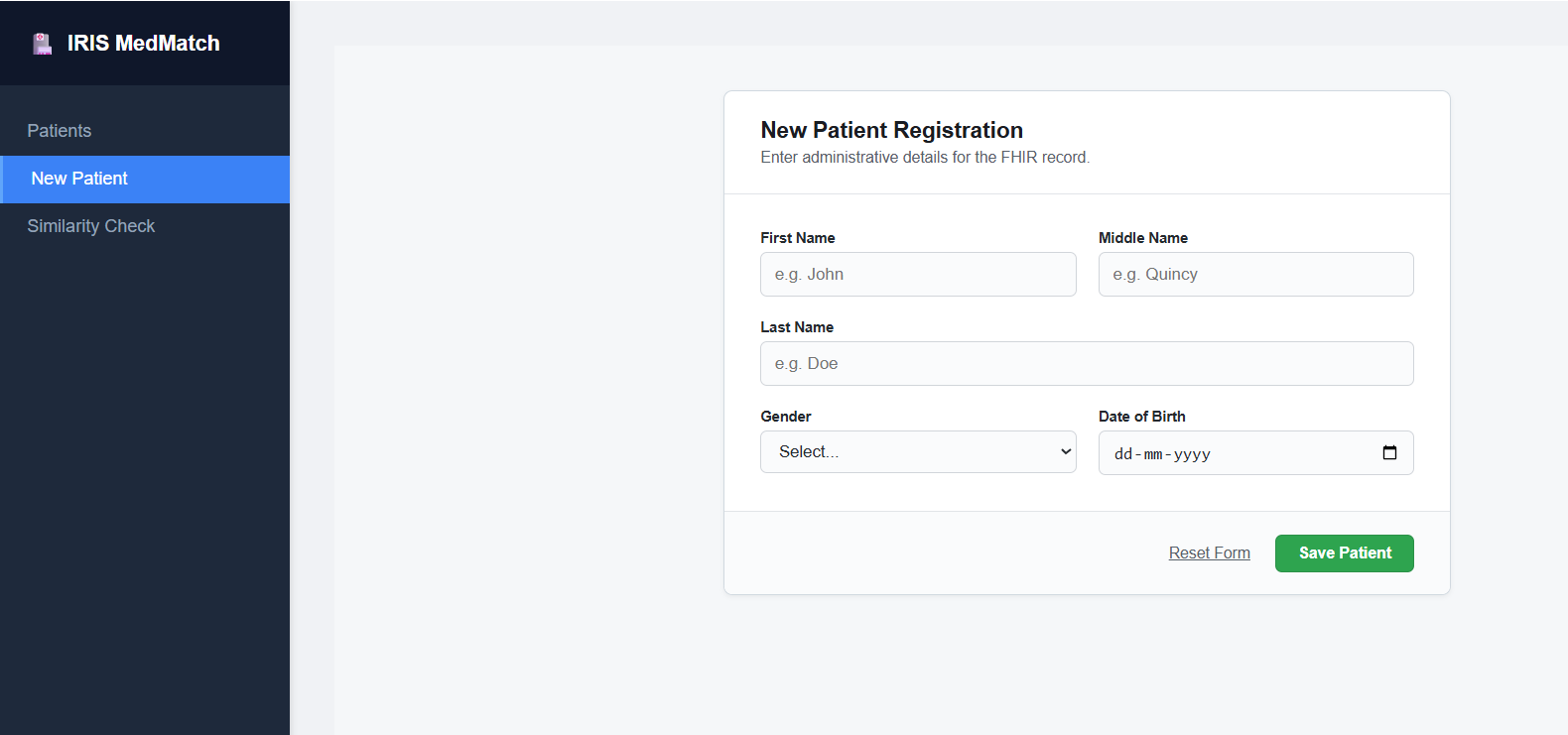
3. New Patient Registration
A streamlined entry point for creating new `Patient` resources within the InterSystems ecosystem. This features direct interaction with the FHIR R4 Repository via standard RESTful POST requests, ensuring data is indexed and searchable immediately.
Conclusion
iris-medmatch demonstrates how InterSystems IRIS is evolving into a comprehensive AI-Native database. By combining the reliability of FHIR with the power of Vector Search, we can create healthcare applications that truly "understand" the clinical data they store.