#Data Model

3 Followers · 91 Posts

A database model is a type of data model that determines the logical structure of a database and fundamentally determines in which manner data can be stored, organized and manipulated. The most popular example of a database model is the relational model, which uses a table-based format.

Learn more.

Question omer · Jan 13, 2025

Hello! 
So my question is quite simple, Do the different data models of Intersystems all support the ACID properties?
I assume that for the SQL data model implementation it does, But does it also work for global (i.e the hierarchical  data model)?
I searched the docs and the different articles, It seems for example that here its implied that the different data models of
Intersystems  DO indeed support the ACID properties and allow for safe insertion, deletion etc... in concurrent operations to the server that is.

Would love to get a clarification, Thx!

8
0 264
Question Neerav Verma · Mar 5, 2019

Just wondering an Insight in the difference between these two indexes

IdKey / PrimaryKey
================= 

Property Identifier As %Integer

Index Index1 on Identifier [Idkey]

Index Index2 on Identifier [PrimaryKey]

What's the difference?

1. If I don't have Index1 and only have Index2,  then cache does still make its own id.
So how and why  do I ever use the PrimaryKey.  In Joins ??

Table1.Identifier = Table2.Identifier instead of Table1.Id = Table2.id ??
But I can still use Table1.Id = Table2.Id as cache still made one ID field

So where is PrimaryKey useful in cache?

4
0 1262
Question Markus Neumann · Mar 31, 2019

Dear Colleagues and Friends,

is there any indication that the .NET object representation of Cache objects (i.e. InterSystems.Data.CacheClient.dll) complies with .NET Standard? I'm planning to extend our existing .NET client/server solution with a mobile option by Xamarin Forms and can't find any significant hints in the internet.

I'm just fooling around a bit and made some expreiments with a REST API and a generic object-to-JSON tier:

ClassMethod ObjectFromObject(As %RegisteredObject, class As %String = "", package As %String = "") As %DynamicObject
{
class = "" class = o.

1
0 434
Question Martin Staudigel · Jan 9, 2023

Hello community,

is there anything special to consider when running a foundation production regarding purge jobs (Ens.Util.Tasks.Purge)? I am thinking specifically of the QuickStreams, which according to my information are stored in a temporary database until the system is restarted. Since a system reboot is much less frequent then the purges, I wonder what happens to the QuickStreams whose messages and headers have already been purged. Is there a way to view Quickstreams (not content, but rather metadata) e.g. via the Management Portal?

Thanks for your comments and hints,

best regards, Martin

3
0 295
Question Scott Roth · Aug 15, 2025

Is there a way to Remove specific all Addresses from a Provider.Individual.Address before reinserting the Addresses from an HL7 message in Provider Directory?

Most fields we can call %clearFields() however since Addresses come from multiple locations we need to isolate and treat Addresses from this HL7 source as a snapshot.

Thanks

Scott

0
0 92
Question Evgeny Shvarov · Jun 28, 2019

Hi guys!

As you know there are two (at least) ways to get the stored value of the property of InterSystems IRIS class if you know the ID of an instance (or a record).

1. Get it by as a property of an instance with "Object access":

ClassMethod GetPropertyForID(stId As %Integer) As %String

{

set obj=..%OpenId(stId)

return obj.StringData

}

2. Get it as a value of a column of the record with "SQL access":

18
0 1310
Question Ashok Kumar T · Sep 29, 2023

Hello Community,

I have couple of question about the DynamicSQL.

1. The %ObjectSelectMode is working perfectly in the DynamicSQL for the object property in direct query. However this is not supported for class query. Is there any way to resolve this / Get the object value for class query result.

2. What is the reason behind for a stored query prepared using %PrepareClassQuery() you must use the %Get("fieldname") method.

Class Samples.DB.NewClass1 Extends %Persistent
{
Property Address As NewClass3;
ClassMethod TestQuery()
{ 
	set statement = ##class(%SQL.Statement).%New()
	set statement.
3
0 469
Question Rosti Zacharias · Oct 24, 2018

Hi,

I would like to know if anyone has had some experience in building systems for multiple end-users. 

To keep things simple, in a hypothetical example, say an Event Booking System, where a Venue could sign up to use such a system and define it's Venue, costs, calendars, etc.. and then invite their customers to book the Venue on different days/times. 

If I wish to offer such a system to many

6
0 2410
Question Stephen Wilson · Oct 18, 2016

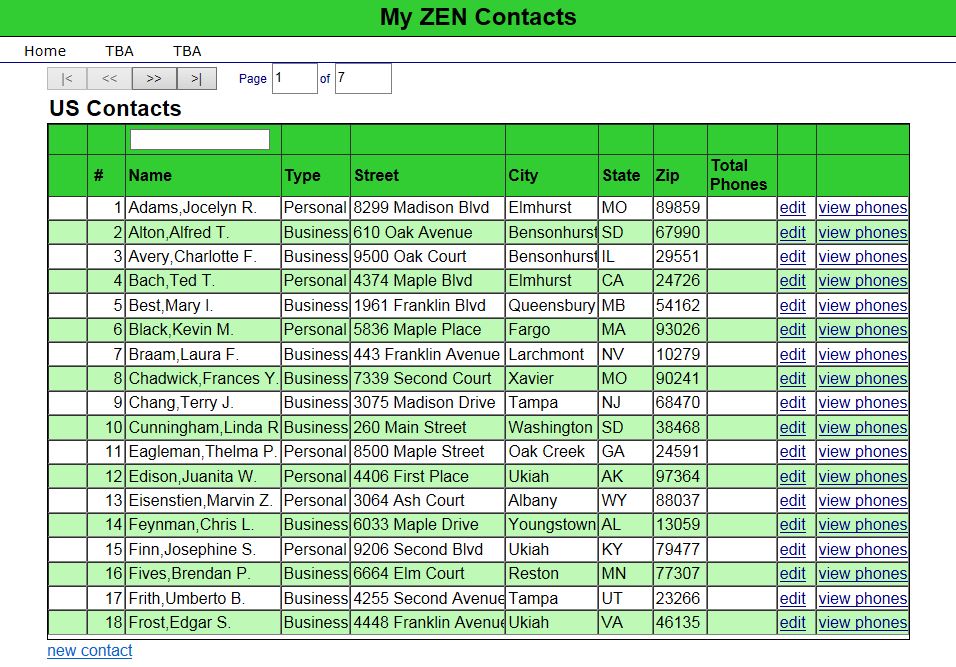
I have been following the online Zen Quickstart Tutorial using the lastest release documentation. In addition to playing around with the styling and making a few minor functionality tweaks, I wanted to add an additional column that shows a count of the number of phone numbers for that Contact (as shown in the image below).

The idea here is that you can see what contacts have phone numbers without having to click on the "view phones" link. All I have done here is add a blank additional column to the %ZEN.Component.tablePane object

4
0 609
Question Yone Moreno · Dec 19, 2023

Good morning,

First of all thanks for your help and time.

We find ourselves at a crossroads in our development journey, and we're reaching out to the community for insights and guidance regarding a critical aspect of our data management strategy.

Our current challenge revolves around the persistence of data in Globals, specifically when it comes to purging. The issue at hand is that, despite purging, data stored in Globals under the current %Persistent classes remains intact. To address this, we are contemplating a shift from %Persistent to %SerialObject for each relevant class.

3
0 406
Question Laura Cavanaugh · Mar 3, 2022

i'm trying to extend both the MemberEnrollment and the MedicalClaim objects in HS.  The CareProvider is perfect for some of my extensions (Operating provider, referring provider, third-party insurer), but the documentation says https://docs.intersystems.com/irisforhealthlatest/csp/docbook/DocBook.U…:

I need something that is just like a CareProvider, and I will be using the CarePRoviderType as a CodeTableDetail.  

Why is CareProvider excluded?  Does this mean I can't add property HS.Local.SDA3.MemberEnrollment.PHPProvider as HS.SDA3.CodeTableDetail.

2
0 399
Question Nigel Salm · Apr 28, 2017

Hi

I have an Ensemble Application with many classes and relationships between those classes.

I need a tool that can connect to Cache/Ensemble and create a visual ERD from the class definitions within a particular Cache Namespace

MS-Access is one option but it does not automatically create the relationship connectors between classes

Any suggestions

Nigel Salm

6
0 5532
Question Sreeram Makam · Oct 8, 2019

Hi All, I am a Data Architect and am trying a method of deploying alter statements onto Cache DB.

My Data Modeling tool generates alters as this.. So question is if the Cache has a way to rename table? If so what is it?

ALTER TABLE <SchemaName>.GROUP_TYPE_NODES RENAME TO GROUP_TYPE_10082019140110000
;

This is giving error.

SQL Error [25] [37000]: [SQLCODE: <-25>:<Input encountered after end of query>]
[Location: <Prepare>]
[%msg: < Input (IDENTIFIER) encountered after end of query^ALTER TABLE xxx.GROUP_TYPE_NODES RENAME>]
 

4
0 864
Question Neerav Verma · Mar 2, 2019

Hi

Just curious to know about the pros and cons of Parent/Child Vs One/Many.

We do use a bit of both. 
One big reason we use Parent child is we feel if we delete one global, it gets rid of all child data too and all parent child data is stored in one global. Much easier to manage.

4
0 952
Question Michel Liberado · Feb 3, 2020

Hi,

I have two namespaces

  1. In the first one, I have defined a class which Extends (%Persistent, Ens.Util.MessageBodyMethods), we'll call it NSOne.Msg.Req
  2. In the second namespace NSTwo, I want to use the previous class with something like SET pInput = ##class(NSOne.Msg.Req).%New()

I mapped the NSOne.Msg.Req package in namespace NSOne. In Atelier, I can see NSOne.Msg.Req in my NSOne. But, when I try to execute line 2 above, it tells me :

{
    "status": {
        "errors": [
            {
                "error": "ERROR #5002: ObjectScript error: <PROTECT>^NStwo.Api.
2
0 601
Question Laura Cavanaugh · Oct 26, 2022

Hello all; I am using a one-to-many relationship.  I have a Claim (one), in a relationship with Lines (many), but the Claim is storing a list of Lines IDs, rather than the Lines storing the Claim Id.  This seems upside down, and not what I expected.

Class Claim

{
    Relationship ClaimLineRel as ClaimLine [Cardinality = many, Inverse = Claim];
}

Class ClaimLine
{
    Relationship Claim as Claim [ Cardinality = one, Inverse = ClaimLineRel, OnDelete = cascade];
    Index ClaimIndex on Claim;
}

But the storage globals for Claim show data in the ClaimLine spot:

^ClaimD(1)=$lb("",$lb(2,3).

3
0 380
Question Evgeny Shvarov · Jun 9, 2017

Hi, Community!

Suppose I have class A with properties P1 and P2.

I want to introduce class B, which would have same records as Class A, but only  one property - P2.

What is the easiest  way to manage it assuming that I would like to use Class A to add records and be available for any operations to Users with Role A.

And I would like to introduce class B for Users with role B for read-only access.  Preferably they shouldn't even be aware of Class A and P1 existence .

What is the easiest way to introduce it and manage it?

Use some proxy-classes?  Property-level security?

10
0 828
Question Michael Davidovich · Apr 10, 2025

Hello,

Our software commonly returns a full result set to the client and we use the DataTables plugin to display table data.  This has worked well, but at datasets grow larger, we are trying to move some of these requests server-side so the server handles the bulk of the work rather than the client.  This has had me scratching my head in so many ways.  

I'm hoping I can get a mix of general best practice advice but also maybe some IRIS specific ideas.

6
0 254
Question Steve Hayworth · Mar 25, 2019

First time post, also a new Cache developer, hence the <Beginner> tag.

If our data has Predefined terms in a dictionary, and a user can add terms on their own, can the terms exist in different tables?

Lets call the tables "Terms" and the user data in "UserTerms".

If a third class definition has a property of "Term" can it not be either Terms or UserTerms?

I'm leaning towards using a Subclass strategy where the pseudo "Parent" (forgive me) is  Dictionary.Term and the child is along the lines of Dictionary.Term.User

Dictionary.Term.User can inherit from Dictionary.

5
0 426