HL7 schemas do not appear in the browser in VSCode. How to access/see them?
How to include them in GIT from VSCode?
GitHub is the largest web service for hosting IT projects and their joint development. This web service is based on the Git version-control system - a distributed version-control system for tracking changes in source code during software development.
HL7 schemas do not appear in the browser in VSCode. How to access/see them?
How to include them in GIT from VSCode?
I am trying to use git-source-control with IRIS.
Welcome dear members of the Community to the presentation and first article of a small project that will demonstrate the capabilities of InterSystems IRIS to provide full backup functionality for a web application developed in Angular. This article will be limited to presenting the concept as well as the InterSystems IRIS functionalities used in a general way, going into more detail in subsequent articles.
Git stores complete history - meaning you would never lose your files, even if they are deleted, they are still available. That, however, presents an issue if large or sensitive files have been committed. Deleting them DOES NOT remove them from history. Recently one of the repos I work on became unexpectedly large, so here's how you can resolve that:
I am happy to share with you my first experience of using a docker container version of IRIS for Health to explore your interest in using or having a trial by taking the advantage of a docker container that is lightweight, and easy to deploy. This cookbook will go through the implementation steps using the GitHub repository called ENSDEMO written by Renan Lourenco.
Steps for setting up an IRIS for Health Community Edition docker container environment
docker pull containers.intersystems.com/intersystems/irishealth-community:2022.2.0.304.0
Hi Developers!
This is yet another short post that is intended to simplify developers' life. Now we'll talk about how to make GitHub run unit tests with every push to the repository by adding just one file to the repo. For free. On Github Cloud. Sounds great, isn't it?
It is possible and very easy to do. Credit goes to @Dmitry Maslennikov (and his repo), ZPM Package Manager, and GitHub Actions. Let's see how this all works!

I am new to Intersystems, in our project we are directly connecting to the server (environment) using Intersystems VSCode extensions and publishing our changes from local machine. This is not the way we usually do as development process.
Is it possible to implement continuous integration ? So that developers can check-in their code in GIT Hub and can integrate Jenkins and automate the deployment?
Could you please help me on this ?
It is becoming more and more common to see beautiful badges in the README.MD file with useful information about the current project in the repositories of GitHub, GitLab and others. For instance:
The project is being developed The quality of the code, which also provides its own badge, which immediately shows the status of code validation of the project. If you insert a line into the README.MD file
Hi Everyone!
I have a question about how teams are using Atelier, in my experience, using a single-server/multi-developer environment is becoming problematic for us, especially when using GitHub to source control our code, let me explain...
What about having your IRIS REST APIs scanned every push you did and being reported on possible vulnerabilities? This is what I am going to show you in this article.
Recently, we had the Security Contest with amazing applications and examples showing how to improve security on your IRIS solutions. One of such examples was the zap-api-scan-sample, made by me and my colleague Henrique Dias. Our application shows how to use the OWASP ZAP API scanner to perform security tests on your REST APIs OpenAPI definitions generated by IRIS.
.png)
In this article I will demonstrate basics of OAuth2 authentication with GitHub account with the help of online demo
https://dappsecurity.demo.community.intersystems.com/csp/user/index.csp by using SuperUser | SYS
I'd like to bring your attention to my two Virtual Summit sessions, even though they're not HALF as cool as Embedded Python.
Git & GitLab for Shared Development Environments details the newly-released git-source-control package (see also on the Open Exchange) which provides a new best-of-breed solution for server-side IRIS/Git integration, especially for shared remote development environments. (I need to write up a post about this package specifically and plan to do so soon.)
I wrote a step by step tutorial in the qewd-howtos repository how you can write state of the art multi-page web apps with Node.js using a QEWD-Up WebSocket/REST api back-end integrated with a mainstream web framework like NuxtJS & Vue.js. In particular with the latest NuxtJS/Vue.js frameworks, writing web applications becomes fun again, allowing you to write your applications very efficiently, hiding all boilerplate code from you.
The tutorial should be very easy to try out on your development machine and consists of two parts:
Hi,
I have CSV file in github repository. I want to import CSV file data into container class during running container.
Thanks
Open up a random ObjectScript project (I think you need to be logged in first for this to work).
Then press "." (press full stop).
This will open the git repo inside an online instance of VS code.
Perhaps not that exciting for some, but I was impressed. Mainly because it's a good demo of editing ObjectScript in the cloud. As much as I like VS code locally, I still can't use it on many sites, and maybe not popular, but I still think IRIS + its own web IDE would be a killer combination.
Hi, Community!
I'm pleased to share that we have a dedicated InterSystems Developer Community GitHub - github.com/intersystems-community!
Hi colleagues!
Often when we collaborate to someone's repo in GitHub we do the following cycle:
Fork-Clone-Change-Commit-Push-Pull-Request-Merge to the original repo.
This is all great and works fine!
And if we want to make a second collaboration right after the merge you need to perform "Fetch upstream" to your forked repo first to "ingest" your own Pull-request in the original repo.
Geeky git-professionals do it with ease but this was always a headache for me so I usually simply deleted the fork and created a new one.
And today I figured that Github added a new UI feature that I can easily fetch-upstream for my fork with the original one and make it up to date and capable for pull-requests.
Here is where the button is:

This is a relief! )
Wanted to share this relief and productivity tip with you!
Bring more collaborations to Github repos!
And speaking of PR - I just made a PR with docker to Google Cloud Run deployment for the FHIRaaS demo made by @Anton Umnikov for the current FHIR Contest! Looking for more of your contributions!
Hi Community,
Please welcome the new video on InterSystems Developers YouTube:
⏯ Deploying InterSystems IRIS Solutions into Kubernetes Google Cloud
Hi folks!
Just a very short note on if you want to add a cute Open Exchange shield like this:
in your GitHub repo you can do it by entering one line like this:
[](https://openexchange.intersystems.com/package/csvgen)
In the URL place the path to your OEX page.
Thanks to the participants of contest for such a neat shield )
What other helpful Github shields do you know? Please share in the comments?
I am currently evaluating Source Control systems that we can use for both MS SQL, MS Visual Studio, and InterSystems IRIS. For both MS SQL and MS Visual Studio we do have the option of either Azure or GitHub. I understand when we upgrade to IRIS 2019.1 we have options for Source Control, and in previous Global Summit's I have heard GitHub discussed. So why can't I user GitHub for both MS SQL/MS Visual Studio and IRIS?
A couple of questions come to mind starting to think about Source Control
Hi Community,
Please welcome the new video recorded by @Evgeny Shvarov on InterSystems Developers YouTube:
⏯ Developing InterSystems IRIS solution using GitHub Codespaces
The first full release of our iKnow open-source NLP library is now available on GitHub and PyPI!
In a previous article, I discussed patterns for running unit tests via the InterSystems Package Manager. This article goes a step further, using GitHub actions to drive test execution and reporting. The motivating use case is running CI for one of my Open Exchange projects, AppS.REST (see the introductory article for it here). You can see the full implementation from which the snippets in this article were taken on GitHub; it could easily serve as a template for running CI for other projects using the ObjectScript package manager.
Features demonstrated implementation include:
This article is a continuation of Deploying InterSystems IRIS solution on GKE Using GitHub Actions, in which, with the help of GitHub Actions pipeline, our zpm-registry was deployed in a Google Kubernetes cluster created by Terraform. In order not to repeat, we’ll take as a starting point that:
In an earlier article (hope, you’ve read it), we took a look at the CircleCI deployment system, which integrates perfectly with GitHub. Why then would we want to look any further? Well, GitHub has its own CI/CD platform called GitHub Actions, which is worth exploring. With GitHub Actions, you don’t need to rely on some external, albeit cool, service.
In this article we’re going to try using GitHub Actions to deploy the server part of InterSystems Package Manager, ZPM-registry, on Google Kubernetes Engine (GKE).
Hi Community!
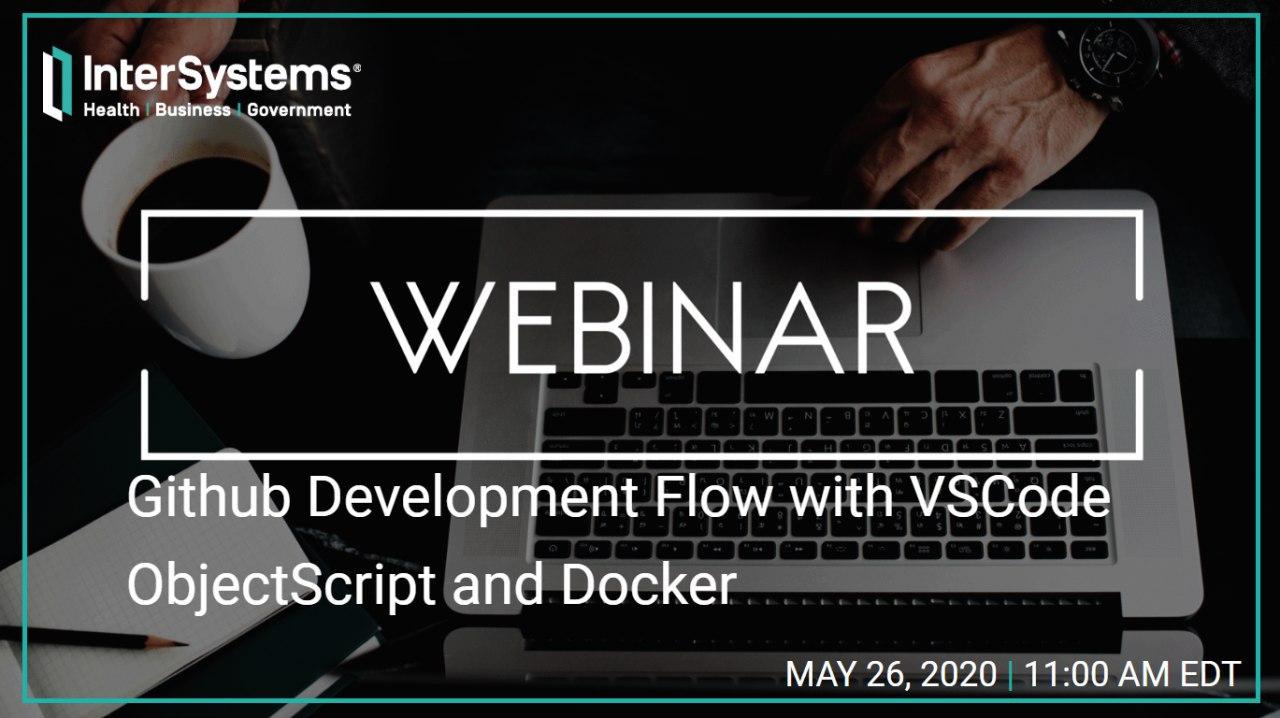
We are glad to invite every developer who uses ObjectSript and VSCode plugin to the second webinar hold by the VSCode ObjectScript plugin developer on May 26 at 11:00 EDT.
You will learn how to develop InterSystems IRIS solutions using GitHub Development Flow with VSCode ObjectScript and Docker.
Speaker: @Dmitry Maslennikov, InterSystems Developers Advocate, CTO at CaretDev.
Hey Developers,
The recording of the Kick-Off Webinar for InterSystems IRIS Native API Online Programming Contest is now available on InterSystems Developers YouTube:
Speakers:
@Bob Kuszewski, InterSystems Product Manager
@Evgeny Shvarov, InterSystems Developer Ecosystem Manager
Hi Community,
New "Coding Talk" video was specially recorded by @Evgeny Shvarov for the second IRIS Programming Contest:
Hi developers!
Suppose you have a Github repository with ObjectScript classes but without a Docker environment.
Recently I published a repository with a set of files that form a universal Docker and VSCode environment to let you either import and run your repository in InterSystems IRIS Community Edition on Docker or turn your repository into Docker and VSCode environment for InterSystems IRIS Community Edition.
So in one sentence:
Unpack these files in your folder and you have the Docker and VSCode environment for your InterSystems IRIS ObjectScript application!
See the details below.
What does everyone think about submitting an issue in a repository and then submitting a pull request to fix that issue. Is it an unnecessary step or does it give extra context and logging for the issue? I ask this because when I find a bug in an Open Exchange app, I always submit the Issue and then often submit a Pull Request to fix the issue.
I think that if the repository owner doesn't like your suggested fix, it is helpful to have the issue around so that they can deny the pull request and potentially implement their own change for the issue.